
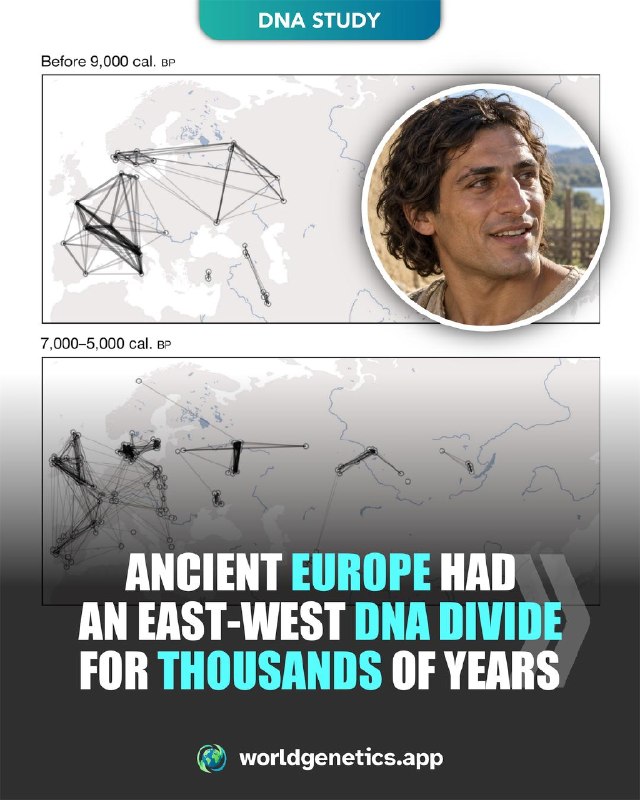
Ancient Europe had a genetic divide running from the Baltic to the Black Sea—and it lasted for millennia.
This study added 317 ancient genomes to a wider dataset of more than 1,600 people, tracing how migrations changed western Eurasia after the Ice Age.
West of the divide, incoming farmers with Anatolian-related ancestry transformed the genetic landscape. East of it, hunting and fishing communities persisted much longer. In the eastern Baltic, Ukraine and western Russia, local hunter-gatherer ancestry remained dominant until around 5,000 years ago, without a noticeable influx of Anatolian farmer ancestry.
But the western story was not uniform replacement. Newly reported early farmer samples from Portugal carry an estimated 27–43% Iberian hunter-gatherer ancestry, pointing to substantial mixing near the arrival of farming.
Then came a second transformation. The paper models Yamnaya-related steppe ancestry as roughly 65% Middle Don hunter-gatherer-related and 35% Caucasus hunter-gatherer-related. The Don reference already contains Caucasus-related ancestry: these are model components, not two separate modern ethnicities.
Groups carrying steppe ancestry mixed with farmers related to the Globular Amphora culture. Their ancestry then spread through Corded Ware and related populations, reaching most of Europe within roughly 1,000 years.
In Denmark and southern Sweden, the two major transitions—from hunters to farmers, then to steppe-related populations—occurred only about 1,000 years apart.
This was a broad genetic boundary, not a wall or a border between “pure” peoples. Ancient samples represent parts of a much larger history; genetic references do not identify exact tribes, languages or migration routes.
📚 Source: Allentoft et al. (2024), Nature
Population genomics of post-glacial western Eurasia
🧬 Curious about your own ancestry?
🌍 Explore your DNA at https://www.worldgenetics.app/
Post #110
191
- ❤ 3