
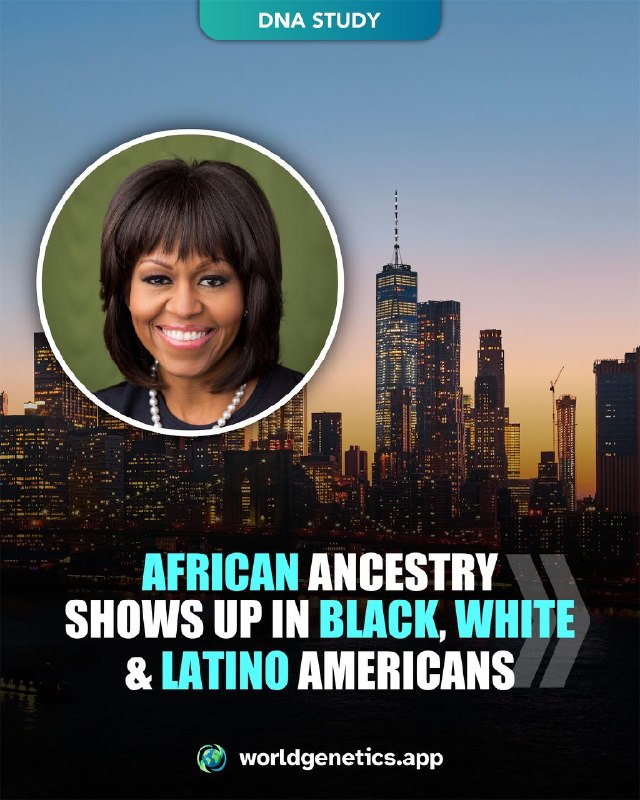
African ancestry reaches beyond a single American identity.
A 2015 study of 23andMe customers finds it across self-identified African Americans, Latinos and European Americans, in very different amounts. Here, “African” means affinity to sub-Saharan African references, not North African ancestry.
The 5,269 African American participants average 73.2% African ancestry, with the highest levels in the South, especially South Carolina and Georgia. African ancestry rises to 76.9% on the X chromosome, supporting greater African female than male contributions. Slavery and exploitation are essential historical context, though DNA cannot establish the circumstances of individual relationships.
The 8,663 Latino participants average 6.2% African ancestry. Levels are especially high in Louisiana and also elevated in the Midwest and Atlantic states. Participants identifying as Puerto Rican or Dominican average more African ancestry than the Latino sample overall.
Among 148,789 European American participants, at least 1.4% have 2% or more estimated African ancestry. In Louisiana and South Carolina, that share reaches about 5%. These numbers describe how many people cross a threshold, not everyone's average DNA percentage. At the lower 1% cutoff, the share in those two states reaches about 12%.
For the African ancestry detected in European Americans, the authors favor mixing in the Americas within the last 500 years over ancient mixing in Europe. The timing comes from demographic models, not a dated ancestor in every family tree.
These are reference-based estimates from a customer sample, not a representative census. Genetic ancestry does not determine identity.
📚 Source: Bryc et al. (2015), The American Journal of Human Genetics
The Genetic Ancestry of African Americans, Latinos, and European Americans across the United States
🧬 Curious about your own ancestry?
🌍 Explore your DNA at https://www.worldgenetics.app/
Post #104
220
- 🌭 1