

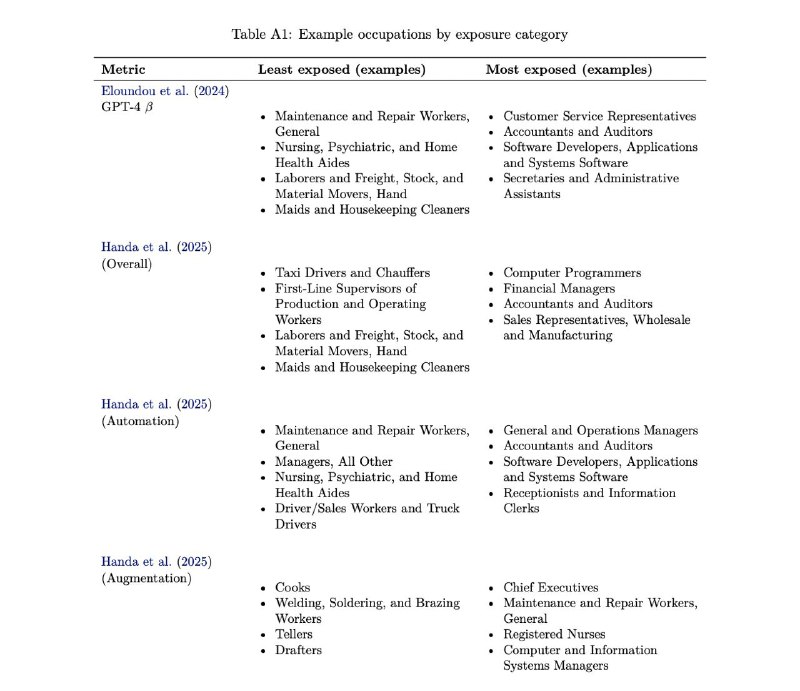

Однако, для некоторых профессий AI работает как усилитель человеческих возможностей — там занятость растет. Это, например, Registered Nurses, Maintenance and Repair Workers, Computer and Information Systems Managers и Chief Executives.
Почему так происходит?
• Если задачу можно поручить AI полностью и корректировать её выполнение внешней обратной связью (особенно если это технические замечания) — кандидат на автоматизацию.
• Если открытые задачи со множеством вариантов, а также где нужны дополнительные знания, и валидация результата — тут augmentation. Особенно если эта экспертиза сложно кодифицируется и формализуется.
Conclusion
• First, we find substantial declines in employment for early-career workers in occupations most exposed to AI, such as software development and customer support.
• Second, we show that economy-wide employment continues to grow, but employment growth for young workers has been stagnant.
• Third, entry-level employment has declined in applications of AI that automate work, with muted effects for those that augment it.
• Fourth, these employment declines remain after conditioning on firm-time effects, with a 13% relative employment decline for young workers in the most exposed occupations.
• Fifth, these labor market adjustments are more visible in employment than in compensation.
• Sixth, we find that these patterns hold in occupations unaffected by remote work and across various alternative sample constructions.
→ https://digitaleconomy.stanford.edu/publications/canaries-in-the-coal-mine
PDF и аудио-саммари в комментариях.