TGViewer
Channel Public Channel
Skoltech Global

Skoltech Global

@skoltech_en

A multidisciplinary science and tech university in Moscow: student.skoltech.ru

Skoltech is part of the VEB.RF Group

About Skoltech in Russian: https://t.me/skoltech_daily
Subscribers
3K
Photos
2.4K
Videos
117
Links
847
Recent Posts 20 shown
Post #2750 422
📚 Meet the latest addition to our book column #book from a mentor of the Innovation Workshop!

Today, Paulina Bazarova, founder of Ethos and venture consultant, recommends Negotiating the Impossible by Deepak Malhotra.

"One of the most useful books on negotiation I've ever read. It's not about manipulation or standard tactics — it's about how to negotiate in situations that seem practically impossible. After reading it, you start looking at negotiations, people, and decision-making under pressure completely differently. Especially useful for founders and anyone who works extensively with people."


Deepak Malhotra is a professor at Harvard Business School and a consultant on international negotiations. In his book, he shows how to break through the toughest deadlocks without pressure, money, or force — using three tools: framing, process, and empathy.
  • ❤ 2
  • 👎 1
  • 🔥 1
Post #2749 444
📺 Why do we find ourselves rewatching Twilight or Friends for the hundredth time when we're feeling down?

As Skoltech Neuro Professor Philipp Khaitovich explains, when stress levels peak, a familiar show can offer a comforting anchor because viewers already know every plot twist, conflict, and resolution.
"When a person is stressed, the brain prefers to rely on something where its predictions are guaranteed to work out. In a new, uncertain situation with an unfamiliar plot, it's anyone's guess whether your predictions will pan out or fall flat again."

Professor Khaitovich views rewatching old favorites not as a mindless habit, but as a genuinely effective way to lower anxiety. The key is not to hide from reality indefinitely — after a cozy mental break, the brain still has to jump back into tackling real-world challenges.

What movie or series is your go-to "comfort blanket" when you're stressed? Let us know in the comments! 👇
  • ❤ 9
  • 🔥 1
Post #2748 588
⚛️ How can we make hydrogen-powered transport more affordable?

Platinum-based catalysts are the heart of eco-friendly fuel cells, yet their astronomical cost remains a major barrier to mass adoption. Now, researchers from Southern Federal University, alongside colleagues from Skoltech, the Institute of Catalysis of the Siberian Branch of the Russian Academy of Sciences, and Bauman Moscow State Technical University, have found a compelling solution.

The team engineered a multi-component alloy combining platinum with palladium, copper, nickel, and cobalt to form compact, accessible nanoparticles. By leveraging computer simulations, researchers uncovered how to precisely control atom distribution during heat treatment: heating the material to 600°C drives roughly 75% of the platinum atoms straight to the outer surface of the nanoparticle.
"Combining experiments with computer simulations helped us understand exactly how atoms of different metals redistribute within nanoparticles when heated. We showed that this process can be controlled to produce materials with tailored properties. This is an important step toward more affordable and longer-lasting fuel cells," comments Ilya Chepkasov, Senior Research Scientist at the Skoltech Materials Center and co-author of the study.

The resulting material demonstrates exceptional resilience. After 10,000 operating cycles, it loses a mere 22% of its activity (compared to a steep 40% drop in commercial alternatives) and proves four times more active overall than standard benchmarks.

The findings are published in the Journal of Alloys and Compounds, supported by the Russian Science Foundation.

Skoltech is part of the VEB.RF Group.
Post #2747 591
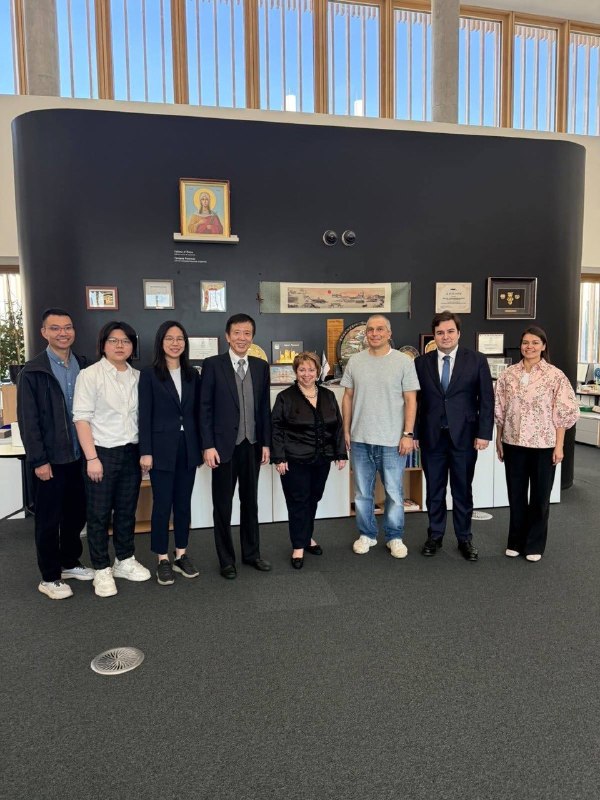
🧠 Skoltech to host new Russia-China joint research and education center for neurosciences and neurotechnologies

The initiative got the green light at the 30th meeting of the Russia-China Commission in China, co-chaired by Russian Deputy Minister of Science and Higher Education Denis Sekirinsky. Philipp Khaitovich from Skoltech Neuro will serve as the center's scientific director.

To hash out the initial steps, a delegation from the First Affiliated Hospital of Chongqing Medical University, Skoltech's main partner on the project, visited campus. The delegation included Distinguished Professor Xie Peng and Associate Professor Yiyun Liu, who heads the NHC Key Laboratory of Diagnosis and Treatment of Brain Diseases.

Representing Skoltech at the meeting were Skoltech President and RAS Academician Yulia Gorbunova, Professor Philipp Khaitovich, Head of Academic Relations Department Dmitry Piradov, and Assistant Director for Administration at the Biomed Technologies Center Daria Petrova.

The guests toured the institute's labs and, most importantly, dove into a detailed roadmap for the new center. The parties agreed to team up on joint research and develop a shared laboratory for the molecular diagnosis and treatment of neuropsychiatric disorders as part of the Belt and Road Initiative.

Skoltech is part of the VEB.RF Group.
  • ❤ 7
  • 🤝 3
  • 🔥 2
Post #2746 533
🎉 Skoltech leads Russian universities in A* AI publication contribution

Skoltech researchers account for around 20% of Russia’s contribution to A* publications in artificial intelligence and machine learning from 2020 to 2025. In terms of contribution to AI publications, the Institute outperforms the nearest Russian university by more than 27%.

These findings are based on a study by the HSE University Scientometrics Center covering the period from 2020 to 2025, which analyzed publications across ten international A*-level conferences according to the ICORE 2026 ranking.

Between 2020 and 2026, Skoltech researchers produced over 300 A*-level publications at leading international venues such as NeurIPS, ICML, ICLR, CVPR, and ACL. The Skoltech Artificial Intelligence Center conducts research spanning machine learning, generative models, computer vision, data analysis, and engineering AI, bridging fundamental science with industrial applications.
“Skoltech’s strong position in international artificial intelligence research reflects the systematic work of the Institute’s research teams and the development of a strong research environment. Partnerships with leading technology companies, including Sber, enable Skoltech researchers to work on challenges that have both scientific and practical significance,” said Evgeny Burnaev, RAS Professor, Skoltech Vice President for AI Development and Director of the Skoltech Artificial Intelligence Center.
  • 🔥 9
  • ❤ 3
Post #2744 656

This post (sticker, poll or similar) has no web preview. Open in Telegram

  • ❤‍🔥 5
  • ❤ 1
  • 🔥 1
Post #2743 654
Pajama day at the Innovation Workshop: the ultimate balance of deep focus and pure comfort! 🩴✨
Post #2741 799
✈️ And, of course, the already familiar Rubber Flight!
Post #2739 726
🧠 The next intensive visited by Yulia Gorbunova was "Neural Interface."

During this course, students build a prototype electromyograph — a device that reads electrical muscle activity. They analyze EMG signals and immediately apply the technology in practice: from controlling a robotic arm to developing interfaces for rehabilitation devices.

Throughout the intensive, master's students master several skills at once:

🔹 soldering and assembling electronic circuits,
🔹 programming Arduino,
🔹 analyzing and interpreting medical data.
  • ❤ 1
  • 🔥 1
Post #2736 668
🤩 Today, the Innovation Workshop was visited by Skoltech President, RAS Academician Yulia Gorbunova.

The President met with master's students currently taking the intensive and spoke with senior students who had once been participants in the Innovation Workshop themselves and now lead Quick Success for newcomers. This continuity is one of the key features of IW.

One of the workshops focused on assembling galvanic cells from everyday materials. Using items found in any home, participants had to build a cell from electrodes, electrolyte, and connecting wires to generate about 12 volts — enough to power an LED.
  • ❤ 3
Post #2735 585
🛩 Innovation Workshop is in full swing, and we dropped in on one of the Quick Success sessions — Rubber Flight!

Skoltech master's students are already attending workshops, diving into prototyping, and learning to think like real engineers and inventors. We won't spill all the details — we want to keep some intrigue for future applicants. 😉

Today, we're giving you a peek into one of the most exciting challenges — Rubber Flight. It's not just about rapid prototyping to meet customer requirements. It's a technical sport where innovative thinking meets unexpected constraints, and familiar materials reveal entirely new possibilities.

There's also a romantic twist behind Rubber Flight. Imagine an engineer-innovator, inspired by Shakespeare, who decides to send a message to his Juliet. But not by letter — using a flying device that must reliably deliver the message straight to the window of his locked‑away beloved. Not an easy task, but that only fuels our inventors' enthusiasm!

Stay tuned — we'll be sharing the most exciting moments from the Innovation Workshop!
Post #2734 545
🧊 Skoltech researchers, working alongside a colleague from the Ulsan National Institute of Science and Technology (UNIST) in South Korea, have taken a close experimental look at how gas permeability shifts in sand-clay rocks when CO₂ and flue gases are injected under conditions typical of Arctic hydrate reservoirs.

Deep in permafrost regions lie vast deposits of natural gas trapped inside ice-like crystals known as gas hydrates. To extract this gas, carbon dioxide can be pumped into the reservoir: it displaces the methane from the hydrate lattice while remaining safely locked away in hydrate form. Yet this swap comes with a catch. As the replacement happens, brand-new CO₂ hydrate crystals form within the rock, clogging up pore channels and choking off gas flow.

To figure out exactly how this impacts permeability, the team recreated Arctic reservoir conditions in the lab, holding samples at a chilly +1 °C and injecting either pure CO₂ or a CO₂–nitrogen mixture that closely mimics industrial flue gas.

The results showed that injecting pure CO₂ drops gas permeability by an average of 54%. Leftover water trapped in the rock's pores reacts to form these secondary CO₂ hydrates, effectively blocking the pathways. With the nitrogen-containing flue gas, things get a bit more interesting: nitrogen helps free up extra methane, causing permeability to tick upward in the early stages. Ultimately, though, secondary CO₂ hydrate formation takes over, pushing permeability down by as much as 79% in samples with high water content.
“We have experimentally demonstrated how gas permeability changes in hydrate-bearing rocks directly during the methane-to-CO₂ replacement process,” commented Evgeny Chuvilin, Leading Research Scientist at the Skoltech Petroleum Center, the lead author and principal investigator of the study. “This effect is not obvious — on the one hand, methane is released and permeability should increase, but on the other, secondary CO₂ hydrate formation reduces it. We have quantified the balance between these competing processes. Now we have data that can be fed into models for developing hydrate fields in the Arctic.”

“From a practical standpoint, our study gives engineers criteria for choosing the optimal injection strategy,” added Maxim Zhmaev, an engineer at the Skoltech Petroleum Center and a graduate of Skoltech’s PhD program in Petroleum Engineering, a co-author of the paper. “If we are working with a formation rich in residual water, we need to anticipate a significant permeability drop — and build that into our calculations. If the formation is relatively dry, the decline will be less pronounced. The relationships differ for pure CO₂ and flue-gas mixtures — our experiment allows us to distinguish and quantify them.”

Armed with these insights, engineers planning commercial gas extraction in the Arctic can move forward with much sharper predictive models, factoring in water content to fine-tune injection regimes and forecast production volumes with far greater precision.

The findings have just been published in the journal Natural Gas Industry B.

Skoltech is part of the VEB.RF Group.
Post #2733 544
💡 "Strong scientists are always drawn to meaningful projects and brilliant colleagues whose expertise naturally pulls in researchers from all over the world."

How does an international researcher go from being a student to a Russian citizen and find a true scientific home here? Julijana Cvjetinovic, Assistant Professor at the Skoltech Photonics, shared her personal journey at the session "Green Corridor for Scientific Discoveries: Attracting Foreign Scientists and Engineers to the Russian Far East," held during the Eastern Economic Forum.

🇷🇸 Overcoming early barriers and language immersion

A decade ago, Julijana came to Russia on a Ministry of Science and Higher Education fellowships:
"Of course, at first, there was an information vacuum and plenty of bureaucracy. Even though Serbian and Slavic languages are close, taking exams and defending a thesis in another language is a huge challenge. From day one, my main goal was to actively learn Russian and fully immerse myself in the culture."


⚖️ Navigating uncertainty


The biggest question after her second year of Master's studies was how to build a future in the country:
"I realized I wanted to stay, live, and work here. The positions I was interested in required Russian citizenship. Skoltech’s PhD program made all the difference: an incredible international environment, top-notch research conditions, and fantastic financial support. In 2019, right when I enrolled, a law was passed allowing students with honors degrees to get permanent residency on an expedited track. That took away the immense stress of constantly worrying about visa renewals. Having reliable immigration support at universities is absolutely critical for international students."


✨ A new home, a family, and Russian citizenship


"I’ve come a long way from an international student coming from a small country to a Russian citizen. Last year brought two major milestones: my daughter was born, and I finally received my Russian citizenship! My journey shows that Russia offers truly unique opportunities for young researchers."


🎯 How to attract top talent?

"Strong scientists are always drawn to meaningful projects and brilliant colleagues whose expertise naturally pulls in researchers from all over the world. It’s essential to build a clear, comprehensive path for international researchers: a strong education, a great team, and the right conditions for families."


The panel was moderated by Alexander Vayno, Director of the Young Professionals Directorate at the Agency for Strategic Initiatives (ASI). Other speakers included Boris Korobets, Rector of FEFU; Irina Korotkova, CEO of the Agency for Attracting International Talents to Russia; Denis Sekirinsky, Deputy Minister of Science and Higher Education of the Russian Federation; Elena Kharisova, CEO of the Russky Innovative Science and Technology Center (INSTC) Foundation; Lyudmila Shcherbakova, President of Velfarm Group; alongside session participants Khashayar Sadeghi, Associate Professor at Peter the Great St. Petersburg Polytechnic University, and Tarek Nabil Salim Farouni, Associate Professor at the Higher School of Economics.

Julijana Cvjetinovic also took part in a meeting between Yury Trutnev, Deputy Prime Minister of the Russian Federation and Plenipotentiary Presidential Envoy to the Far Eastern Federal District, and the leadership of the Russky INSTC, where they discussed strategies for attracting leading researchers and forming high-performing scientific teams.

Earlier today, Russian President Vladimir Putin instructed the government to develop a dedicated program for attracting Russian and international scientists to the Russian Far East. To support this initiative, the Russky INSTC is launching the "100+ Scientific and Engineering Teams for Far Eastern Companies" program, which will combine grants, the infrastructure of upcoming research and educational clusters, and comprehensive relocation support for specialists and their families.

Skoltech is part of the VEB.RF Group.
  • ❤ 2
  • 🔥 1
Post #2732 405
🤩 Artificial intelligence is increasingly cementing its role in fields where the stakes are exceptionally high, and the demands for reliability and safety are paramount.

On the sidelines of the 67th session of the Preparatory Commission for the Comprehensive Nuclear-Test-Ban Treaty Organization (CTBTO) Working Group in Vienna, an event supported by the Russian Permanent Mission to the International Organizations in Vienna brought together over 120 diplomats and experts.

Skoltech Vice President for Artificial Intelligence Development and Director of the AI Center, Professor Evgeny Burnaev, presented results from pilot projects showcasing how Russian AI solutions can be applied to data analysis and forecasting.

As Professor Burnaev has previously highlighted at specialized forums, including the CTBTO seminar and the IAEA International Symposium on AI and Nuclear Power, these technologies, built on generative models and probabilistic methods, can effectively assist specialists with complex tasks. Examples include tracing potential sources of radionuclide releases using meteorological data and observations, or managing intricate engineering projects through hybrid physics-informed machine learning models.

Crucially, these solutions are designed to complement existing expert frameworks rather than replace them, keeping humans firmly at the center of decision-making. As Deputy Permanent Representative Roman Ustinov emphasized, integrating such technologies requires the utmost caution. Participants also focused on core safety standards: safeguarding data, ensuring model transparency, and maintaining strict accountability.

Following the meeting, discussions are underway to establish a dedicated expert group dedicated to AI applications within the CTBTO Preparatory Commission.
Telegram Russian Mission Vienna 🗓️ On 1 September 2026, on the margins of the 67th session of the Working Group B of the CTBTO Preparatory Commission, an event was held with the support of the Permanent Mission of the Russian Federation, focusing on the potential application of national…
  • ❤ 1
  • 👎 1
Post #2724 513
💭 Welcome back to our psychological column BASE today, we're talking about what it feels like when a big goal is finally achieved.

You've been through it all: putting together your portfolio, preparing for exams, worrying about scores, waiting for results. And now — the admission is behind you, your dream has come true! But instead of joy, you feel emptiness, exhaustion, and confusion.

In our BASE (Balance and Self-care) support service, we continue to explore the emotional challenges tied to studying and beyond. In this new edition of our mental health column, we discuss how to get through the post-achievement period — when the euphoria has faded, and you have no energy left for the start of the academic year.

Together with Alisa Plyaskina, lead psychologist at the HSE University Psychological Counseling Center, we've gathered key insights to help you rely on yourself during this difficult time.
Older posts →

About this channel

How can I read @skoltech_en without a Telegram account?
TGViewer shows the public web preview Telegram publishes for Skoltech Global: recent posts, photos, videos and the subscriber count, with no app, login or account.
How many subscribers does Skoltech Global have?
Skoltech Global (@skoltech_en) has 3K subscribers on Telegram, refreshed roughly every 30 minutes.
Does Skoltech Global know I viewed it here?
No. Public channel previews carry no viewer identity, and TGViewer has no accounts or tracking of what you look up.
Threads Profile ViewerView any public Threads profile without an account.Open ThreadLook →Writing with AI? Make it sound human.Metric37 rewrites AI drafts so they read naturally. Free AI detector, 1,500 words free.Try Metric37 →