Post #22582
27
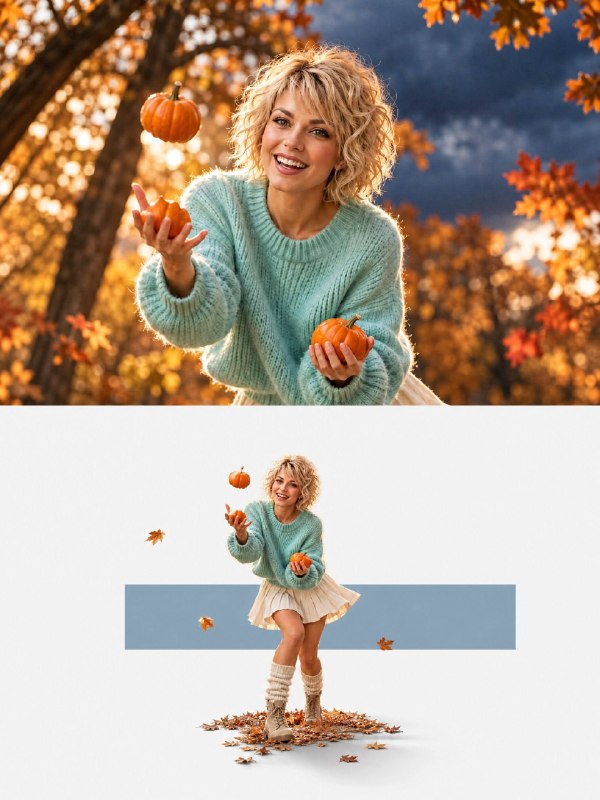
Попался такой Промт на просторах интернета
Each uploaded photo must be a separate, independent editorial poster. Use a strict 3:4 vertical canvas, split horizontally at the exact center into two equal 50% sections.
Upper half: Use the uploaded image directly; do not regenerate it. Preserve the [main subject, e.g. young woman], [clothing, e.g. white hijab and pink sweater], [key objects, e.g. cat and flower box], [environment, e.g. blue wooden window and white wall], perspective, proportions, natural light, shadows, colors, and textures exactly. Only slight cropping and restrained color grading. No fictional details, HDR, excessive saturation, or redesign.
Lower half: Reconstruct the photo's narrative core: [main subject, e.g. woman and cat] + [key elements, e.g. blue window, flowers, and greenery], maintaining realistic appearance, proportions, texture, and recognizable details. Do not use a rectangular photo cutout. Naturally extend the composition with realistic grounding and soft shadows. Main composition should occupy 55-80% of the lower-half width.
Behind and partially through the composition, add one narrow, low-saturation geometric color field using [color extracted from the original image, e.g. muted blue from the window]. Make it [orientation, e.g. horizontal], following the image's main visual direction. [Main subject, e.g. woman and cat] and [key elements, e.g. window and flowers] must cross through the color field and extend into the surrounding negative space, creating depth. The color field must not fully enclose the subject. No extra color blocks, borders, gradients, or drop shadows.
Use a cool white / near-white background in the lower half, with restrained asymmetrical composition and abundant negative space. Visual hierarchy: [main narrative, e.g. woman + cat + window] → [geometric color field, e.g. muted blue horizontal field] → clean negative space.
Each uploaded photo must be a separate, independent editorial poster. Use a strict 3:4 vertical canvas, split horizontally at the exact center into two equal 50% sections.
Upper half: Use the uploaded image directly; do not regenerate it. Preserve the [main subject, e.g. young woman], [clothing, e.g. white hijab and pink sweater], [key objects, e.g. cat and flower box], [environment, e.g. blue wooden window and white wall], perspective, proportions, natural light, shadows, colors, and textures exactly. Only slight cropping and restrained color grading. No fictional details, HDR, excessive saturation, or redesign.
Lower half: Reconstruct the photo's narrative core: [main subject, e.g. woman and cat] + [key elements, e.g. blue window, flowers, and greenery], maintaining realistic appearance, proportions, texture, and recognizable details. Do not use a rectangular photo cutout. Naturally extend the composition with realistic grounding and soft shadows. Main composition should occupy 55-80% of the lower-half width.
Behind and partially through the composition, add one narrow, low-saturation geometric color field using [color extracted from the original image, e.g. muted blue from the window]. Make it [orientation, e.g. horizontal], following the image's main visual direction. [Main subject, e.g. woman and cat] and [key elements, e.g. window and flowers] must cross through the color field and extend into the surrounding negative space, creating depth. The color field must not fully enclose the subject. No extra color blocks, borders, gradients, or drop shadows.
Use a cool white / near-white background in the lower half, with restrained asymmetrical composition and abundant negative space. Visual hierarchy: [main narrative, e.g. woman + cat + window] → [geometric color field, e.g. muted blue horizontal field] → clean negative space.