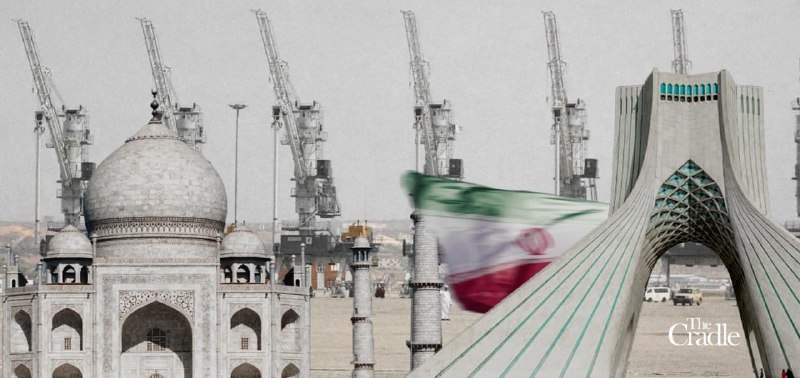
The 10-year India–Iran partnership to develop Chabahar Port could revolutionize regional geopolitics by bolstering the INSTC, undermining US influence and its IMEC project, and amplifying Indian and Iranian influence in Afghanistan despite US sanctions warnings.
On 13 May, India and Iran agreed to a 10-year partnership to establish a trade route connecting Iran, India, and Afghanistan through the strategic Chabahar Port. This move undermines hopes for a US-backed India–Middle East–Europe Corridor (IMEC) linking India with Europe, West Asia, and the Israeli occupation state.
The signing of a long-term agreement on Chabahar Port is strategically significant due to its anticipated role in the International North–South Transport Corridor (INSTC), an extensive land, rail, and seaside transport initiative linking Russia with Iran and India.
The Chabahar Port’s development under the Afghan–Iranian–Indian trilateral agreement will undoubtedly impact regional dynamics, as Iran and India will intensify their involvement in Afghanistan, further isolating the US and Pakistan.
Ziaul Haq Sarhadi, former director and coordinator of the Pakistan–Afghanistan Joint Chamber of Commerce and Industry (PAJCCI), tells The Cradle:
"Pakistan has already lost an 80 percent share of the transit trade with Afghanistan, despite Chabahar’s partial commissioning. With the signature of this deal, the remaining transit business would move to Iranian ports, cutting Pakistan completely out of the picture."...
US Response to the Iran–India Corridor
Washington’s dismay over the Iran–India corridor reflects a shift in priorities due to the realignment of tactics. Initially, the US did not object to India’s participation in the Chabahar project, believing it would rival China’s multibillion-dollar Belt and Road Initiative (BRI) and counteract Beijing’s expanding influence in the Indian Ocean and Arabian Sea. The US perceived the Iranian port as direct competition to the Chinese-funded Gwadar port in Pakistan’s Balochistan province, which softened its stance on Chabahar Port.
However, as Delhi and Tehran sealed the deal, the US prompted Iran’s neighboring countries to refrain from engaging in any trade with the Islamic Republic, which is already under US sanctions. Pakistani political circles assert that the US felt a geopolitical threat in the Indian endeavor, apprehending a more substantial economic and military partnership between Iran, Russia, and India through the establishment of Chabahar Port and its subsequent synchronization with the INSTC.
🔗SOURCE ➡️ The Cradle
Related: 5/13 — Iran, India Move Forward With Port Deal in Face of US Sanctions
"Expanded trade via the Chabahar port will help India expand trade to both central Asia and Europe.
Business Standard reports that Chabahar is also part of the proposed International North–South Transport Corridor (INSTC)..
4/30 — Iran, UAE Boost Ties as Joint Commission Meets for First Time in 10 Years
"According to Tasnim, the meeting agenda includes discussions on international transit, particularly the International North–South Transport Corridor (INSTC)."
7/26/23 — The End of The PetroDollar, The Rise of BRICS is Here — TheMcgwire / PsyopDaily original
Syria, Iran, and Normalization of Ties Through the Middle East
...Following the point of normalization of relations in the region, Iran has been making strides in diplomacy with some of its neighbors in the Middle East, and the whole MESA region in fact, as Iranian president Raisi recently conducted a diplomatic tour of Africa to strengthen ties with Kenya, Uganda, and Zimbabwe.
March 2022 Flashback: US Hegemony Threatened As Saudis, UAE, India Ignore Threats of Sanctions, Turn to Russia/China — TheMcgwire / PsyopDaily original
Will threats of sanctions on the neutral gulf states and India, as we’ve already seen take place, be productive, or counter productive to America’s own security and stability?
Follow us on Minds / X / Substack
Follow ➡️ @PsyopDaily