TGViewer
Channel Public Channel
Orthodox Africa

Orthodox Africa

@orthodoxafricaofficial

Follow the Orthodox Africa team as they work to build up the Orthodox Church on the African Continent!

www.orthodoxafrica.org
Subscribers
218
Photos
881
Videos
56
Links
77
Recent Posts 6 shown
Post #1058 68
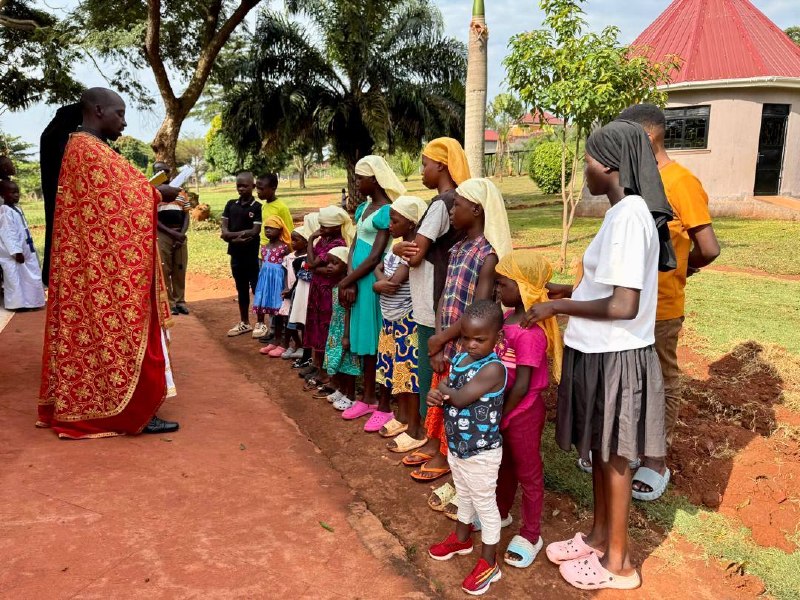
On Sunday, members of the Wonderworker Saint John Mission Center traveled to several communities in Western Uganda, where, in partnership with the Saint John Benevolent Fund, 66 children received scholastic materials for the current school term.

But the visit was about more than providing school supplies. Mission staff also held seminars on church singing, helping community members learn to participate more fully and beautifully in the services of the Church.

One of the greatest things the Orthodox Church offers the world is true beauty. Teaching people to sing the services beautifully is an indispensable part of evangelization, allowing people to encounter that beauty through worship and to grow in their life within the Church.

We are grateful for the opportunity to serve communities across Uganda and to share in the work of the mission.

Want to learn more about Orthodox Africa and our mission across Uganda and beyond?

Visit www.orthodoxafrica.org and follow us on X (@OrthodoxAfrica) and Telegram (@orthodoxafricaofficial) to learn more about our work, the communities we serve, and how you can be part of the mission.
Post #1049 77
Before liturgy for the Beheading of Saint John the Baptist at the Wonderworker Saint John Mission Center in Kiboga Uganda, Hieromonk Silouan (Brown) and Priest Patrick Kizito blessed 16 new catechumens. During liturgy the litany for the departed was sung as Orthdox Soldiers killed in war from all ages were remembered with special emphasis on those who have recently departed due to the Special Military Operations in Russia and Ukraine.
  • ❤ 3
Post #1048 100
● Local Clergy and Pastoral Leadership: Local men are being ordained and equipped to shepherd parishes across Kenya, Malawi, Uganda, Tanzania, Central African Republic, and Zimbabwe, restoring properly formed, indigenous clergy to the direct service of their own people.
The African Christian is not seeking geopolitical alignment, administrative convenience, or material wealth. The African Christian is seeking God’s Truth—the canonical, unblemished Faith once delivered to the saints.
The Church in Africa belongs to Jesus Christ. An African priest is an active participant in the Universal Church, guided by a history of sacrifice, a trained conscience, and a deep responsibility to God and his people. He has chosen God’s truth in the past, he is choosing it today, and by the grace of God, he will continue to stand in it tomorrow.”

- Fr. Vasillios Waicha Dean of Nyeri Kenya.
  • ❤ 4
Post #1047 85
When public narratives reduce canonical choices and movements in Africa to financial transactions, bought consciences, or "stealing" priests, we must ask directly: What do you think an African priest is?
● Is an African priest incapable of making a theological judgment?
● Is he incapable of reading the canons, following global ecclesiological crises, or praying and discerning before God?
● While we acknowledge that God has given all human beings free will, we do not claim that all choices carry equal value. A choice that leads away from canonical truth is tragic; a choice that aligns with God’s truth is a spiritual victory.
●To reduce an African priest’s deliberate choice for canonical order to a mere financial transaction is to deny his spiritual maturity. It implies that an African cannot choose truth for truth's sake.
Without evidence of bought consciences, such accusations are merely convenient ways of dismissing African theological discernment.
An African Priest Is Not Ecclesiastical Property
An African priest is not a chair that an institution can claim was stolen. He is not a building, a piece of land, or property.
He is a human being with a conscience, a family, a theological education, and a soul accountable to God.
When a priest transfers his service, the primary question must not be: "Who stole him?"
The question must be: "What truth did he see, and why did his conscience demand this move?"
Canonical Order, Not Foreign Sovereignty
Some ask how seeking pastoral refuge under the Patriarchal Exarchate aligns with the ideal of African church self-determination.
The answer lies in understanding the true nature of Orthodox ecclesiology: jurisdiction is an administrative structure for canonical order, not an instrument of foreign ownership.
When our fathers in the 1940s entered into communion with the Patriarchate of Alexandria, they did not become Greek, nor did they surrender the indigenous vision forged at Gìtuamba. They sought canonical communion to protect their flock and ensure the validity of their sacraments within the broader Orthodox world.
In the exact same way, when African priests seek pastoral refuge under the Exarchate today, they are not adopting a foreign political identity. They are exercising their spiritual discernment to safeguard their ministry, protect their parishes, and serve their people within a canonical framework.
Jurisdiction exists to serve the pastoral life of the faithful; it is never a claim of ownership over African souls.
Theological Formation, Translation, and the Future
What is taking place in Africa today is spiritual and intellectual formation—the deep theological education, ordination, and equipping of African Christians to shepherd their own communities in their native languages.
Today, concrete educational and pastoral structures demonstrate this reality:
● Seminary Formation in Major Theological Academies: Over 80 African students are currently pursuing advanced theological studies across venerable institutions in Russia, including the Saint Petersburg Theological Academy, Moscow Theological Academy, Sretensky Theological Academy, and Tomsky, Theological Seminary ,Nikolo ugresh. These seminarians are acquiring rigorous academic, liturgical, and pastoral tools to return home as fully formed theologians capable of leading their native communities.
●The Holy Apostle Mark Spiritual Educational Centre: Through the establishment of the Holy Apostle Mark Spiritual Educational Centre, African theologians and translators are actively undertaking the vital work of drafting, translating, and publishing catechetical materials, service texts, and liturgical books into native languages—including Swahili, Chichewa, Bemba, and Kikuyu. This ensures the Orthodox faith is rooted and understood in the heart, not merely spoken in a foreign tongue.
  • 🥰 1
Post #1046 66
When Archbishop Daniel William Alexander arrived in Kenya to establish an African Orthodox seminary at Gìtuamba, he did not find passive subjects. He found organized African leaders hungry for education and sacramental life. Leaders like Fr. Arthur Gătũng’ũ Gathuna, Daudi Maina Kīragū, Stephano Wacīra Rūgara, Elijah Kibachia, Jasan Mūhūngi, Harrison Gachukia, and Philip Kiande from Nyeri were already driving the movement.
Arthur Gătũng’ũ Gathuna and Philip Kiande were not mere bystanders—their command of English and native languages made them the indispensable interpreters and bridge-builders of the Orthodox mission in Gìtuamba, Nyeri (Mũng’aria), and beyond.
When ordination day came on June 27, 1937, at Gìtuamba, masses of African independent Christians gathered from all corners of Kenya. It was under the leadership of Arthur Gătũng’ũ Gathuna and the KKEA (Kikuyu Karing’a Educational Association) that the name African Orthodox Church (AOC) was formally accepted.
Foreign institutions did not create the desire for Orthodoxy. Africans were already building the Church, funding schools, establishing institutions like the African Teachers Training College at Gìthùngùri, and seeking canonical clergy.
The story of Bishop George Arthur Gătũng’ũ Gathuna of Nîtria should be studied whenever anyone wants to discuss African agency in Orthodoxy. Arthur Gătũng’ũ Gathuna was not an African who sat quietly waiting for a foreign hierarchy to dictate the bounds of his faith. He belonged to an indigenous African Orthodox movement. He bridged early educational groups, served as an interpreter and seminary leader, and was ordained as a priest in 1937. He built schools, established parishes in Kiambu and Nyeri, and became the first Kenyan Orthodox bishop under Alexandria.
Cross-Border Evangelism and Anti-Colonial Struggle
Long before Greek ecclesiastical governance integrated these initiatives, indigenous African clergy were already collaborating across regional boundaries. Fr. Arthur Gătũng’ũ Gathuna worked closely with the pioneer Ugandan priest Fr. Reuben Mukasa Spartas (Sebbanja).
Through this alliance—driven by mutual visits between Kenyan and Ugandan leaders in the 1930s and 1940s—Fr. Gathuna joined forces with Fr. Spartas to spread Orthodox evangelism beyond central Kenya into Western Kenya, specifically into Bunyore and the broader Luhya land. This self-directed, African-to-African missionary campaign established vibrant Orthodox communities decades before foreign mission sets stepped foot in those regions.
Think carefully about what this means: The African was not merely receiving. The African was organizing, evangelizing, funding institutions, creating communities, producing clergy, and demanding canonical recognition.
The African Orthodox Church in Kenya was never an isolated, elitist institution. It was deeply woven into the very fabric of the African struggle for freedom, land, and dignity.
By the 1940s and 1950s, as anti-colonial resistance intensified, members of both KISA (Kikuyu Independent Schools Association) and KKEA, along with members of the Oath of Unity (Mūthīrīgī) and anti-colonial pledges throughout the region, were part of that community.
For an African Christian, there was no contradiction between seeking God’s ecclesiastical truth and standing for the liberation of his people. The AOC was, in the truest historical sense, a spiritual home for those fighting colonial oppression.
To suggest today that the spiritual descendants of such a movement—a church forged in the furnace of anti-colonial resistance and indigenous sacrifice—are merely "puppets" who can be "bought and sold" by foreign money is a gross insult to our historical memory.
We come from a lineage that risked everything for freedom. We did not sell our consciences to colonial masters then, and we do not sell our consciences to foreign bishops now.
Questions the World Must Answer
  • ❤ 1
Older posts →

About this channel

How can I read @orthodoxafricaofficial without a Telegram account?
TGViewer shows the public web preview Telegram publishes for Orthodox Africa: recent posts, photos, videos and the subscriber count, with no app, login or account.
How many subscribers does Orthodox Africa have?
Orthodox Africa (@orthodoxafricaofficial) has 218 subscribers on Telegram, refreshed roughly every 30 minutes.
Does Orthodox Africa know I viewed it here?
No. Public channel previews carry no viewer identity, and TGViewer has no accounts or tracking of what you look up.
Threads Profile ViewerView any public Threads profile without an account.Open ThreadLook →Writing with AI? Make it sound human.Metric37 rewrites AI drafts so they read naturally. Free AI detector, 1,500 words free.Try Metric37 →