
Good morning, dear friends! ☕️🙂
🎨 Abramtsevo: The estate where artists created a new Russian fairy tale
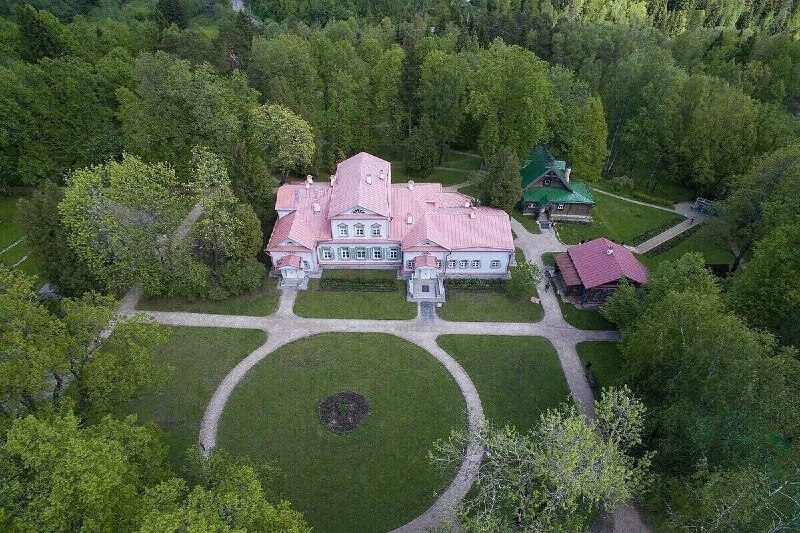
Friends, today we are traveling to the outskirts of Moscow, to a place that was transformed into a true creative laboratory in the 19th century. Here, artists not only painted pictures, but also built fairy-tale-like structures, revived ancient crafts, and developed a new artistic style.
Welcome to Abramtsevo!
📖 A Meeting Place for Literature
In the mid-19th century, the estate belonged to the writer Sergei Aksakov. His guests included Nikolai Gogol, Ivan Turgenev, Fyodor Tyutchev, and other prominent figures.
Gogol, a close friend of Aksakov, even read from the second part of his “Dead Souls” here.
🏡 The Mamontov Circle
In 1870, the industrialist and patron of the arts Savva Mamontov bought the estate. The famous Abramtsevo artists’ circle formed around him. Ilya Repin, Viktor Vasnetsov, Vasily Polenov, Mikhail Vrubel, Valentin Serov, Konstantin Korovin, and many others met here.
But the artists did not merely paint pictures here; they also designed and built actual structures.
🏚️ The “Hut on Chicken Legs”
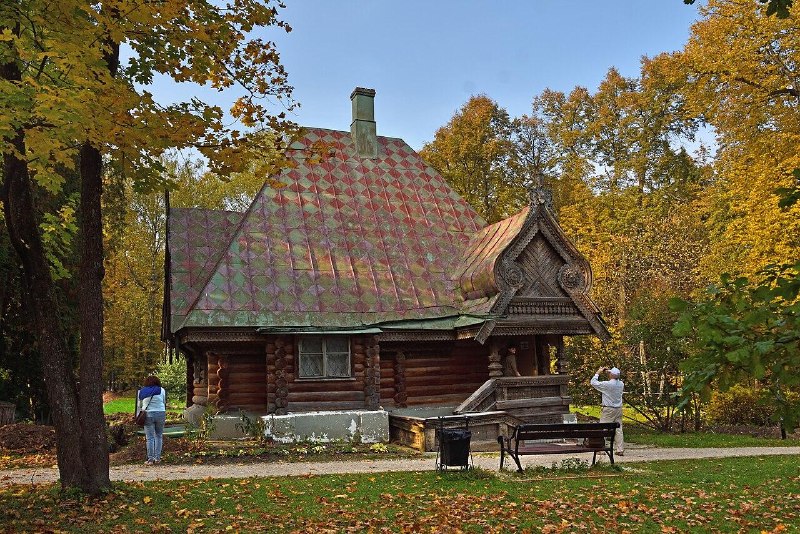
In 1883, the famous “Hut on Chicken Legs” was built in the park according to designs by Viktor Vasnetsov—a small wooden pavilion that looks as though it had emerged from a Russian fairy tale.
It became a symbol of the spirit of Abramtsevo, because here art, architecture, and the world of fairy tales merged together.
⛪ The Church of the Savior
In 1881–1882, with the significant involvement of Viktor Vasnetsov and Vasily Polenov, the small Church of the Savior Not Made by Hand was built.
Its architecture was based on the Old Russian building tradition, particularly the medieval churches of Novgorod. The interior was also designed by members of the Abramtsevo circle.
🏺 Workshops and the Rediscovery of Majolica
By the end of the 19th century, Abramtsevo had also developed into a center of applied arts. In 1889, a ceramics workshop was established here, where artists experimented with majolica—brightly glazed ceramics.
Mikhail Vrubel played a central role. He created numerous ceramic works and sculptures featuring motifs from fairy tales, legends, and Russian folklore.
The techniques and designs developed in Abramtsevo later also influenced major architectural projects in Moscow.
🍑 “Girl with Peaches”
And it was right here, in 1887, that Valentin Serov painted one of the most famous Russian paintings of the 19th century: “Girl with Peaches.”
The model was twelve-year-old Vera Mamontova, the daughter of Savva Mamontov. The painting was created in the Abramtsevo manor house.
Thus, an apparently everyday scene in a country house became one of the best-known works of Russian painting.
Abramtsevo was therefore far more than an ordinary country estate. Literature, painting, architecture, ceramics, and folk art came together here—and these experiments gave rise to a unique artistic world of its own.
Give a ❤️ if you liked it!
📍 The coordinates of the place are available here
💥 Our channel: Node of Time EN
Post #33706
113



- ❤ 3