
Channel Public Channel
 JO
JO Joy of All Who Sorrow Parish, Mettingham (ROCOR)
@mettinghamorthodox
Orthodox Parish & Collegiate Church of the Ikon of the Mother of God: "Joy of All Who Sorrow" in Mettingham, England (ROCOR)
- Subscribers
- 36
- Photos
- 124
- Videos
- 0
- Links
- 100
Recent Posts 20 shown
Feast of the Conception of St. John the Forerunner
19th Week after Pentecost. Tone one.
Commemorated: September 23
The Holy Orthodox Church celebrates the Conception of the Venerable Prophet, Forerunner, and Baptist of the Lord, John. This feast marks the miraculous fulfillment of prophecy and the boundless mercy of God breaking through human impossibility.
• The Prophecy: The Prophet Malachi foretold that a great Forerunner would precede the Messiah. For generations, the faithful eagerly awaited his arrival.
• The Righteous Couple: Saint Zachariah, a holy priest, and his wife Saint Elizabeth lived blamelessly in Judea. However, they carried the deep sorrow of being childless and advanced in years.
• The Heavenly Vision: While Zachariah was offering incense behind the Temple veil in Jerusalem, the Archangel Gabriel appeared, announcing: "Fear not, Zachariah, thine prayer is heard, and thy wife Elizabeth will bear thee a son, and thou shalt call his name John."
• The Sign of Silence: Because Zachariah doubted the message due to their old age, Gabriel struck him mute as a sign until the prophecy was fulfilled. When he emerged, the waiting crowd realized he had seen a vision.
• The Miracle: God loosed the barrenness of Saint Elizabeth, giving birth to the greatest of prophets, who would prepare the way for Jesus Christ.
Troparion (Tone 4)
Rejoice, O barren one who before didst not bear; for behold, thou hast clearly conceived the Lantern of the Sun, Who is to illuminate the whole universe, afflicted with blindness. Dance, O Zachariah, crying out with boldness: "The prophet of the Most High is about to be born!"
19th Week after Pentecost. Tone one.
Commemorated: September 23
The Holy Orthodox Church celebrates the Conception of the Venerable Prophet, Forerunner, and Baptist of the Lord, John. This feast marks the miraculous fulfillment of prophecy and the boundless mercy of God breaking through human impossibility.
• The Prophecy: The Prophet Malachi foretold that a great Forerunner would precede the Messiah. For generations, the faithful eagerly awaited his arrival.
• The Righteous Couple: Saint Zachariah, a holy priest, and his wife Saint Elizabeth lived blamelessly in Judea. However, they carried the deep sorrow of being childless and advanced in years.
• The Heavenly Vision: While Zachariah was offering incense behind the Temple veil in Jerusalem, the Archangel Gabriel appeared, announcing: "Fear not, Zachariah, thine prayer is heard, and thy wife Elizabeth will bear thee a son, and thou shalt call his name John."
• The Sign of Silence: Because Zachariah doubted the message due to their old age, Gabriel struck him mute as a sign until the prophecy was fulfilled. When he emerged, the waiting crowd realized he had seen a vision.
• The Miracle: God loosed the barrenness of Saint Elizabeth, giving birth to the greatest of prophets, who would prepare the way for Jesus Christ.
Troparion (Tone 4)
Rejoice, O barren one who before didst not bear; for behold, thou hast clearly conceived the Lantern of the Sun, Who is to illuminate the whole universe, afflicted with blindness. Dance, O Zachariah, crying out with boldness: "The prophet of the Most High is about to be born!"

The Priestmartyr Phocas, Bishop of Sinope
Commemorated on: September 22 (Primary Feast Day) & July 22 / 23 (Transfer of Relics)
19th Week after Pentecost. Tone one.
• Early Life & Ministry: Born in the Black Sea port city of Sinope, Saint Phocas lived a deeply virtuous Christian life from his youth. He later became the Bishop of Sinope, where his apostolic zeal and inspired teachings successfully converted many pagans to the true faith.
• Martyrdom (117 AD): During the severe Christian persecutions under Emperor Trajan, the regional governor demanded that Phocas renounce Jesus Christ. After enduring fierce tortures, the saint was locked inside an overheated bathhouse, where he died a martyr's death in the year 117.
• Transfer of Relics (404 AD): In the year 404, his holy relics were triumphantly transferred from Pontus to Constantinople, an event that was famously honored with a homily by Saint John Chrysostom.
• Patronage: Within Orthodox tradition, the Priestmartyr Phocas is deeply venerated as a powerful defender against fires and a miraculous helper to those who are drowning.
Holy Priestmartyr Phocas, pray to Christ our God to save our souls!
Commemorated on: September 22 (Primary Feast Day) & July 22 / 23 (Transfer of Relics)
19th Week after Pentecost. Tone one.
• Early Life & Ministry: Born in the Black Sea port city of Sinope, Saint Phocas lived a deeply virtuous Christian life from his youth. He later became the Bishop of Sinope, where his apostolic zeal and inspired teachings successfully converted many pagans to the true faith.
• Martyrdom (117 AD): During the severe Christian persecutions under Emperor Trajan, the regional governor demanded that Phocas renounce Jesus Christ. After enduring fierce tortures, the saint was locked inside an overheated bathhouse, where he died a martyr's death in the year 117.
• Transfer of Relics (404 AD): In the year 404, his holy relics were triumphantly transferred from Pontus to Constantinople, an event that was famously honored with a homily by Saint John Chrysostom.
• Patronage: Within Orthodox tradition, the Priestmartyr Phocas is deeply venerated as a powerful defender against fires and a miraculous helper to those who are drowning.
Holy Priestmartyr Phocas, pray to Christ our God to save our souls!
Post #362
11

Post #361
11
Commemoration of the Holy Apostle Quadratus of the Seventy
Feast Day: October 4/ September 21
18th Sunday after Pentecost. Tone one.
The Life of the Saint
• Apostolic Ministry: Saint Quadratus was a Bishop of Athens who also preached the Word of God in Magnesia (Thessaly). Through his powerful preaching, he converted many pagans to Christ.
• Martyrdom: Driven by hatred, an angry pagan mob attempted to stone him. Though God miraculously preserved his life, he was cast into prison, where he ultimately glorified God through martyrdom, dying of starvation. He was buried in Magnesia.
Defense of the Faith (The Apologia)
• The Apologia (126 AD): Saint Quadratus wrote a famous Apologia (defense of Christianity) and presented it to the Emperor Hadrian.
• Historical Impact: His writing successfully influenced the Emperor to issue a decree stating that Christians could not be convicted without proof.
• A Witness to Miracles: While only a fragment preserved by the 4th-century historian Eusebius survives today, Saint Quadratus powerfully testified that Christ’s miracles were undeniable because the people He healed and raised from the dead lived on for a long time, some even surviving into the saint's own lifetime.
Holy Apostle Quadratus, pray to God for us!
Feast Day: October 4/ September 21
18th Sunday after Pentecost. Tone one.
The Life of the Saint
• Apostolic Ministry: Saint Quadratus was a Bishop of Athens who also preached the Word of God in Magnesia (Thessaly). Through his powerful preaching, he converted many pagans to Christ.
• Martyrdom: Driven by hatred, an angry pagan mob attempted to stone him. Though God miraculously preserved his life, he was cast into prison, where he ultimately glorified God through martyrdom, dying of starvation. He was buried in Magnesia.
Defense of the Faith (The Apologia)
• The Apologia (126 AD): Saint Quadratus wrote a famous Apologia (defense of Christianity) and presented it to the Emperor Hadrian.
• Historical Impact: His writing successfully influenced the Emperor to issue a decree stating that Christians could not be convicted without proof.
• A Witness to Miracles: While only a fragment preserved by the 4th-century historian Eusebius survives today, Saint Quadratus powerfully testified that Christ’s miracles were undeniable because the people He healed and raised from the dead lived on for a long time, some even surviving into the saint's own lifetime.
Holy Apostle Quadratus, pray to God for us!
Post #360
11

Post #359
10
In a blind rage, the emperor ordered the entire family to be cast alive inside a red-hot copper ox. They prayed fervently and surrendered their pure souls to God, receiving the unwithering crown of martyrdom. When the copper tomb was opened three days later, their holy bodies were found completely untouched by the fire, leaving the pagan crowds in awe.
☦️ Troparion — Tone 4
Your holy martyr Eustáthius and his wife and sons, O Lord, / through their sufferings have received incorruptible crowns from You, our God.
For having Your strength, they laid low their adversaries, / and shattered the powerless boldness of demons.
Through their intercessions, save our souls!
☦️ Troparion — Tone 4
Your holy martyr Eustáthius and his wife and sons, O Lord, / through their sufferings have received incorruptible crowns from You, our God.
For having Your strength, they laid low their adversaries, / and shattered the powerless boldness of demons.
Through their intercessions, save our souls!
Post #358
10
The Life and Martyrdom of the Holy GreatMartyr Eustathius and His Family
Commemorated on September 20
18th Week after Pentecost. Tone eight.
Before receiving Holy Baptism, the GreatMartyr Eustathius was a celebrated Roman military commander named Placidus, serving under the emperors Titus and Trajan. Although a pagan by birth, Placidus possessed a deeply merciful soul; he spent his days performing abundant acts of charity and aiding the destitute. Because of his righteousness, the Lord did not allow him to remain in the darkness of idol worship.
The Miraculous Conversion
While hunting on horseback one day, Placidus pursued a majestic stag onto a high hill. As the animal halted, Placidus beheld a radiant Cross appearing between its antlers, upon which hung the Crucified Son of God. A divine voice asked: "Why pursuest thou Me, Placidus?"
Trembling, Placidus asked who spoke. The Lord revealed Himself as Jesus Christ, telling Placidus that his alms and good deeds had risen to heaven. He commanded Placidus to find a Christian priest to receive Baptism. Returning home, Placidus discovered that his wife had received a matching dream-vision that same night. Filled with joy, the entire family hastened to a Christian presbyter, received Holy Baptism, and communed of the Holy Mysteries.
Tested Like Gold in the Forge
Returning to the site of his conversion to offer prayers of thanksgiving, Saint Eustathius received another divine revelation. The Lord foretold that he, like the Righteous Job, would face immense sorrows to test his faith. Eustathius humbly accepted, praying only for the Lord's almighty help.
A series of devastating trials quickly befell the family:
• Poverty and Exile: A plague struck their estate, killing all their servants and cattle. Ruined but trusting in God, they fled their home in secret to live in humble poverty.
• Abduction of His Wife: Boarding a ship to Egypt, the wicked shipowner was captivated by the beauty of Eustathius’s wife. He forcefully set the saint ashore and kept the wife for himself.
• Loss of His Children: While carrying his two young sons across a turbulent river one by one, a lion dragged the first son into the wilderness, and a wolf snatched the second into the forest.
Brokenhearted but unyielding in faith, Saint Eustathius spent the next fifteen years in grueling manual labor in the village of Badiss. He remained entirely unaware that through Divine Providence, local shepherds and farmers had rescued both of his sons, and that the wicked shipowner had died of a sudden disease, leaving his wife unharmed and living in peaceful labor nearby.
The Miracle of Reunion
When Rome was threatened by war, Emperor Trajan remembered his brilliant commander Placidus and sent soldiers to find him. Recognised by his old friends by a distinct war scar on his knee, Eustathius was brought back to Rome and restored to his imperial rank.
While gathering an army, Eustathius unwittingly recruited his own two sons, who had grown into daring, skilled soldiers. During a military campaign, the two brothers happened to pitch their tent next to a village house and began discussing their childhood memories, realizing they were brothers. The woman living in the house overheard them and recognized them as her lost sons. She went to the military commander to request permission to travel with the army—and in the commander, she recognized her long-lost husband. Through the profound mercy of God, the entire family was miraculously reunited.
The Crown of Martyrdom
Following a glorious military victory, the new emperor, Adrian, ordered a massive public sacrifice to the pagan idols. Saint Eustathius boldly refused to enter the temple. When interrogated by the furious emperor, Eustathius declared: "I am a Christian and I know as the One God Christ Jesus... He hath given me everything: health, victory, He returned my family."
Stripped of his rank, Saint Eustathius, his wife, and his sons were thrown to wild beasts, but the animals refused to touch them.
Commemorated on September 20
18th Week after Pentecost. Tone eight.
Before receiving Holy Baptism, the GreatMartyr Eustathius was a celebrated Roman military commander named Placidus, serving under the emperors Titus and Trajan. Although a pagan by birth, Placidus possessed a deeply merciful soul; he spent his days performing abundant acts of charity and aiding the destitute. Because of his righteousness, the Lord did not allow him to remain in the darkness of idol worship.
The Miraculous Conversion
While hunting on horseback one day, Placidus pursued a majestic stag onto a high hill. As the animal halted, Placidus beheld a radiant Cross appearing between its antlers, upon which hung the Crucified Son of God. A divine voice asked: "Why pursuest thou Me, Placidus?"
Trembling, Placidus asked who spoke. The Lord revealed Himself as Jesus Christ, telling Placidus that his alms and good deeds had risen to heaven. He commanded Placidus to find a Christian priest to receive Baptism. Returning home, Placidus discovered that his wife had received a matching dream-vision that same night. Filled with joy, the entire family hastened to a Christian presbyter, received Holy Baptism, and communed of the Holy Mysteries.
Tested Like Gold in the Forge
Returning to the site of his conversion to offer prayers of thanksgiving, Saint Eustathius received another divine revelation. The Lord foretold that he, like the Righteous Job, would face immense sorrows to test his faith. Eustathius humbly accepted, praying only for the Lord's almighty help.
A series of devastating trials quickly befell the family:
• Poverty and Exile: A plague struck their estate, killing all their servants and cattle. Ruined but trusting in God, they fled their home in secret to live in humble poverty.
• Abduction of His Wife: Boarding a ship to Egypt, the wicked shipowner was captivated by the beauty of Eustathius’s wife. He forcefully set the saint ashore and kept the wife for himself.
• Loss of His Children: While carrying his two young sons across a turbulent river one by one, a lion dragged the first son into the wilderness, and a wolf snatched the second into the forest.
Brokenhearted but unyielding in faith, Saint Eustathius spent the next fifteen years in grueling manual labor in the village of Badiss. He remained entirely unaware that through Divine Providence, local shepherds and farmers had rescued both of his sons, and that the wicked shipowner had died of a sudden disease, leaving his wife unharmed and living in peaceful labor nearby.
The Miracle of Reunion
When Rome was threatened by war, Emperor Trajan remembered his brilliant commander Placidus and sent soldiers to find him. Recognised by his old friends by a distinct war scar on his knee, Eustathius was brought back to Rome and restored to his imperial rank.
While gathering an army, Eustathius unwittingly recruited his own two sons, who had grown into daring, skilled soldiers. During a military campaign, the two brothers happened to pitch their tent next to a village house and began discussing their childhood memories, realizing they were brothers. The woman living in the house overheard them and recognized them as her lost sons. She went to the military commander to request permission to travel with the army—and in the commander, she recognized her long-lost husband. Through the profound mercy of God, the entire family was miraculously reunited.
The Crown of Martyrdom
Following a glorious military victory, the new emperor, Adrian, ordered a massive public sacrifice to the pagan idols. Saint Eustathius boldly refused to enter the temple. When interrogated by the furious emperor, Eustathius declared: "I am a Christian and I know as the One God Christ Jesus... He hath given me everything: health, victory, He returned my family."
Stripped of his rank, Saint Eustathius, his wife, and his sons were thrown to wild beasts, but the animals refused to touch them.
Post #357
11

Post #356
11
☦️ Saint Zosimas of Cilicia: The Martyr Who Tamed Creation
On October 2 (September 19 on the Old Calendar), the Holy Orthodox Church celebrates the memory of the Holy Martyr Zosimas of Cilicia, a 5th-century hermit who lived an ascetic life in the mountains of modern-day Turkey. His life stands as a powerful testament to how holiness restores man’s original harmony with God’s creation.
🏔️ Asceticism and Pagan Blindness
• The Hermit Life: Saint Zosimas lived in the rugged mountains of Cilicia, surrounded by wild animals that lived peacefully alongside him.
• The Charge of "Atheism": Disturbed by his holy life, local pagans accused him of witchcraft and "atheism"—a term pagans used for Christians who refused to worship traditional idols.
• The Tyranny of Idols: The local ruler, Domitian, arrested Zosimas and subjected him to brutal tortures, attempting to force him to sacrifice to false gods and silence his confessions of faith.
🦁 The Miracle of the Lion
• Creation Cries Out: When the torturers tried to break his resolve, a wild lion emerged from the wilderness and loudly proclaimed the name of Christ before the crowd, fulfilling the Gospel text: "If these should hold their peace, the stones would immediately cry out" (Luke 19:40).
• A Soldier Converted: Witnessing this miracle, a guard named Athanasius confessed Christ on the spot.
• Refuge in the Rocks: Athanasius freed the saint, and the two fled into a crevice in the rocks, protected from the bewildered pagan authorities by the presence of the fierce lion.
🌱 The Mystery of Divine Meekness
• Inheriting the Earth: The Church Fathers see Saint Zosimas’ relationship with wild animals as a visible explanation of Christ’s words, "Blessed are the meek, for they shall inherit the earth" (Matthew 5:5).
• Paradise Restored: Wild beasts recognized in Saint Zosimas the original, unfallen state of man. His peaceful dominion over nature offers us a glimpse into the Age to Come—the coming Kingdom where suffering, fear, and death are completely undone.
Holy Martyrs Zosimas and Athanasius, pray to God for us!
On October 2 (September 19 on the Old Calendar), the Holy Orthodox Church celebrates the memory of the Holy Martyr Zosimas of Cilicia, a 5th-century hermit who lived an ascetic life in the mountains of modern-day Turkey. His life stands as a powerful testament to how holiness restores man’s original harmony with God’s creation.
🏔️ Asceticism and Pagan Blindness
• The Hermit Life: Saint Zosimas lived in the rugged mountains of Cilicia, surrounded by wild animals that lived peacefully alongside him.
• The Charge of "Atheism": Disturbed by his holy life, local pagans accused him of witchcraft and "atheism"—a term pagans used for Christians who refused to worship traditional idols.
• The Tyranny of Idols: The local ruler, Domitian, arrested Zosimas and subjected him to brutal tortures, attempting to force him to sacrifice to false gods and silence his confessions of faith.
🦁 The Miracle of the Lion
• Creation Cries Out: When the torturers tried to break his resolve, a wild lion emerged from the wilderness and loudly proclaimed the name of Christ before the crowd, fulfilling the Gospel text: "If these should hold their peace, the stones would immediately cry out" (Luke 19:40).
• A Soldier Converted: Witnessing this miracle, a guard named Athanasius confessed Christ on the spot.
• Refuge in the Rocks: Athanasius freed the saint, and the two fled into a crevice in the rocks, protected from the bewildered pagan authorities by the presence of the fierce lion.
🌱 The Mystery of Divine Meekness
• Inheriting the Earth: The Church Fathers see Saint Zosimas’ relationship with wild animals as a visible explanation of Christ’s words, "Blessed are the meek, for they shall inherit the earth" (Matthew 5:5).
• Paradise Restored: Wild beasts recognized in Saint Zosimas the original, unfallen state of man. His peaceful dominion over nature offers us a glimpse into the Age to Come—the coming Kingdom where suffering, fear, and death are completely undone.
Holy Martyrs Zosimas and Athanasius, pray to God for us!
Post #355
11
Post #354
12
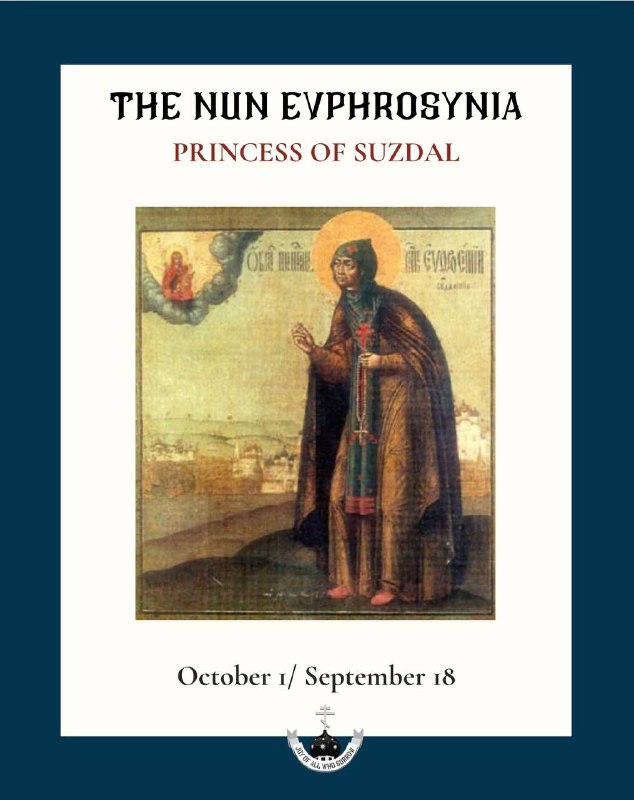
Commemoration of Saint Evphrosynia, Princess of Suzdal’
On September 18, the Orthodox Church honors The Nun Evphrosynia, Princess of Suzdal’, a remarkable 13th-century ascetic, spiritual mother, and visionary leader whose prayers protected her monastery from total destruction.
🕊️ Miracle of Birth and Early Life
• A Child of Prayer: Born in 1212 to the future Holy Martyr Prince Michael of Chernigov, she was named Theodulia at Baptism. Her parents had been childless and were granted a daughter after the Mother of God appeared to them three times.
• Devout Upbringing: She was raised in deep faith, receiving an excellent education under the guidance of the pious noble Theodore.
💒 A Divine Pivot to Monasticism
• Unexpected Loss: Theodulia was betrothed to Holy Prince Theodore, the brother of Saint Alexander Nevsky. However, her groom tragically fell asleep in the Lord on their wedding day in 1233.
• Taking the Veil: Recognizing God's calling, she withdrew to the Suzdal’ Robe-Placing Convent. She was tonsured with the name Evphrosynia and dedicated her youth to intense prayer, fasts, and vigil.
🛡️ Spiritual Leadership and the Miracle of Suzdal’
• Monastic Reform: Becoming Hegumeness (Abbess), Mother Evphrosynia split the monastery into sections for virgins and widows to better nurture their distinct spiritual paths. Her wisdom drew thousands of pilgrims seeking counsel.
• Prophecy and Protection: The Lord granted her visions foretelling both her father's martyrdom and the brutal Mongol-Tatar invasion of Rus'.
• The Intercession: In 1238, the hordes completely burned and devastated the city of Suzdal’. However, through Mother Evphrosynia’s fervent prayers, her monastery was miraculously spared from the destruction.
☦️ Holy Repose and Glorification
Mother Evphrosynia fell asleep in the Lord on September 25, 1250. Centuries later, following countless healings at her grave, her relics were officially glorified on September 18, 1698, by Metropolitan Ilarion of Suzdal' with the blessing of Patriarch Adrian.
Through the prayers of the Holy Nun Evphrosynia, Lord Jesus Christ, have mercy on us!
On September 18, the Orthodox Church honors The Nun Evphrosynia, Princess of Suzdal’, a remarkable 13th-century ascetic, spiritual mother, and visionary leader whose prayers protected her monastery from total destruction.
🕊️ Miracle of Birth and Early Life
• A Child of Prayer: Born in 1212 to the future Holy Martyr Prince Michael of Chernigov, she was named Theodulia at Baptism. Her parents had been childless and were granted a daughter after the Mother of God appeared to them three times.
• Devout Upbringing: She was raised in deep faith, receiving an excellent education under the guidance of the pious noble Theodore.
💒 A Divine Pivot to Monasticism
• Unexpected Loss: Theodulia was betrothed to Holy Prince Theodore, the brother of Saint Alexander Nevsky. However, her groom tragically fell asleep in the Lord on their wedding day in 1233.
• Taking the Veil: Recognizing God's calling, she withdrew to the Suzdal’ Robe-Placing Convent. She was tonsured with the name Evphrosynia and dedicated her youth to intense prayer, fasts, and vigil.
🛡️ Spiritual Leadership and the Miracle of Suzdal’
• Monastic Reform: Becoming Hegumeness (Abbess), Mother Evphrosynia split the monastery into sections for virgins and widows to better nurture their distinct spiritual paths. Her wisdom drew thousands of pilgrims seeking counsel.
• Prophecy and Protection: The Lord granted her visions foretelling both her father's martyrdom and the brutal Mongol-Tatar invasion of Rus'.
• The Intercession: In 1238, the hordes completely burned and devastated the city of Suzdal’. However, through Mother Evphrosynia’s fervent prayers, her monastery was miraculously spared from the destruction.
☦️ Holy Repose and Glorification
Mother Evphrosynia fell asleep in the Lord on September 25, 1250. Centuries later, following countless healings at her grave, her relics were officially glorified on September 18, 1698, by Metropolitan Ilarion of Suzdal' with the blessing of Patriarch Adrian.
Through the prayers of the Holy Nun Evphrosynia, Lord Jesus Christ, have mercy on us!
Post #353
10
Holy Martyrs Socrates and Stephen of England were martyred during the persecution of Emperor Diocletian, from 303 to 311. Together with Saint Alban, protomartyr of Britain (†22 June), Saints Julius and Aaron (†304), protomartyrs of Wales (†1 July), and the One Thousand Martyrs of Lichfield (†2 January), Socrates and Stephen are the only Christians in the British Isles recorded in the Martyrology as having been martyred for their faith.
Post #352
10

Post #351
16
The Witness of Saints Faith, Hope, Love, and Sophia
18th Week after Pentecost. Tone eight.
Fast. By Monastic Charter: Strict Fast (Bread, Vegetables, Fruits)
On September 17 (Old Calendar) / September 30 (New Calendar), the Orthodox Church honors the memory of the holy child-martyrs Saints Vera (Faith), Nadezhda (Hope), and Liubov' (Love), alongside their pious mother, Saint Sophia (Wisdom). Their life and martyrdom stand as one of the most poignant testimonies of early Christian endurance, proving that the grace of the Holy Spirit knows no bounds of age or physical strength.
A Family Rooted in Virtue
Living in Italy during the 2nd-century reign of Emperor Hadrian, Saint Sophia was a devout Christian widow. True to her name, which means "Wisdom," she raised her three young daughters—aged 12, 10, and 9—to personify the greatest theological virtues. They did not hide their devotion to Christ; instead, they openly confessed their faith before a hostile pagan society. This public confession caught the attention of the authorities, and they were forcefully summoned to Rome to stand trial before the Emperor.
Miraculous Composure Amidst Torture
Knowing the fate that awaited them, the holy virgins prayed fervently for the strength to endure. When they stood before Hadrian, the court was astonished by their absolute peace and joy; they appeared as though they were arriving at a festive banquet rather than facing execution.
One by one, the Emperor commanded the young girls to deny Christ and sacrifice to the goddess Artemis. Each refused with unwavering resolve. Hadrian then subjected them to brutal tortures:
• They were stretched over iron grates and thrown into boiling cauldrons.
• The youngest, Liubov', was bound to a wheel and beaten until her body was covered in wounds.
• Through it all, the Unseen Power of God miraculously preserved them from fear and despair, allowing them to glorify their Heavenly Bridegroom until they were finally beheaded.
The Spiritual Triumph of Saint Sophia
The Emperor inflicted a unique, agonizing psychological torment on Saint Sophia, forcing her to watch the violent executions of her own children. Rather than yielding to despair, Sophia showed adamant, Christ-like courage. She stood by them, urging her daughters to endure the temporary pains for the sake of eternal glory.
After their martyrdom, Sophia reverently buried her daughters' bodies on a high hill outside the city. She remained at their graveside in deep, prayerful vigil for three days until she peacefully gave up her soul to the Lord, joining her daughters in the Kingdom of Heaven. Today, their holy relics rest in Alsace, France, where they continue to be a source of grace for the faithful.
Spiritual Reflection for the Faithful
The witness of these holy martyrs reminds us that spiritual maturity is not measured by years, but by the depth of our love for Christ. Saint Sophia did not seek earthly comfort or social status for her daughters; she sought their eternal salvation. In an age where the world constantly pressures us to compromise our faith, this holy family challenges us to cultivate real Faith, unyielding Hope, and sacrificial Love within our own homes.
Through the prayers of the Holy Martyrs Faith, Hope, Love, and Wisdom, O Christ our God, have mercy on us and save us! 🙏✨
18th Week after Pentecost. Tone eight.
Fast. By Monastic Charter: Strict Fast (Bread, Vegetables, Fruits)
On September 17 (Old Calendar) / September 30 (New Calendar), the Orthodox Church honors the memory of the holy child-martyrs Saints Vera (Faith), Nadezhda (Hope), and Liubov' (Love), alongside their pious mother, Saint Sophia (Wisdom). Their life and martyrdom stand as one of the most poignant testimonies of early Christian endurance, proving that the grace of the Holy Spirit knows no bounds of age or physical strength.
A Family Rooted in Virtue
Living in Italy during the 2nd-century reign of Emperor Hadrian, Saint Sophia was a devout Christian widow. True to her name, which means "Wisdom," she raised her three young daughters—aged 12, 10, and 9—to personify the greatest theological virtues. They did not hide their devotion to Christ; instead, they openly confessed their faith before a hostile pagan society. This public confession caught the attention of the authorities, and they were forcefully summoned to Rome to stand trial before the Emperor.
Miraculous Composure Amidst Torture
Knowing the fate that awaited them, the holy virgins prayed fervently for the strength to endure. When they stood before Hadrian, the court was astonished by their absolute peace and joy; they appeared as though they were arriving at a festive banquet rather than facing execution.
One by one, the Emperor commanded the young girls to deny Christ and sacrifice to the goddess Artemis. Each refused with unwavering resolve. Hadrian then subjected them to brutal tortures:
• They were stretched over iron grates and thrown into boiling cauldrons.
• The youngest, Liubov', was bound to a wheel and beaten until her body was covered in wounds.
• Through it all, the Unseen Power of God miraculously preserved them from fear and despair, allowing them to glorify their Heavenly Bridegroom until they were finally beheaded.
The Spiritual Triumph of Saint Sophia
The Emperor inflicted a unique, agonizing psychological torment on Saint Sophia, forcing her to watch the violent executions of her own children. Rather than yielding to despair, Sophia showed adamant, Christ-like courage. She stood by them, urging her daughters to endure the temporary pains for the sake of eternal glory.
After their martyrdom, Sophia reverently buried her daughters' bodies on a high hill outside the city. She remained at their graveside in deep, prayerful vigil for three days until she peacefully gave up her soul to the Lord, joining her daughters in the Kingdom of Heaven. Today, their holy relics rest in Alsace, France, where they continue to be a source of grace for the faithful.
Spiritual Reflection for the Faithful
The witness of these holy martyrs reminds us that spiritual maturity is not measured by years, but by the depth of our love for Christ. Saint Sophia did not seek earthly comfort or social status for her daughters; she sought their eternal salvation. In an age where the world constantly pressures us to compromise our faith, this holy family challenges us to cultivate real Faith, unyielding Hope, and sacrificial Love within our own homes.
Through the prayers of the Holy Martyrs Faith, Hope, Love, and Wisdom, O Christ our God, have mercy on us and save us! 🙏✨
Post #349
12

Post #348
15
The Holy GreatMartyress Euphemia the All-Praiseworthy (Commemorated September 16) is a pillar of steadfast faith and a protector of Orthodoxy who suffered in Chalcedon around the year 304 during the Diocletian persecutions.
18th Week after Pentecost. Tone eight.
• Faithful Witness: Euphemia was arrested alongside 49 Christians who refused to participate in a pagan sacrifice to Ares. Separated by the governor Priscus to break her spirit, she stood completely firm in prayer.
• Miraculous Deliverance: Subjected to horrific tortures—including being bound to a knife-lined wheel and thrown into a red-hot oven—she was repeatedly healed and protected by Angels. Her courage even converted her executioners, Victor and Sosthenes, who won the martyr's crown before her.
• A Peaceful Departure: After surviving fire, traps, and gladiatorial arenas untouched, she prayed to finally be granted a martyr's death. A single she-bear gave her a small wound on the leg, from which she peacefully fell asleep in the Lord.
• Defender of Orthodoxy: Beyond her earthly life, her relics miraculously confirmed the true faith at the Fourth Ecumenical Council (451) by holding the Orthodox decree while trampling the Monophysite document, a miracle celebrated on July 11.
"In your suffering, O Euphemia, you did not waver; you triumphed over the enemy by the power of the Cross."
May her holy prayers be with us all
18th Week after Pentecost. Tone eight.
• Faithful Witness: Euphemia was arrested alongside 49 Christians who refused to participate in a pagan sacrifice to Ares. Separated by the governor Priscus to break her spirit, she stood completely firm in prayer.
• Miraculous Deliverance: Subjected to horrific tortures—including being bound to a knife-lined wheel and thrown into a red-hot oven—she was repeatedly healed and protected by Angels. Her courage even converted her executioners, Victor and Sosthenes, who won the martyr's crown before her.
• A Peaceful Departure: After surviving fire, traps, and gladiatorial arenas untouched, she prayed to finally be granted a martyr's death. A single she-bear gave her a small wound on the leg, from which she peacefully fell asleep in the Lord.
• Defender of Orthodoxy: Beyond her earthly life, her relics miraculously confirmed the true faith at the Fourth Ecumenical Council (451) by holding the Orthodox decree while trampling the Monophysite document, a miracle celebrated on July 11.
"In your suffering, O Euphemia, you did not waver; you triumphed over the enemy by the power of the Cross."
May her holy prayers be with us all
Post #347
11

Post #346
14
THE HOLY GREATMARTYR NIKITA
Commemorated on September 15
18th Week after Pentecost. Tone eight.
The Holy GreatMartyr Nikita was a Goth (a Germanic tribe). He was born and lived on the banks of the Danube River, and suffered for Christ in the year 372. The Christian faith was then already widely spread throughout the territory of the Goths. Saint Nikita believed in Christ and accepted Baptism from the Gothic bishop Theophilus, a participant in the First OEcumenical Council. Pagan Goths began to oppose the spread of Christianity, which resulted in internecine strife. After the victory of Fritigern, – heading a Christian army and inflicting defeat on the pagan Athanarik, the Christian faith began to spread increasingly among the Goths. Bishop Wulfil, the successor to Bishop Theophilus, created a Gothic alphabet and translated into the Gothic language many priestly books. Saint Nikita worked intensely among his fellow Goths at spreading Christianity. By his personal example and inspired words he brought many pagans to the Christian faith. However, Athanarik after his defeat again contrived to gather his own forces, return to his own country and reestablish his former power. Having remained a pagan, he continued to hate Christians and persecute them. Saint Nikita, having undergone many tortures, was thrown into a fire, where he died in the year 372. The friend of Saint Nikita, a Christian named Marianus, by night retrieved the body of the martyr, – unharmed by the fire and illumined by a miraculous light, and gave it over to burial in Cilicia. Afterwards it was transferred to Constantinople. Part of the relics of the GreatMartyr Nikita were later transferred to the monastery of Vysokie Dechany in Serbia.
Holy Saint Nikita pray to God for us 🙏
Commemorated on September 15
18th Week after Pentecost. Tone eight.
The Holy GreatMartyr Nikita was a Goth (a Germanic tribe). He was born and lived on the banks of the Danube River, and suffered for Christ in the year 372. The Christian faith was then already widely spread throughout the territory of the Goths. Saint Nikita believed in Christ and accepted Baptism from the Gothic bishop Theophilus, a participant in the First OEcumenical Council. Pagan Goths began to oppose the spread of Christianity, which resulted in internecine strife. After the victory of Fritigern, – heading a Christian army and inflicting defeat on the pagan Athanarik, the Christian faith began to spread increasingly among the Goths. Bishop Wulfil, the successor to Bishop Theophilus, created a Gothic alphabet and translated into the Gothic language many priestly books. Saint Nikita worked intensely among his fellow Goths at spreading Christianity. By his personal example and inspired words he brought many pagans to the Christian faith. However, Athanarik after his defeat again contrived to gather his own forces, return to his own country and reestablish his former power. Having remained a pagan, he continued to hate Christians and persecute them. Saint Nikita, having undergone many tortures, was thrown into a fire, where he died in the year 372. The friend of Saint Nikita, a Christian named Marianus, by night retrieved the body of the martyr, – unharmed by the fire and illumined by a miraculous light, and gave it over to burial in Cilicia. Afterwards it was transferred to Constantinople. Part of the relics of the GreatMartyr Nikita were later transferred to the monastery of Vysokie Dechany in Serbia.
Holy Saint Nikita pray to God for us 🙏
About this channel
- How can I read @mettinghamorthodox without a Telegram account?
- TGViewer shows the public web preview Telegram publishes for Joy of All Who Sorrow Parish, Mettingham (ROCOR): recent posts, photos, videos and the subscriber count, with no app, login or account.
- How many subscribers does Joy of All Who Sorrow Parish, Mettingham (ROCOR) have?
- Joy of All Who Sorrow Parish, Mettingham (ROCOR) (@mettinghamorthodox) has 36 subscribers on Telegram, refreshed roughly every 30 minutes.
- Does Joy of All Who Sorrow Parish, Mettingham (ROCOR) know I viewed it here?
- No. Public channel previews carry no viewer identity, and TGViewer has no accounts or tracking of what you look up.