TGViewer
Channel Public Channel
LTCM (Long-Term Capital Management)

LTCM (Long-Term Capital Management)

@ltcmx

— equity L/S + event-driven + global macro + relative value
— riding the markets 24/7
— est.1994

any questions: @net_admin_global
Subscribers
36.9K
Photos
1.4K
Videos
687
Links
1.3K
Recent Posts 17 shown
Post #2270 2.1K
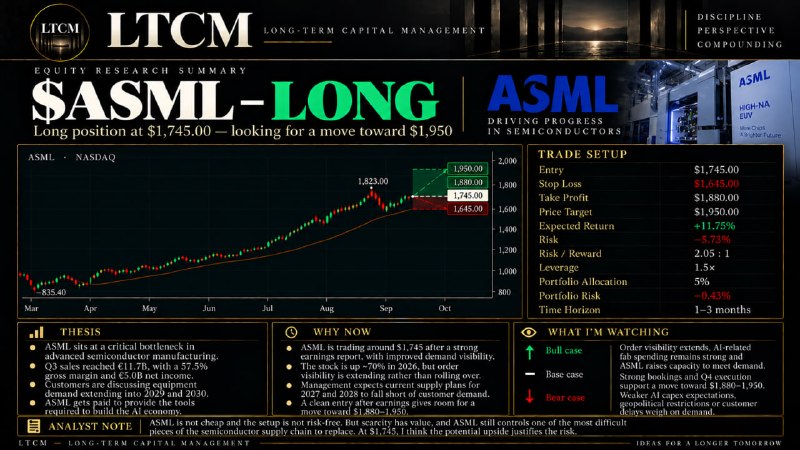
$ASML — #LONG

I’m opening a tactical long position in ASML around $1,745.00.

▪️ Entry: $1,745.00
▪️ Stop Loss: $1,645.00
▪️ Take Profit: $1,880.00
▪️ Price Target: $1,950.00
▪️ Expected Return: +11.75%
▪️ Risk: −5.73%
▪️ Risk / Reward: 2.05 : 1
▪️ Leverage: 1.5×
▪️ Portfolio Allocation: 5%
▪️ Portfolio Risk: −0.43%
▪️ Time Horizon: 1–3 months


THE THESIS

I’m buying ASML here because I think the market is spending too much time debating whether the AI infrastructure cycle is approaching a peak and not enough time looking at what the actual supply chain is saying.
ASML just gave us a fairly clear answer.
Q3 sales reached €11.7 billion, net income came in at roughly €5.0 billion, and gross margin expanded to 57.5%. More importantly, customers are now discussing equipment demand extending into 2029 and even 2030. ASML Investor Relations
That matters more to me than another quarter of strong headline earnings.
ASML sits at one of the hardest bottlenecks in advanced semiconductor manufacturing.
NVIDIA, AMD, Broadcom and the hyperscalers can all disagree on architectures, models and economics.
But the most advanced chips still need leading-edge lithography.
ASML doesn’t need to predict which AI company wins.


WHY NOW

ASML closed yesterday at $1,717.76 and is trading around $1,744 pre-market after the earnings release. MarketBeat
Normally, I don’t love buying a stock after a strong report when it has already had a major year.
ASML is up roughly 70% in 2026. Reuters
But the important part of this report is that demand visibility improved again rather than rolling over.
Management now expects current supply plans for both 2027 and 2028 to fall short of customer demand, and is considering additional capacity expansion. ASML Investor Relations
That changes the setup.
My first take-profit level is $1,880.
The broader target is $1,950.
I don’t need another valuation expansion cycle.
I need the market to keep recognizing that ASML’s order visibility is becoming longer, not shorter.


RISK MANAGEMENT

My invalidation level is $1,645.
The biggest risk here is obvious.
The stock has already had an exceptional run, and the entire semiconductor complex is becoming increasingly sensitive to questions around AI returns, competition and capital spending.
We are already seeing that pressure elsewhere in the sector. Semiconductor stocks have been selling off as investors question both the durability of AI spending and growing competition from China. MarketWatch
If ASML loses the post-earnings structure and trades back through $1,645, I don’t want to explain the decline away because the long-term story still looks good.
I would rather take the controlled loss and reassess.


WHAT I’M WATCHING

▪️ Bull case: Customer order visibility continues extending, AI-related fab spending remains strong and ASML raises capacity to meet demand that currently exceeds planned supply.
▪️ Base case: Strong bookings and Q4 execution support a gradual move toward $1,880–1,950 as investors become more comfortable with the duration of the AI infrastructure cycle.
▪️ Bear case: AI capex expectations weaken, geopolitical restrictions intensify or customers begin delaying advanced-node capacity expansion.


MY NOTE

ASML is one of the few AI trades where I don’t need to have an opinion on which model wins.
I don’t need to know whether NVIDIA keeps its current share.
I don’t need to know which hyperscaler builds the best AI product.
I don’t even need every AI investment being made today to generate a great return.
What I need is continued demand for leading-edge compute.
And right now, ASML’s customers are discussing machines they may need four years from now.
That is a very different signal from a market narrative built around the next quarter.
The stock is not cheap.
The setup is not risk-free.
But scarcity has value.
And ASML still controls one of the most difficult pieces of the semiconductor supply chain to replace.


▪️ Position: LONG ASML
▪️ $1,745.00 → $1,950.00
▪️ Expected return: +11.75%
Post #2269 2.5K
$AMZN — #LONG

I’m opening a long position in Amazon around $257.00.

▪️ Entry: $257.00
▪️ Stop Loss: $244.00
▪️ Take Profit: $285.00
▪️ Price Target: $300.00
▪️ Expected Return: +16.73%
▪️ Risk: −5.06%
▪️ Risk / Reward: 3.31 : 1
▪️ Leverage: 1.5×
▪️ Portfolio Allocation: 5%
▪️ Portfolio Risk: −0.38%
▪️ Time Horizon: 1–3 months


THE THESIS

I’m buying Amazon here because I think the market is still separating the retail business from the part of Amazon that matters more to the valuation.
AWS.
The AI infrastructure cycle is getting more expensive, more capital intensive and more competitive.
That creates risk.
It also creates an enormous opportunity for the companies that already own the distribution, data centers and enterprise relationships required to deploy that compute.
Amazon is one of them.
AWS has already invested hundreds of billions of dollars into infrastructure, and the company continues expanding capacity as AI demand grows. Amazon also remains deeply connected to Anthropic through cloud infrastructure and distribution. Reuters
I don’t need Amazon to become the dominant AI company for this trade to work.
I need AWS to remain one of the places where the AI economy gets built.


WHY NOW

AMZN closed the latest session at $262.43, while pre-market trading is around $256–257.
That gives me a cleaner entry after the stock’s recent strength rather than forcing me to chase the move above $260. Investing.com
The stock’s 52-week high is around $287, which is also why my first take-profit level sits near $285. Investing.com
The broader target is $300.
Amazon reports earnings on October 29.
That gives the position a clear catalyst and enough time for the market to reassess both AWS growth and the economics behind the current AI infrastructure buildout. Investing.com
I don’t need a perfect quarter.
I need AWS demand to remain durable and margins across the broader business to stay strong enough to support continued investment.


RISK MANAGEMENT

My invalidation level is $244.
Below that area, the current setup begins to lose the structure that makes the entry attractive.
The biggest risk here is not that Amazon suddenly stops being relevant.
It is that the market begins questioning whether the enormous amount of capital flowing into AI infrastructure can generate adequate returns.
That debate is already becoming louder across the industry. Reuters
If Amazon loses the setup while that narrative is getting worse, I don’t want to sit around waiting for the thesis to rescue the position.
I would rather take the predefined loss and reassess.


WHAT I’M WATCHING

▪️ Bull case: AWS growth accelerates, AI workloads continue expanding and earnings reinforce the view that Amazon can monetize infrastructure investment at scale.
▪️ Base case: AWS remains durable, retail margins stay healthy and the stock moves back through $285 toward $300.
▪️ Bear case: AI infrastructure spending begins to look less economical, AWS growth disappoints or rising rates compress valuations across large-cap technology.


MY NOTE

Amazon is interesting because the market still talks about it as several different companies.
Retail.
Advertising.
Logistics.
Cloud.
AI.
I think that complexity is part of the opportunity.
The retail business gives Amazon scale.
Advertising gives it margin.
AWS gives it infrastructure.
And AI gives AWS another reason for customers to spend more.
I’m not betting that every dollar Amazon spends on AI produces an immediate return.
That would be unrealistic.
I’m betting that very few companies are better positioned to monetize the infrastructure cycle if demand remains strong.
At $257, I think the upside is large enough to justify taking that risk.


▪️ Position: LONG AMZN
▪️ $257.00 → $300.00
▪️ Expected return: +16.73%
  • 💯 191
  • ❤ 171
  • 🎉 171
  • 🏆 165
Post #2268 2.54K
$TSLA — #SHORT

I’m opening a tactical short position in Tesla around $372.50.

▪️ Entry: $372.50
▪️ Stop Loss: $395.00
▪️ Take Profit: $345.00
▪️ Price Target: $325.00
▪️ Expected Return: +12.75%
▪️ Risk: −6.04%
▪️ Risk / Reward: 2.11 : 1
▪️ Leverage: 1.5×
▪️ Portfolio Allocation: 5%
▪️ Portfolio Risk: −0.45%
▪️ Time Horizon: 2–6 weeks


THE THESIS

I’m taking a tactical short in Tesla here because I think the market is still pricing the company primarily around what the next business could become rather than what the current business is earning.
That distinction matters.
Tesla’s Q3 deliveries came in ahead of expectations at 486,532 vehicles, but they were still slightly below the same quarter last year. At the same time, the company is pushing aggressively into robotaxis, AI infrastructure and humanoid robotics. MarketWatch
I’m not arguing that those opportunities are fake.
I’m arguing that they are expensive.
Tesla expects to spend more than $25 billion in capex in 2026, while the core auto business still has to generate enough cash to support that buildout. MarketWatch
That creates a setup where execution has to remain unusually strong.
At roughly $372, I think the market is still giving Tesla a large amount of credit for businesses whose economics are not fully proven yet.


WHY NOW

TSLA closed yesterday around $377.81 and is trading near $372–373 today after failing to hold the recent move above $380. Investing.com
That is the part of the setup I care about.
The stock rallied after stronger-than-expected Q3 deliveries.
The good news is already known.
Now the market has to decide whether those deliveries are enough to justify the valuation while spending continues to rise.
Tesla reports earnings on October 21. That gives the trade a clear catalyst and a relatively short time horizon. MarketWatch
My first take-profit level is $345.
The broader target is $325.
I’m not looking for a collapse.
I’m looking for expectations to reset.


RISK MANAGEMENT

My invalidation level is $395.
If Tesla recovers that area and holds above it, I don’t want to keep fighting the momentum.
This is particularly important with TSLA.
The stock can move much further than fundamentals alone would suggest, in both directions.
That is why I’m keeping the position relatively small and the leverage limited.
I will not average into the short above the stop.
If the market tells me the setup is wrong, I’m out.


WHAT I’M WATCHING

▪️ Bull case: Strong earnings, improving margins and clearer progress in robotaxis or Optimus push the stock back through $395.
▪️ Base case: Strong deliveries fail to translate into enough earnings leverage, and the stock retraces toward $345–325.
▪️ Bear case: Higher capex, weaker free cash flow or slower AI monetization forces the market to reassess how much of Tesla’s future is already priced in.


MY NOTE

Tesla is probably one of the clearest examples of why I separate a company from a trade.
I can believe autonomous driving will become enormous.
I can believe robotics will become enormous.
I can believe Tesla has a real chance to participate in both.
None of that tells me what the stock should be worth today.
The market is asking Tesla to fund the present while simultaneously pricing the future.
That can work.
But it leaves very little room for execution to become merely “good.”
I don’t need the long-term Tesla story to fail.
I only need the market to demand more evidence before paying for the next chapter.
At this price, I think that is a trade worth taking.


▪️ Position: SHORT TSLA
▪️ $372.50 → $325.00
▪️ Expected return: +12.75%
  • ❤ 213
  • 🎉 210
  • 💯 192
  • 🏆 186
Post #2267 2.7K
$MSFT — #LONG

I’m opening a long position in Microsoft around $526.00.

▪️ Entry: $526.00
▪️ Stop Loss: $498.00
▪️ Take Profit: $575.00
▪️ Price Target: $600.00
▪️ Expected Return: +14.07%
▪️ Risk: −5.32%
▪️ Risk / Reward: 2.64 : 1
▪️ Leverage: 1.5×
▪️ Portfolio Allocation: 5%
▪️ Portfolio Risk: −0.40%
▪️ Time Horizon: 2–4 months


THE THESIS

I’m buying Microsoft here because I think the market is starting to differentiate between companies that simply spend on AI and companies that already have the distribution to monetize it.
Microsoft is firmly in the second group.
Azure gives the company the infrastructure layer.
Microsoft 365 gives it enterprise distribution.
Copilot gives it a direct path to increasing revenue per user without needing to build an entirely new customer base.
That combination matters.
The market has spent a lot of time debating whether AI capex is becoming excessive.
I think Microsoft is one of the companies where that spending has a clearer path toward recurring enterprise revenue.
I don’t need AI spending to accelerate indefinitely for this trade to work.
I need Microsoft to keep proving that the infrastructure it built can be monetized across an ecosystem customers already use.


WHY NOW

MSFT closed the latest session at $525.18, up 1.48%, after trading as high as $532.35. The stock has gained roughly 36% over the last three months, but it is still below its 52-week high near $554. MarketBeat
Normally, I don’t like buying after a move like that.
What makes this different is that the stock is beginning to break out while the fundamental catalysts are still in front of us.
Microsoft has its fiscal Q1 update later this month, followed by Ignite in November.
At the same time, Melius just upgraded the stock to Buy and raised its target to $665, arguing that Microsoft’s enterprise position and AI governance advantage are becoming more valuable as companies deploy AI at scale. Investor's Business Daily
My first take-profit level is $575.
The broader target is $600.
I don’t need the most bullish Wall Street scenario to play out.
I only need the current re-rating to continue.


RISK MANAGEMENT

My invalidation level is $498.
That area matters because it sits around the zone where the stock traded before the latest breakout.
If Microsoft falls back through it and fails to recover, I would rather assume the breakout failed than keep defending the position.
The stock has already had a strong quarter.
That makes discipline more important, not less.
I’m not interested in averaging down simply because Microsoft is a high-quality business.
Quality and entry price are two different things.


WHAT I’M WATCHING

▪️ Bull case: Azure growth remains strong, Copilot monetization improves and earnings reinforce the view that Microsoft can translate AI investment into higher recurring revenue.
▪️ Base case: Enterprise AI adoption continues gradually and the stock re-rates toward the $575–600 range.
▪️ Bear case: AI capex remains elevated while monetization disappoints, enterprise spending slows or the stock loses the recent breakout structure.


MY NOTE

Microsoft is probably one of the least exciting AI trades on the board.
I mean that as a compliment.
It doesn’t need to invent a new consumer behavior.
It already owns the workflow.
It already owns the enterprise relationship.
It already owns a large part of the infrastructure.
The question is simply how much more revenue AI can generate inside that existing system.
That is a much cleaner question than trying to predict which new AI product becomes dominant.
Microsoft has already had a strong run.
I’m aware of that.
But momentum alone is not a reason to avoid a position if the earnings power is still moving in the same direction.
At this price, I think there is still enough room between the entry and the fundamental upside to justify taking the trade.


▪️ Position: LONG MSFT
▪️ $526.00 → $600.00
▪️ Expected return: +14.07%
  • 💯 161
  • 🎉 157
  • ❤ 152
  • 🏆 129
Post #2266 2.83K
$AVGO — #LONG

I’m opening a long position in Broadcom around $347.00.

▪️ Entry: $347.00
▪️ Stop Loss: $328.00
▪️ Take Profit: $385.00
▪️ Price Target: $405.00
▪️ Expected Return: +16.71%
▪️ Risk: −5.48%
▪️ Risk / Reward: 3.05 : 1
▪️ Leverage: 1.5×
▪️ Portfolio Allocation: 5%
▪️ Portfolio Risk: −0.41%
▪️ Time Horizon: 2–4 months


THE THESIS

I’m buying Broadcom here because I think the market is starting to focus more on the structure around the AI buildout than on the demand itself.
That distinction matters.
Broadcom’s AI semiconductor revenue grew 221% year-over-year in Q3, driven by strong demand for custom AI accelerators and networking, and the company expects that momentum to continue into Q4. Broadcom Inc.
That is the part of the story I care about.
The recent debate around AI financing, customer concentration and the scale of infrastructure commitments is real.
But I don’t think those concerns automatically invalidate the underlying demand.
Broadcom is increasingly becoming one of the companies sitting directly underneath the AI infrastructure cycle rather than simply trading around the narrative.
At roughly $347, I think the risk/reward is becoming attractive again.


WHY NOW

AVGO closed at $343.64 on October 1 after falling 2.15% and is trading around $347 overnight. The stock is also still more than 30% below its 52-week high of $495. MarketWatch
I like that setup.
I’m not buying after a vertical move.
I’m buying after the market has had time to question the story.
My first take-profit level is $385.
The broader target is $405.
I don’t need Broadcom to return to its previous highs for the trade to work.
I only need the market to become more comfortable with the idea that AI demand remains strong even if the financing structure around that demand becomes more complicated.


RISK MANAGEMENT

My invalidation level is $328.
Below that level, I think the current setup begins to lose the asymmetry that makes the entry interesting.
The biggest risk is not that Broadcom suddenly stops being relevant to AI.
The bigger risk is that the market starts assigning a much larger discount to customer concentration, financing exposure or the durability of AI infrastructure spending.
If that starts happening, I don’t want to defend the thesis indefinitely.
I would rather exit, reassess and come back later.


WHAT I’M WATCHING

▪️ Bull case: AI accelerator and networking demand remains strong, Q4 execution stays ahead of expectations and financing concerns fade.
▪️ Base case: Growth remains strong enough for the stock to recover toward $385–405 as sentiment normalizes.
▪️ Bear case: Customer concentration, financing risk or weaker AI capex expectations cause the market to compress the multiple further.


MY NOTE

Broadcom is interesting because it doesn’t need to win the AI narrative.
It needs to remain embedded in the infrastructure.
That is a much simpler thesis.
The latest Anthropic financing arrangement is a good example of both sides of the story: Broadcom is becoming more important to the AI buildout, but that importance also creates new financial and concentration risks. Reuters
I’m comfortable with that.
I don’t need the setup to be perfect.
I need the upside to justify the risk.
At this price, I think it does.


▪️ Position: LONG AVGO
▪️ $347.00 → $405.00
▪️ Expected return: +16.71%
  • 🎉 133
  • 🏆 124
  • 💯 121
  • ❤ 117
  • 🔥 1
Post #2264 564
STOCKS ARE GETTING INTERESTING AGAIN

Crypto has been the default playground for retail traders for years.

At this point, almost every “opportunity” starts to look the same. Another token. Another narrative. Another chart promising 10×. I’m much more interested in equities right now. Not because stocks are easier. They aren’t.

But because the market is giving us cleaner setups, clearer catalysts and, in many cases, much more understandable risk.

That matters. You don’t need to trade everything. You need to know what you’re looking for, where you’re entering and where the idea stops working.

That’s why I’ve been watching Hedge Capital.

They publish stock setups and trading signals regularly, with the focus on actual entries rather than endless market commentary.

The part I like is simple:
▪️Specific idea
▪️Clear direction
▪️Defined entry
▪️Defined risk
▪️Defined target


No trade is guaranteed. And a signal is useless if you don’t know how much you’re willing to lose before entering.

But if you’re looking for another source of equity ideas to compare against your own view, Hedge Capital is worth adding to the watchlist.

Crypto isn’t going anywhere. I just think equities are becoming much harder to ignore.
Post #2263 2.74K
$NVDA — #LONG

I’m opening a long position in NVIDIA at $184.94.

▪️ Entry: $184.94
▪️ Stop Loss: $169.00
▪️ Take Profit: $220.00
▪️ Price Target: $220.00
▪️ Expected Return: +18.96%
▪️ Risk: −8.62%
▪️ Risk / Reward: 2.20 : 1
▪️ Leverage: 2×
▪️ Portfolio Allocation: 10%
▪️ Portfolio Risk: −1.72%
▪️ Time Horizon: 6–9 months


THE THESIS

I’m bullish on NVIDIA here, but this is not simply a bet that “AI will keep growing.”
Everyone already knows NVIDIA is the dominant supplier of AI accelerators.
That is not the edge.
The more important question is whether hyperscalers and enterprises are willing to keep spending at a level high enough to sustain the infrastructure cycle.
My view is that we are still relatively early.
AI workloads are becoming larger, more complex and more expensive to run. That creates a strong incentive to keep investing in faster and more efficient compute.
NVIDIA remains one of the clearest ways to express that view.
At $184.94, I think the market is giving me enough upside to justify taking defined risk.


WHY NOW

I don’t want to chase NVIDIA after a vertical momentum move.
I’d rather build exposure while the market is still debating how durable AI infrastructure spending really is.
My target is $220, representing roughly 19% upside from the entry.
I don’t need another perfect quarter for this trade to work.
I need demand to remain durable and the market to keep recognizing that NVIDIA’s competitive position is still difficult to replicate.


RISK MANAGEMENT

My invalidation level is $169.
Below that level, the setup becomes materially less attractive to me.
I’m not interested in turning a trade into a long-term investment simply because the price moves against me.
If the thesis breaks, I would rather take the controlled loss and reassess.
A strong company does not automatically mean every entry is a good one.


WHAT I’M WATCHING

▪️ Bull case: Continued hyperscaler capex, strong accelerator demand and positive forward guidance.
▪️ Base case: AI spending stays elevated and NVIDIA continues compounding revenue faster than the broader semiconductor sector.
▪️ Bear case: Hyperscalers reduce capex, competition increases faster than expected or AI infrastructure spending begins to slow.


MY NOTE

NVIDIA is one of those stocks where investors are constantly trying to identify the exact moment when the story stops working.
Eventually, that moment will come.
I just don’t think we are there yet.
Everyone knows the AI story.
Everyone knows NVIDIA is dominant.
The edge is not knowing the story.
The edge is deciding when the price gives you enough room for the story to be wrong.
At $184.94, I think there is enough room.


▪️ Position: LONG NVDA
▪️ $184.94 → $220.00
▪️ Expected return: +18.96%
  • ❤ 1
Post #2262 2.64K
$META — #SHORT

I’m looking to open a tactical short position in Meta around $750.00.

▪️ Entry: $750.00
▪️ Stop Loss: $782.00
▪️ Take Profit: $710.00
▪️ Price Target: $690.00
▪️ Expected Return: +8.00%
▪️ Risk: −4.27%
▪️ Risk / Reward: 1.88 : 1
▪️ Leverage: 1.5×
▪️ Portfolio Allocation: 5%
▪️ Portfolio Risk: −0.32%
▪️ Time Horizon: 2–6 weeks


THE THESIS

I’m taking a tactical short in Meta after one of the strongest repricings the stock has seen this year.
This is not a bearish call on Meta as a business.
The AI story has improved materially. Muse has given the market something it has been waiting for: visible evidence that Meta may be able to turn its AI spending into a consumer product with real distribution and, eventually, real monetization. Reuters
I agree with that part of the story.
What I’m less comfortable with is how quickly the market has priced it in.
META went from roughly $613 earlier this month to almost $780 at the recent high. That is an enormous change in valuation for a thesis that is still in the early stages of proving itself. Investing.com 日本
I don’t need Muse to fail for this trade to work.
I only need expectations to cool faster than the fundamentals improve.


WHY NOW

META reached $779.82 on September 24 and then closed the next session at $751.66, down 3.33%.
That matters to me.
After a vertical move, the first failed attempt to hold new highs is usually more interesting than the move itself.
I’m not trying to short the exact top.
I’m looking for a normalization toward $710 first, with a broader target at $690.
Even at $690, the stock would still be well above where it traded before the latest AI-driven repricing.
That is why I don’t need a fundamental breakdown.
I just need some of the enthusiasm to come out of the price.


RISK MANAGEMENT

My invalidation level is $782.
That sits just above the recent high.
If META breaks back through that area and holds it, the market is telling me that momentum is still stronger than the mean-reversion setup I’m trading.
I would rather take a small predefined loss than keep increasing a short against a stock making new highs.
I will not average into this position above the stop.
The position is deliberately smaller because shorting momentum is not the place to be aggressive.


MY NOTE

Meta is probably one of the better examples of why I separate a company from its stock.
I like the business.
I like the distribution.
I like the fact that Meta finally has a clearer answer to the question of how its AI infrastructure spending might become a product.
None of that means I have to like the stock after a 25–30% monthly move.
The market has gone from questioning Meta’s AI spending to aggressively pricing in its success in a matter of weeks.
That transition may ultimately be correct.
I just think the price got there faster than the evidence did.
I’m not betting against Meta.
I’m betting against the idea that every good story deserves to be bought at any price.


▪️ Position: SHORT META
▪️ $750.00 → $690.00
▪️ Expected return: +8.00%
Post #2261 2.98K
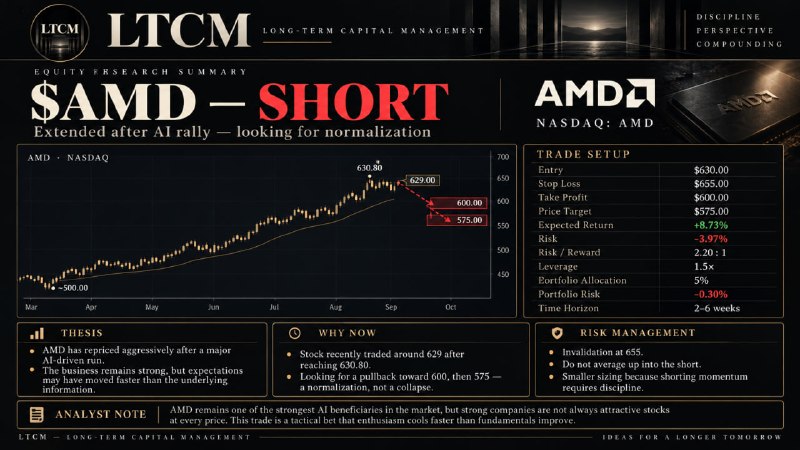
$AMD — #SHORT

I’m opening a tactical short position in AMD around $630.00.

▪️ Entry: $630.00
▪️ Stop Loss: $655.00
▪️ Take Profit: $600.00
▪️ Price Target: $575.00
▪️ Expected Return: +8.73%
▪️ Risk: −3.97%
▪️ Risk / Reward: 2.20 : 1
▪️ Leverage: 1.5×
▪️ Portfolio Allocation: 5%
▪️ Portfolio Risk: −0.30%
▪️ Time Horizon: 2–6 weeks


THE THESIS

I’m taking a tactical short in AMD here after one of the strongest momentum runs in the market.
This is not a bearish call on AMD as a business.
The company remains one of the clearest beneficiaries of the AI infrastructure cycle, and the market is increasingly recognizing its position across CPUs, accelerators and full-system compute.
That is exactly why I think the setup is becoming interesting from the other side.
AMD has moved from roughly $500 to above $630 in less than two weeks. The stock is now trading near fresh highs after an extremely aggressive repricing.
At this point, I think expectations have moved faster than the underlying information.
I don’t need the AI thesis to break for this trade to work.
I only need the market to stop pricing every incremental piece of good news as another reason to expand the multiple.


WHY NOW

AMD closed yesterday at roughly $629, after trading as high as $630.80.
Momentum can obviously continue.
But this is the type of move where I become more interested in the asymmetry of a pullback than in chasing the final part of the rally.
My first take-profit level is $600.
The broader target is $575, which would still leave AMD well above where it traded only a few sessions ago.
I’m not calling for a collapse.
I’m looking for a normalization.


RISK MANAGEMENT

My invalidation level is $655.
If AMD continues breaking higher through that level, I don’t want to fight the momentum.
Shorting a strong company at an all-time high is one of the easiest ways to be fundamentally right and still lose money.
That’s why the position is smaller, leverage is limited and the stop is defined before the trade begins.
I will not average into this short above the invalidation level.


MY NOTE

I still like AMD.
That doesn’t mean I have to like AMD at every price.
The market has spent most of this year discovering reasons to pay more for the same story.
AI demand is real. Server demand is real. AMD’s competitive position is improving.
None of that automatically means the stock should move vertically without interruption.
The interesting part here is that I don’t need the market to change its mind about AMD.
I only need enthusiasm to cool.
Sometimes the cleanest short isn’t a broken company.
It’s a great company after the market has temporarily forgotten that price still matters.


▪️ Position: SHORT AMD
▪️ $630.00 → $575.00
▪️ Expected return: +8.73%
  • 🤩 5
  • ❤ 4
  • 🎉 4
  • 😁 3
  • 🔥 2
  • 👍 1
Post #2260 2.99K
$GOOGL — #LONG

I’m opening a long position in Alphabet around $352.00.

▪️Entry: $352.00
▪️Stop Loss: $334.00
▪️Take Profit: $385.00
▪️Price Target: $400.00
▪️Expected Return: +13.64%
▪️Risk: −5.11%
▪️Risk / Reward: 2.67 : 1
▪️Leverage: 1.5×
▪️Portfolio Allocation: 6%
▪️Portfolio Risk: −0.46%
▪️Time Horizon: 3–6 months


THE THESIS

I’m taking a long position in Alphabet here because I think the market is still treating AI as a potential threat to Google when it is increasingly becoming another layer of distribution for the business.
The obvious risk is search disruption.
Everyone knows that.
What interests me more is whether Alphabet can use its existing distribution, infrastructure and data advantage to turn that disruption into another monetization surface.
I think it can.
Google doesn't need the economics of search to remain completely unchanged for this trade to work. It needs the market to become more comfortable with the idea that AI changes the product without destroying the underlying business.
At roughly $352, I think there is still enough room between the current price and the upper end of the recent range to justify taking the risk.


WHY NOW

Alphabet has been moving higher, but I don't think the setup requires me to chase a vertical move.
The stock closed around $355 yesterday and is indicating slightly lower in pre-market trading today, giving me a cleaner entry rather than buying directly into strength.
My first take-profit level is $385.
The broader target is $400, which still sits below the stock's recent 52-week high around $409.
I don't need a breakout to new highs immediately.
I need the current trend to remain intact while the market continues getting more comfortable with Alphabet's AI economics.


RISK MANAGEMENT

My invalidation level is $334.
Below that area, the trade begins to lose the structure that makes the current entry attractive.
I’m not interested in averaging down simply because Alphabet is a high-quality company.
Quality does not remove price risk.
If the market gives me evidence that the setup has changed, I would rather take a controlled loss and reassess from outside the position.


MY NOTE

I think Alphabet is one of the more interesting AI trades precisely because the market still argues about whether AI helps or hurts the company.
That disagreement creates the opportunity.
If everyone already agreed that Google was one of the clear winners, I would probably be paying a very different price.
I don't need every concern around search to disappear.
I need Alphabet to prove that its distribution is more durable than the disruption narrative suggests.
At this price, I think that is a bet worth taking.


▪️Position: LONG GOOGL
▪️$352.00 → $400.00
▪️Expected return: +13.64%
  • ❤ 8
  • 👍 4
  • 😁 2
  • 🎉 2
  • 🤩 2
  • 🔥 1
Post #2255 2.53K
RESULTS — JANUARY TO SEPTEMBER

Eleven positions closed. Eleven closed in profit.

Before anyone gets excited, the honest breakdown: seven hit the full published target. Four I closed early - in profit - when the setup stopped working. Small wins instead of stop-outs. That's not a footnote. That's the system.

The numbers:
▪️11 trades — 11 profitable
6 longs / 5 shorts
▪️+11.5% total portfolio return
▪️+9.1% average move per trade
▪️Average risk per trade: ~1% of the portfolio
▪️Average holding period: 3 weeks
▪️Best trade: ROKU, +42% move, +63% on the position


I don't think every position needs to be a 30–40% winner.

A portfolio is built from different types of opportunities.

WHAT MATTERS MORE THAN THE WIN RATE

The interesting part isn't simply that every target was reached.

It's the fact that every position had a defined:
▪️Entry.
▪️Stop.
▪️Target.
▪️Position size.
▪️Time horizon.


Every entry was published here in real time - entry, stop, target, size - before the move, not after. Scroll up and check.

What made this work was not prediction. Half of these positions were uncomfortable at some point. The AMD long was cut for +2% just before the stock broke down, and the AMD short opened into that same crash paid +29%. I'd rather book a small gain than defend a thesis into a stop.

Sizing did the rest. No single trade risked more than ~1.7% of the portfolio. When a loss can only cost you 1%, you never have to be a hero.

One warning, mostly to myself: 11-for-11 is discipline plus variance being generous. It will not last forever. At some point a stop will trigger, it will cost about 1%, and nothing about the process will change.

Position: unchanged.
Process: unchanged.

The next setups will be judged by exactly the same rules.

▪️Define the risk.
▪️Take the asymmetric trade.
▪️Know when to get out.
  • ❤ 15
  • ❤‍🔥 2
  • 🔥 2
  • 💩 2
  • ⚡ 1
  • 🤝 1
  • 🎄 1
Post #2252 7.46K
$ORCL — #SHORT

I’m opening another tactical short position in Oracle at $150.28.
▪️Entry: $150.28
▪️Stop Loss: $158.00
▪️Take Profit: $145.00
▪️Price Target: $145.00
▪️Expected Return: +3.65%
▪️Risk: −5.13%
▪️Risk / Reward: 0.71 : 1
▪️Leverage: 2×
▪️Portfolio Allocation: 4%
▪️Portfolio Risk: −0.41%
▪️Time Horizon: 1–2 weeks


THE THESIS
I'm staying short Oracle.

The first part of the trade has already played out, with ORCL moving materially lower from the levels where I originally became bearish.

But I'm not holding the same position indefinitely just because the first thesis worked.

This is a new tactical setup.

At $150.28, I think the stock still has room to retrace toward $145 as investors reassess the pace at which Oracle's AI infrastructure ambitions can translate into sustainable financial results.


WHY NOW
The important question at this point is no longer whether Oracle has an AI opportunity.

It clearly does.

The question is whether the current valuation can continue to absorb the enormous expectations attached to that opportunity.

After the initial decline, I think there is still potential for another leg lower before the market establishes a more convincing floor.

My target is deliberately conservative: $145.

I'm not expecting a collapse.


RISK MANAGEMENT
The stop is $158.

If ORCL recovers that level, I will close the trade.
I don't want to turn a short-term tactical position into a permanent bearish thesis.

This is a trade with a defined target and defined invalidation.


WHAT I’M WATCHING
▪️Bull case: Strong AI demand and renewed institutional buying push ORCL back above $158.
▪️Base case: Continued profit-taking takes the stock toward $145.
▪️Bear case: Broader weakness in high-growth technology stocks creates a much deeper decline.


MY NOTE
There is something I like about trading a stock after the market has already started questioning the narrative.

You don't need everyone to become bearish.

You just need the marginal buyer to become less aggressive.

That's what I'm watching here.

Oracle remains a company with significant long-term potential. My position doesn't require me to disagree with that.

I'm simply saying that great long-term stories can still experience very normal periods of multiple compression.

For this trade, $145 is where I want to take the money off the table.


▪️Position: SHORT ORCL
▪️$150.28 → $145.00
▪️Expected return: +3.65%
  • 🔥 8
  • 🎉 7
  • 🤩 6
  • ❤ 5
  • 😁 5
  • 👍 4
Post #2251 7.1K
$ORCL — #SHORT

I’m opening a short position in Oracle at $158.78.
▪️Entry: $158.78
▪️Stop Loss: $168.00
▪️Take Profit: $150.00
▪️Price Target: $150.00
▪️Expected Return: +5.53%
▪️Risk: −5.81%
▪️Risk / Reward: 0.95 : 1
▪️Leverage: 2×
▪️Portfolio Allocation: 5%
▪️Portfolio Risk: −0.58%
▪️Time Horizon: 1–4 weeks


THE THESIS
I'm short Oracle here because I think the market is getting increasingly aggressive in pricing the company's AI and cloud opportunity.

Oracle is clearly benefiting from the AI infrastructure cycle.

The question is not whether demand exists.

The question is how much of that future growth is already reflected in the stock price.

After a major repricing, even strong fundamentals can become insufficient to support the current multiple.

I'm looking for a valuation and sentiment reset rather than a deterioration of Oracle's underlying business.


WHY NOW
At $158.78, I think the stock has relatively little room for disappointment.

My target is $150, which is only a modest retracement.
The trade therefore doesn't require a disastrous earnings report or an AI spending collapse.

A simple shift from extreme optimism toward more balanced expectations could be enough.


RISK MANAGEMENT
My stop is $168.

If Oracle breaks above that level, the market is telling me that the bullish momentum is stronger than I anticipated.
I will not average into the short.

The position is deliberately sized at 5% of the portfolio because this is an expectations trade, not a conviction that Oracle's business is fundamentally broken.


WHAT I’M WATCHING
▪️Bull case: Continued AI infrastructure enthusiasm and accelerating cloud expectations push ORCL through $168.
▪️Base case: Sentiment cools and the stock retraces toward $150.
▪️Bear case: A broader tech selloff causes the stock to overshoot the target to the downside.


MY NOTE
Oracle is a good example of why I separate company quality from stock price.

I can believe Oracle will become a much larger AI infrastructure business and still think the stock needs to breathe after a major move.

That's the position I'm taking here.

I'm not betting against Oracle's future.

I'm betting that the market has moved faster than the fundamentals.

Sometimes the best short isn't a bad company.

It's a good company where expectations have temporarily become too good.


▪️Position: SHORT ORCL
▪️$158.78 → $150.00
▪️Expected return: +5.53%
  • 👍 11
  • 🔥 11
  • 😁 11
  • 🎉 10
  • ❤ 8
  • 🤩 5
Post #2250 7.08K
$AMD — #SHORT

I’m opening a tactical short position in AMD at $465.58.
▪️Entry: $465.58
▪️Stop Loss: $480.00
▪️Take Profit: $450.00
▪️Price Target: $450.00
▪️Expected Return: +3.35%
▪️Risk: −3.10%
▪️Risk / Reward: 1.08 : 1
▪️Leverage: 2×
▪️Portfolio Allocation: 4%
▪️Portfolio Risk: −0.62%
▪️Time Horizon: 1–3 weeks


THE THESIS
I'm taking a short-term short position in AMD after an exceptionally strong run.

This isn't a bearish call on AMD's long-term business.
The opposite is true: AMD remains one of the most interesting semiconductor companies in the market.
The trade is about price versus expectations.

At $465.58, the stock has already priced in a significant amount of optimism. When momentum becomes this strong, the risk/reward can temporarily shift even if the underlying fundamentals remain attractive.

I'm looking for a relatively small retracement rather than a fundamental breakdown.


WHY NOW
The setup is deliberately tactical.

I'm not looking for AMD to collapse. I only need a move back toward $450 to close the trade.

That gives me approximately 3.35% downside in the stock with a defined stop at $480.

The position is small because I'm fully aware of the risk of shorting a high-momentum semiconductor stock.


RISK MANAGEMENT
The stop is $480.

If AMD continues accelerating through that level, I don't want to fight the momentum.

This is particularly important with semiconductor names: once a stock enters a strong momentum regime, trying to pick the exact top can become an expensive exercise.
The trade is therefore strictly tactical.


WHAT I’M WATCHING
▪️Bull case: AMD continues its momentum and breaks higher through $480.
▪️Base case: Short-term profit-taking pushes the stock toward $450.
▪️Bear case: A broader semiconductor selloff accelerates the decline below my target.


MY NOTE
This is one of those trades where I don't need to be right about the company.

I only need to be right about the next move.

AMD can be an excellent long-term investment and still be temporarily overextended.

That's the distinction I'm trading.

I'm not trying to call the top.

I'm simply taking the other side of an unusually strong move with a very clearly defined exit.


▪️Position: SHORT AMD
▪️$465.58 → $450.00
▪️Expected return: +3.35%
  • 🥰 12
  • 🤩 9
  • 🔥 6
  • 😍 5
  • 💯 5
  • 👍 4
  • ❤‍🔥 4
  • ❤ 3
  • 🎉 3
Post #2248 2.14K
$PLTR — #LONG

I’m opening a tactical long position in Palantir at $179.01.
▪️Entry: $179.01
▪️Stop Loss: $164.00
▪️Take Profit: $188.00
▪️Price Target: $188.00
▪️Expected Return: +5.02%
▪️Risk: −8.39%
▪️Risk / Reward: 0.60 : 1
▪️Leverage: 1.5×
▪️Portfolio Allocation: 4%
▪️Portfolio Risk: −0.50%
▪️Time Horizon: 2–6 weeks


THE THESIS
This is a very different trade from my earlier PLTR position.

I'm not buying Palantir here because I suddenly believe the company is worth dramatically more than I did three months ago.

I'm trading momentum and near-term price action around a company where the underlying fundamental narrative remains strong.

At $179, valuation risk is significant.

That's why this is a smaller tactical position with a short time horizon.

I'm looking for the stock to push through $188 as momentum remains intact rather than making a new long-term valuation call.


WHY NOW
When a stock has strong institutional momentum, fighting the trend without a clear catalyst can be expensive.

I'm willing to participate in the trend, but only with a small position.

The trade has a clearly defined exit.

If the momentum breaks and PLTR trades below $164, I'm out.


WHAT I’M WATCHING
▪️Bull case: Continued momentum and additional confirmation of commercial AI adoption.
▪️Base case: Consolidation followed by another attempt at higher levels.
▪️Bear case: Valuation concerns trigger profit-taking and momentum reverses.


MY NOTE
This is probably the least “comfortable” trade on my board.

I don't love buying an expensive stock after a major run.
But investing isn't about finding trades that feel comfortable.

It's about knowing exactly why you're entering and where you will leave.

I'm not marrying this position.

If PLTR reaches $188, I take the profit.

If the thesis breaks, I take the loss.

Simple.


▪️Position: LONG PLTR
▪️$179.01 → $188.00
▪️Expected return: +5.02%
  • 🎉 13
  • 🥰 11
  • 😍 11
  • 👍 9
  • ❤ 8
  • ❤‍🔥 8
  • 🤩 7
  • 🔥 5
  • 💯 5
Post #2247 6.24K
$META — #LONG

I’m opening a long position in Meta at $594.97.
▪️Entry: $594.97
▪️Stop Loss: $555.00
▪️Take Profit: $650.00
▪️Price Target: $650.00
▪️Expected Return: +9.25%
▪️Risk: −6.72%
▪️Risk / Reward: 1.38 : 1
▪️Leverage: 2×
▪️Portfolio Allocation: 8%
▪️Portfolio Risk: −1.07%
▪️Time Horizon: 1–3 months


THE THESIS
I’m buying Meta here because the market continues to underestimate how effectively the company has converted its enormous user base into an increasingly sophisticated advertising machine.

The AI investment story is important, but I don't view this as an AI trade in isolation.

Meta already has the distribution, data and advertising infrastructure.

AI is being layered onto an existing business that is already capable of generating enormous cash flow.

That distinction matters.

The company doesn't need AI to create a business from zero. It needs AI to make an already massive business more efficient and more valuable.


WHY NOW
At $594.97, I'm looking for a relatively straightforward continuation trade toward $650.

I'm not trying to make a five-year valuation call here.
This is a tactical position based on the combination of strong fundamentals, advertising resilience and continued AI-driven improvements to recommendation and monetization.


RISK MANAGEMENT
My stop is $555.

The downside is therefore defined at approximately 6.7%, while my initial upside is approximately 9.25%.

This is not an asymmetric home-run setup, which is why I'm keeping the position size controlled.


MY NOTE
Meta is interesting because the market often focuses on what the company is spending on AI.

I pay more attention to what that spending is producing.

If AI improves recommendation quality, engagement and advertising efficiency, the return on that infrastructure investment can be much larger than the initial cost suggests.

That's the part of the story I want exposure to.


▪️Position: LONG META
▪️$594.97 → $650.00
▪️Expected return: +9.25%
  • ❤ 11
  • 💯 11
  • 👍 10
  • 🎉 10
  • 🔥 9
  • ❤‍🔥 9
  • 🥰 8
  • 🤩 7
  • 😍 5
Post #2245 6.05K
📣 Your phone number is probably rented. Degenphone wants to make it ownable.

Most virtual numbers work the same way: you pay, use it for SMS or verifications, then lose it when the subscription ends. Nothing is really yours.


❗️ Degenphone flips this model ❗️

You mint a fresh European number once, use it on 50+ platforms, receive SMS, pass verifications for crypto exchanges, apps, services and other platforms, and keep the number as an NFT. No KYC, no documents, no monthly “please keep paying or we take it back” energy.

And now there’s a contest running on top of it 🎁

🔥 Degenphone is giving away 6 NFT numbers:
— 1 Gold
— 2 Silver
— 3 Common


The mechanics are simple: every roll gives you points, and each next roll gives more than the previous one.

1st roll = 10 points
2nd roll = 20 points
3rd roll = 30 points
4th roll = 40 points

…and it keeps stacking.

💵 The more you roll, the heavier your entry becomes. And if you mint a number, your total points get multiplied by x2

Winners are picked randomly, but the draw is weighted by points. So yes, luck matters — but farming the contest properly matters too.

🗓 Contest ends June 20.

eSIM is already going mainstream. The interesting part here is that Degenphone turns a virtual number from a rented tool into something you can actually own, use, trade, or sell later.

Early utility + NFT ownership + live giveaway.

✅✅✅ 👉 Start rolling
  • 🔥 18
  • 🎉 16
  • ❤‍🔥 16
  • 👍 15
  • 🥰 14
  • 💯 14
  • 😍 12
  • ❤ 11
  • 🤩 8
Older posts →

About this channel

How can I read @ltcmx without a Telegram account?
TGViewer shows the public web preview Telegram publishes for LTCM (Long-Term Capital Management): recent posts, photos, videos and the subscriber count, with no app, login or account.
How many subscribers does LTCM (Long-Term Capital Management) have?
LTCM (Long-Term Capital Management) (@ltcmx) has 36.9K subscribers on Telegram, refreshed roughly every 30 minutes.
Does LTCM (Long-Term Capital Management) know I viewed it here?
No. Public channel previews carry no viewer identity, and TGViewer has no accounts or tracking of what you look up.
Threads Profile ViewerView any public Threads profile without an account.Open ThreadLook →Writing with AI? Make it sound human.Metric37 rewrites AI drafts so they read naturally. Free AI detector, 1,500 words free.Try Metric37 →