TGViewer
Channel Public Channel
Hedge Capital

Hedge Capital

@hedge_capital

long when it makes sense, short when it doesn’t

stocks, events, momentum, mispricing

Any questions: @net_admin_global
Subscribers
2.83K
Photos
1.2K
Videos
598
Links
1K
Recent Posts 20 shown
Post #1891 991
$JNJ — #LONG

I’m looking to build a position in Johnson & Johnson around $263.73.

▪️ Entry: $263.73
▪️ Stop Loss: $252.00
▪️ Take Profit: $278.00
▪️ Price Target: $289.00
▪️ Expected Return: +9.58%
▪️ Risk: −4.45%
▪️ Risk / Reward: 2.15 : 1
▪️ Leverage: 1.25×
▪️ Portfolio Allocation: 5%
▪️ Portfolio Risk: −0.28%
▪️ Time Horizon: 3–8 weeks


THE THESIS

I like J&J here because the company is replacing weakness rather than pretending it does not exist.
Stelara sales are falling hard as generic competition arrives. That is the obvious problem.
But Tremfya grew 68% to $2.4 billion in the latest quarter, while Darzalex sales increased 16% to $4.24 billion. J&J also beat third-quarter earnings expectations and raised its full-year outlook, with adjusted EPS now centered around $11.10. Reuters
That tells me the portfolio is doing what a diversified pharmaceutical business is supposed to do.
One franchise weakens. Another has to take its place.
I do not need every division to accelerate at once. I need enough of the portfolio to keep replacing what is rolling off.


WHY NOW

The timing is interesting because the stock initially traded lower even after the earnings beat.
That is the kind of reaction I pay attention to.
When a company raises guidance and the stock still struggles, the market is usually telling you expectations were already high or investors are focusing on a different problem.
In J&J’s case, that problem is the medical-device side.
MedTech sales grew only 2.5%, while international demand was pressured by the Middle East conflict, European austerity and pricing pressure in China. Reuters
I am comfortable buying that hesitation as long as the pharmaceutical engine keeps doing the heavier lifting.
The setup is not based on perfection.
It is based on the idea that the bad news is visible while the earnings base is still holding.


WHAT I’M WATCHING

Tremfya matters more to me than the headline beat.
The reason is simple: Stelara’s decline is not temporary. J&J needs replacement growth, and Tremfya is starting to prove that it can carry more of that burden.
I am also watching Darzalex.
It is still growing, but the latest quarter came in below expectations despite the 16% increase. Reuters
The other pressure point is Abiomed.
The heart-pump business continues to face scrutiny after a UK study questioned the use of Impella devices. Reuters
So this is not a clean story.
I actually prefer that.
The upside comes from execution improving faster than the market expects, not from investors pretending the risks do not exist.


RISK MANAGEMENT

$252.00 is where I stop giving the setup room.
Below that level, I would assume the market is no longer just digesting earnings. I would read it as a broader rejection of the post-report thesis.
The biggest risk is that weakness in MedTech becomes more persistent while pharmaceutical growth fails to offset it.
J&J also has less valuation room for disappointment after a strong year; Reuters noted the shares had already gained about 27% year to date before the latest report. Reuters
That is why I am keeping leverage at 1.25×.
I want exposure to the earnings durability.
I do not want to pay aggressively for a defensive stock that suddenly starts behaving like a high-multiple growth name.


MY NOTE

Defensive does not mean static.
The best defensive businesses are the ones that can keep replacing old earnings streams before the market fully notices the transition.
That is what I am testing with J&J.
Stelara is fading.
Tremfya is accelerating.
Darzalex is still expanding.
The medical-device business is the weak link, but the company has enough diversification that one soft segment does not automatically break the whole thesis.
$278 is where I would begin reducing.
$289 is my broader target.
$252 is where I stop treating the weakness as an entry.


▪️ Position: LONG JNJ
▪️ $263.73 → $289.00
▪️ Expected return: +9.58%
  • ❤ 2
  • 👍 2
  • 🏆 1
Post #1890 1.13K
$TSM — #LONG

I’m looking to buy Taiwan Semiconductor around $457.99.

The market is suddenly asking whether the AI buildout is becoming too dependent on leverage, aggressive financing and optimistic assumptions. That is a fair question. But TSMC is one of the places where the story is already showing up as actual revenue.

▪️ Entry: $457.99
▪️ Stop Loss: $438.00
▪️ Take Profit: $490.00
▪️ Price Target: $515.00
▪️ Expected Return: +12.45%
▪️ Risk: −4.36%
▪️ Risk / Reward: 2.86 : 1
▪️ Leverage: 1.25×
▪️ Portfolio Allocation: 5%
▪️ Portfolio Risk: −0.27%
▪️ Time Horizon: 2–6 weeks


THE THESIS

There is a big difference between an AI company selling expectations and a supplier already getting paid for the infrastructure.
TSMC just reported T$1.49 trillion in third-quarter revenue, up 50% year over year and above market expectations. September alone grew 54.6% from a year earlier. Reuters
That matters because the current debate around AI has become increasingly financial.
Investors are questioning debt, vendor financing, capital intensity and whether some of the companies spending tens of billions will earn enough to justify it.
TSMC sits one layer underneath that debate.
Nvidia, Apple and other major chip designers still need advanced manufacturing capacity whether the market feels comfortable with AI valuations this week or not. Reuters
I would rather own the bottleneck than argue about which application eventually wins.


WHY NOW

Today’s weakness is exactly why the setup interests me.
Semiconductor stocks sold off as concerns around OpenAI’s reported revenue and the increasingly leveraged AI buildout hit sentiment. The chip index fell sharply even as TSMC delivered record revenue. Reuters
That creates a useful separation.
The market is discounting uncertainty around the economics of AI customers while TSMC is still reporting concrete demand at the manufacturing layer.
I do not know whether every AI project being financed today will produce attractive returns.
I do know that somebody has to manufacture the chips while those projects are being built.
Around $458, I am willing to take that asymmetry.


WHAT I’M WATCHING

TSMC reports full third-quarter earnings next week, and that is the obvious event risk.
Revenue has already been disclosed. The part that matters now is guidance.
I want to hear whether management still sees the same demand trajectory into the next quarter and whether advanced packaging remains a constraint rather than a demand problem.
There was another useful signal today: GlobalFoundries agreed to manufacture silicon interposers for TSMC under a $2 billion deal in New York. Interposers are a critical part of advanced AI packaging. Reuters
To me, expanding that supply chain makes more sense if TSMC expects the capacity to be used.


RISK MANAGEMENT

$438.00 is the level that changes the trade for me.
If TSM breaks below it, I would not treat the move as a normal reaction to a weak semiconductor session anymore.
I would assume the market is beginning to price something more serious into next week’s earnings or the broader AI cycle.
Macro is another reason I am keeping leverage modest.
Oil has jumped, long-term yields remain elevated, and investors have become much less forgiving toward capital-intensive technology exposure. Reuters
I want the upside if TSMC confirms the demand picture.
I do not want to turn an earnings trade into a permanent position if guidance says otherwise.


MY NOTE

AI is entering a healthier phase for investors.
The market is starting to ask who is actually earning money from the buildout rather than rewarding every company attached to the theme.
That scrutiny is probably overdue.
It is also why I like TSMC here.
The company does not need every AI startup to become a great business.
It needs enough of them to keep competing for compute.
So far, the revenue says they are.
$490 is where I would begin reducing.
$515 is my broader target.
$438 is where I stop treating weakness as an opportunity.


▪️ Position: LONG TSM
▪️ $457.99 → $515.00
▪️ Expected return: +12.45%
  • 🏆 58
  • 💯 50
  • 🎉 48
  • ❤ 42
  • 🔥 3
Post #1889 1.17K
$MSFT — #LONG

I’m looking to build a position in Microsoft around $526.47.

The market still talks about Microsoft’s AI story mostly through Azure. I think the more interesting development is that Microsoft is starting to push AI compute in the opposite direction — out of the cloud and directly onto Windows devices.

▪️ Entry: $526.47
▪️ Stop Loss: $507.00
▪️ Take Profit: $552.00
▪️ Price Target: $570.00
▪️ Expected Return: +8.27%
▪️ Risk: −3.70%
▪️ Risk / Reward: 2.23 : 1
▪️ Leverage: 1.25×
▪️ Portfolio Allocation: 6%
▪️ Portfolio Risk: −0.28%
▪️ Time Horizon: 3–8 weeks


THE THESIS

Microsoft’s AI opportunity is becoming broader than cloud revenue.
Today, Microsoft and Nvidia are set to introduce the Surface Laptop Ultra, built around Nvidia’s RTX Spark chips and designed to run increasingly complex AI-agent workloads directly on the device. Reuters
That matters to me because Microsoft already owns one of the most important distribution layers in enterprise computing: Windows.
If AI agents become something employees use continuously rather than occasionally access through a browser, the operating system becomes strategically important again.
Microsoft does not need every workload to stay inside Azure.
It needs its ecosystem to remain the place where those workloads happen.


WHY NOW

The timing is interesting because the market is rewarding AI exposure again, but the next phase may look different from the first.
Microsoft has already benefited from the data-center buildout. The new opportunity is extending that AI stack into PCs and local computing, where customers themselves carry more of the hardware cost. Reuters
That potentially gives Microsoft another way to deepen Windows, Copilot and enterprise AI usage without requiring every incremental task to consume Azure capacity.
The stock is trading near $526, and I am not looking for a huge re-rating from here.
I am looking for a controlled continuation toward $552 first and $570 if the broader tech bid remains intact.
This is less about chasing a catalyst and more about positioning for a widening AI ecosystem.


RISK MANAGEMENT

$507.00 is my invalidation.
If Microsoft loses that area, I would assume the market is no longer treating this as a clean continuation setup.
There are also fundamental reasons to keep the risk tight.
The biggest near-term issue is hardware economics. Memory costs have risen sharply, and Reuters noted that high component prices are making local AI machines significantly more expensive than the industry originally envisioned. Nvidia recently raised the price of its DGX Spark system to $6,950. Reuters
Higher Treasury yields are another constraint. Long-term U.S. yields are sitting near multi-decade highs, which makes premium-valued technology stocks less forgiving if growth expectations slip. Reuters
That is why I am keeping leverage at 1.25× despite the relatively tight stop.


MY NOTE

The most interesting part of Microsoft’s AI strategy may be that it does not require Microsoft to win in only one place.
Cloud workloads help Azure.
Local workloads can strengthen Windows.
Copilot sits across both.
And the more AI becomes embedded into everyday enterprise computing, the more valuable that distribution becomes.
That is the setup I want exposure to.
I am not betting that one new Surface device changes Microsoft’s valuation.
I am betting that AI is moving from a cloud feature toward a computing layer — and Microsoft already controls one of the largest surfaces where that layer can live.
$552 is where I would start trimming.
$570 is my broader target.
$507 is where I stop paying for the thesis.


▪️ Position: LONG MSFT
▪️ $526.47 → $570.00
▪️ Expected return: +8.27%
  • ❤ 92
  • 🎉 81
  • 💯 76
  • 🏆 70
Post #1888 1.21K
$ACN — #LONG

I’m looking to build a position in Accenture around $198.90.

The market spent most of this year asking whether AI would make consulting less valuable. Accenture’s latest numbers suggest the opposite question may now matter more: what if AI actually makes implementation expertise more valuable?

▪️ Entry: $198.90
▪️ Stop Loss: $188.50
▪️ Take Profit: $218.00
▪️ Price Target: $228.00
▪️ Expected Return: +14.63%
▪️ Risk: −5.23%
▪️ Risk / Reward: 2.80 : 1
▪️ Leverage: 1.25×
▪️ Portfolio Allocation: 5%
▪️ Portfolio Risk: −0.33%
▪️ Time Horizon: 3–8 weeks


THE THESIS

Accenture spent months trading like a company that AI was supposed to disrupt.
I think that framing became too simple.
Companies can buy models, software and compute. What they cannot instantly buy is the ability to integrate all of it into existing workflows, data systems and operating structures.
That is where Accenture still has leverage.
The latest quarter produced $18.68 billion in revenue, while bookings increased to $22.17 billion. More importantly, management guided to 3–6% revenue growth for fiscal 2027, above what the market had been expecting. Reuters
That does not look like a business being rapidly automated out of existence.
It looks like a company finding a role inside the transition.


WHY NOW

The timing is interesting because the first repricing has already happened — and now the market is testing whether it believes it.
ACN jumped sharply after earnings as investors reconsidered the AI-disruption thesis. Today, the stock has given part of that move back and is trading around $199. BestStocks
I prefer this setup to chasing the first reaction.
A violent earnings gap tells me expectations changed. The pullback tells me whether buyers are willing to defend that change.
I do not need another 20% move in a day.
I need the stock to establish that the post-earnings repricing was not simply short covering and excitement.
Around $198.90, that gives me a cleaner asymmetry than buying immediately after the earnings spike.


RISK MANAGEMENT

$188.50 is where I stop giving the post-earnings thesis the benefit of the doubt.
Below that level, I would assume the market is beginning to fade the entire repricing rather than simply taking profits after a large move.
The risks are real.
Accenture acknowledged pricing pressure as clients demand a share of the efficiencies created by AI, and growth is still nowhere near the levels that would justify treating this as a hyper-growth story. Reuters
That is why I am keeping leverage at 1.25×.
I want exposure to the change in expectations, not oversized exposure to one earnings reaction.


MY NOTE

Some of the most interesting AI trades may eventually be companies the market initially assumed AI would kill.
Accenture is a good example.
The first-order assumption was simple: automation means fewer consultants.
The second-order reality may be different.
The more complicated enterprise AI becomes, the more companies may need somebody to connect models, cybersecurity, cloud infrastructure, internal data and actual business processes.
Accenture does not need to own the best AI model for that thesis to work.
It only needs to remain one of the companies enterprises call when they decide to actually use one.
$218 is where I would start reducing.
$228 is my broader target.
$188.50 is where I admit the repricing failed.


▪️ Position: LONG ACN
▪️ $198.90 → $228.00
▪️ Expected return: +14.63%
  • 🎉 84
  • 🏆 84
  • ❤ 68
  • 💯 64
Post #1884 432
$AVGO — #LONG

I’m building a position in Broadcom around $351.19.

The part of the story I care about is no longer simply whether AI spending continues. It is where that spending becomes structurally difficult to avoid.

▪️ Entry: $351.19
▪️ Stop Loss: $334.00
▪️ Take Profit: $382.00
▪️ Price Target: $395.00
▪️ Expected Return: +12.47%
▪️ Risk: −4.89%
▪️ Risk / Reward: 2.55 : 1
▪️ Leverage: 1.25×
▪️ Portfolio Allocation: 5%
▪️ Portfolio Risk: −0.31%
▪️ Time Horizon: 3–8 weeks


THE THESIS

Broadcom is becoming harder to describe as just another semiconductor trade.
The company sits inside custom AI silicon, networking infrastructure and increasingly the financing architecture around large-scale compute.
That last part is what makes the setup interesting to me.
Anthropic’s relationship with Broadcom now stretches across chip supply, equipment leasing and potentially tens of billions of dollars in financing. At the same time, Broadcom is guiding toward roughly $115 billion of AI semiconductor revenue in fiscal 2027, with an even larger number projected for 2028. Reuters
I am not buying the idea that every dollar of AI capex automatically deserves a higher multiple.
I am buying the company that increasingly sits at the intersection of where that money has to go.


WHY NOW

What interests me here is the gap between operating momentum and investor comfort.
Broadcom’s AI chip sales more than tripled to $16.7 billion in its latest reported quarter, yet the stock has not traded like a completely unquestioned AI winner. Competition, spending concerns and a slightly softer quarterly revenue outlook have kept some skepticism in the price. Reuters
I actually prefer that.
The easiest momentum trades become dangerous when nobody can find a reason to hesitate.
Here, the bull case is visible, but so are the objections.
Around $351, I am willing to pay for the growth as long as the market keeps treating pullbacks as consolidation rather than distribution.


RISK MANAGEMENT

$334.00 is my line.
Below that level, I would assume the market is no longer simply digesting the story. It would suggest that investors are beginning to discount something more fundamental.
There are real reasons that could happen.
Broadcom is taking on deeper exposure to customers such as Anthropic, and the supplier-financier relationship creates a different kind of risk than a normal chip sale. Reuters noted that Anthropic’s filing itself highlights potential conflicts and repayment risks around these arrangements. Reuters
Higher bond yields are another problem. Long-duration growth becomes less forgiving when the cost of capital rises, and global yields are already sitting near multi-year highs. Reuters
That is why I am keeping leverage at 1.25× rather than trying to maximize exposure.


MY NOTE

There is a difference between selling picks and selling infrastructure.
And there is another difference between selling infrastructure and helping finance the customer that needs it.
Broadcom is moving further down that chain.
That can strengthen demand visibility, but it also makes the relationship more complicated.
I am comfortable with that complexity while price confirms the thesis.
My first area to reduce is $382.00.
My broader target is $395.00.
I do not need Broadcom to become the next Nvidia.
I need AI infrastructure spending to remain large enough that Broadcom keeps collecting its share of the buildout.


▪️ Position: LONG AVGO
▪️ $351.19 → $395.00
▪️ Expected return: +12.47%
  • ❤ 2
  • 🤨 1
Post #1873 1.44K
Winners have a tendency to keep winning — at least for a while.

That’s the practical takeaway I’m using for $AMD here.

Jegadeesh and Titman’s momentum research found persistence in stocks that had already performed strongly. The important point is that strength alone doesn’t make a stock “too expensive” to own. Sometimes the market is still processing the information that created the move in the first place.

AMD fits that setup for me. Price has already advanced, but I still see more room in the move than in the downside required to invalidate it.

I’d rather pay up for confirmed momentum than wait indefinitely for a perfect pullback.

LONG — $AMD
Entry — $545.09
Stop — $519.00
Target — $639.00
Expected move — +17.23%
Portfolio — 6%
Leverage — 1.5x


If AMD loses $519, I’m wrong about the continuation.
Post #1872 1.37K
Not every trade needs a 15% target to be worth taking

Sometimes the edge is in probability rather than distance.

$NVDA is sitting near the top of its range and, importantly, it isn’t showing the type of distribution I’d expect before a larger reversal.

Momentum research gives me a framework for accepting that. Recent winners don’t have to immediately mean-revert simply because they are trading near highs.

So this is intentionally a narrow trade.

I’m asking NVDA for continuation, not another vertical leg.

LONG — $NVDA
Entry — $227.38
Stop — $222.00
Target — $233.21
Expected move — +2.56%
Portfolio — 8%
Leverage — 1.25x


Small expected move. Tight invalidation. Larger allocation.

I care about the distribution of outcomes, not how impressive the percentage looks in a screenshot.
Post #1871 1.25K
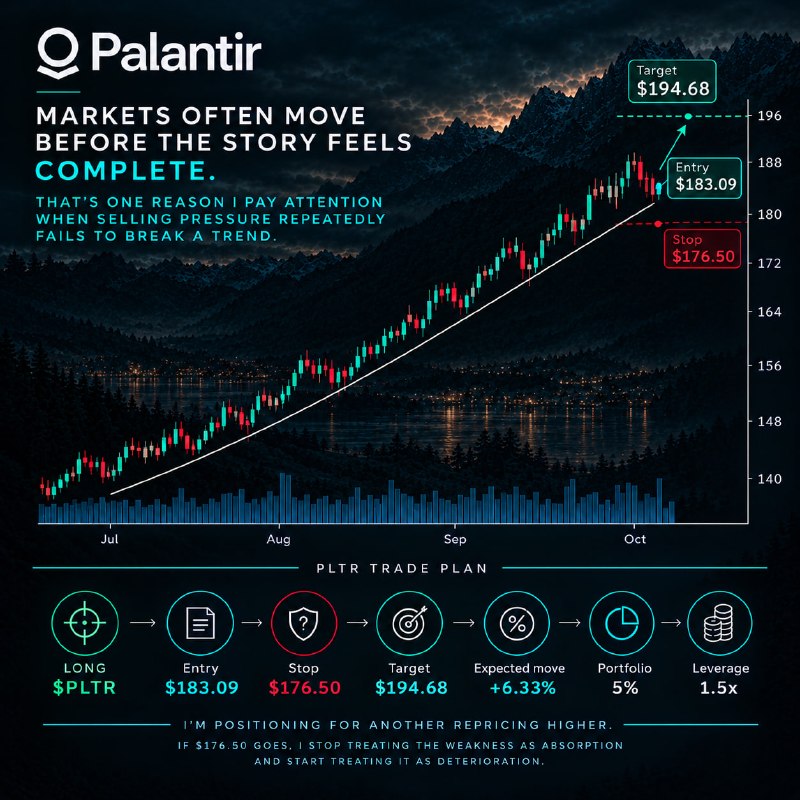
Markets often move before the story feels complete.

That’s one reason I pay attention when selling pressure repeatedly fails to break a trend.

Hong and Stein argued that information can diffuse gradually through a market. When that happens, prices can underreact first and trend later as additional investors respond.

$PLTR looks like that type of tape to me.

Weakness keeps getting absorbed. Buyers don’t need to dominate every session — they just need to keep preventing sellers from changing the structure.

I’m positioning for another repricing higher.

LONG — $PLTR
Entry — $183.09
Stop — $176.50
Target — $194.68
Expected move — +6.33%
Portfolio — 5%
Leverage — 1.5x


If $176.50 goes, I stop treating the weakness as absorption and start treating it as deterioration.
Post #1870 1.26K
A tight trade can still be a good trade

The mistake is judging every setup by the size of the target rather than by the relationship between probability, risk and capital committed.

$NVDA is consolidating near its highs instead of immediately rejecting them.
Momentum research gives me no reason to assume that strength must reverse purely because the stock has already performed well.

So I’m not asking for much.

I’m asking for one more controlled continuation leg.

LONG — $NVDA
Entry — $228.87
Stop — $224.00
Target — $233.21
Expected move — +1.90%
Portfolio — 8%
Leverage — 1.25x


This is almost the opposite of a lottery ticket: modest payoff, close stop, higher confidence in the path.
Post #1869 1.28K
Prices don’t only trend because fundamentals change

Sometimes price itself changes investor behavior.

That feedback loop is what interests me in $TSLA.

Daniel, Hirshleifer and Subrahmanyam’s work on investor overconfidence describes how successful prior beliefs can reinforce confidence and push prices further before the process eventually reverses.

TSLA has already priced in a lot of optimism, but the stock is now struggling to extend despite that enthusiasm.
That asymmetry is shifting.

I don’t need a crash. I just need momentum to stop feeding itself.

SHORT — $TSLA
Entry — $378.90
Stop — $390.00
Target — $359.26
Expected move — -5.18%
Portfolio — 5%
Leverage — 1.5x


Above $390, buyers would still be controlling the feedback loop. I’m out there.
  • ❤ 2
Post #1868 1.18K
Overreaction doesn’t always end with a crash

Sometimes it ends with a boring pullback.

De Bondt and Thaler’s classic work found evidence consistent with investors overreacting to dramatic information and prior price performance.

That’s the framework I’m using for $AMZN.

The stock looks stretched, but I’m not building some grand bearish thesis around Amazon. I simply think expectations have moved far enough ahead of the immediate tape to create room for a reset.

This is a tactical fade.

SHORT — $AMZN
Entry — $254.98
Stop — $260.50
Target — $244.73
Expected move — -4.02%
Portfolio — 5%
Leverage — 1.5x


I’m trading the gap between enthusiasm and near-term follow-through — not betting against the business.
Post #1867 1.27K
The second failed push often interests me more than the first one

$TSLA has already had the opportunity to turn higher prices into a clean continuation. It hasn’t.

Behavioral models of overconfidence offer one explanation for why these moves can overshoot: investors become more confident as prior price action appears to validate their beliefs. Eventually, the marginal buyer becomes harder to find.

That’s where I think TSLA is getting interesting from the short side.

SHORT — $TSLA
Entry — $380.12
Stop — $392.00
Target — $359.26
Expected move — -5.49%
Portfolio — 5%
Leverage — 1.5x


The trade isn’t “Tesla is bad.”

The trade is: optimism has already done a lot of work, while price is struggling to reward the next buyer.
  • ❤ 4
  • 🎉 4
  • 👍 2
  • 🔥 2
  • 😁 2
  • 🤩 1
Post #1866 1.2K
Momentum is useful right up until you start confusing it with certainty

$MU is still giving me a continuation setup, but it’s also far enough into the move that I want less exposure, not more.

Daniel, Hirshleifer and Subrahmanyam modeled how overconfidence and self-attribution can reinforce short-run momentum before eventually contributing to overreaction.

That distinction is exactly what I’m managing here.

I still want the long, but I don’t want to pretend late-stage momentum carries the same risk profile as an early breakout.

LONG — $MU
Entry — $1,043.96
Stop — $1,005.00
Target — $1,108.72
Expected move — +6.20%
Portfolio — 4%
Leverage — 1.25x


I’m staying with the trend while reducing the amount of portfolio risk I’m willing to attach to it.
  • 🔥 4
  • ❤ 3
  • 👍 3
  • 🎉 3
  • 🤩 1
Post #1865 1.22K
The market can move from underreaction to extrapolation faster than people expect

Barberis, Shleifer and Vishny modeled both behaviors: investors may initially react too little to new information, then eventually place too much weight on a perceived streak.

$META is starting to look like it has crossed that line.

The upside story is already well understood. What I’m watching now is whether price can continue rewarding increasingly optimistic expectations.

Right here, I think the easier move is a reset.

SHORT — $META
Entry — $744.10
Stop — $758.00
Target — $717.65
Expected move — -3.55%
Portfolio — 6%
Leverage — 1.5x


I’m not calling a long-term top. I’m betting that expectations have temporarily outrun the next incremental buyer.
  • 👍 3
  • ❤ 2
  • 🔥 2
  • 🎉 2
  • 😁 1
  • 🤩 1
Post #1864 1.35K
Mean reversion trades work best when you don’t ask them to become something bigger

That’s exactly how I’m treating $AMZN.

De Bondt and Thaler found evidence that markets can overreact, creating subsequent reversal effects. But I don’t need a full-blown behavioral anomaly here. I need a much smaller version of the same mechanism.

Momentum has weakened and my target is deliberately close.

I’m fading the last part of the move, not trying to predict a collapse.

SHORT — $AMZN
Entry — $249.27
Stop — $254.50
Target — $244.73
Expected move — -1.82%
Portfolio — 7%
Leverage — 1.25x


The target is small because the thesis is small.

Take the inefficiency you’re offered. Don’t invent a bigger one.
  • 👍 4
  • 🎉 4
  • ❤ 2
  • 🔥 2
  • 😁 2
  • 🤩 1
Post #1863 1.2K
The more obvious a trend becomes, the more careful I get about joining it late

$META has moved far enough that I’m now interested in the other side.

Barberis, Shleifer and Vishny describe a behavioral process where investors can extrapolate a sequence of good news and eventually overreact.

The practical implication is simple: a good company and an attractive short can exist at the same time.

I’m not shorting META because I suddenly dislike the business.

I’m shorting the distance between current expectations and what I think the next marginal buyer is willing to pay.

SHORT — $META
Entry — $777.59
Stop — $794.00
Target — $717.65
Expected move — -7.71%
Portfolio — 6%
Leverage — 1.5x


This is an expectations trade, not a corporate obituary.
  • ❤ 4
  • 🎉 3
  • 🤩 3
  • 🔥 2
  • 👍 1
  • 😁 1
Post #1862 1.17K
A crowded trade doesn’t reverse just because it’s crowded

That’s an important distinction.

Shleifer and Vishny’s work on the limits of arbitrage explains why mispricing can persist even when sophisticated investors recognize it: taking the opposite side requires capital, timing and the ability to survive being early.

That’s why I’m not dramatically oversizing this $TSLA short.

I think the stock is struggling to justify current levels, but I also respect how long momentum can remain detached from what looks reasonable.

SHORT — $TSLA
Entry — $377.94
Stop — $389.50
Target — $359.26
Expected move — -4.94%
Portfolio — 5%
Leverage — 1.5x


Being right too early can still lose money.
The stop is there because timing is part of the thesis.
  • 🎉 5
  • ❤ 3
  • 👍 2
  • 🔥 2
  • 🤩 2
Post #1861 1.26K
The hardest shorts are usually the ones that look the most obviously overextended

$PLTR is a good example.

A momentum stock can keep overshooting because rational traders have limited capital and no guarantee that mispricing corrects on their schedule. That is essentially the problem Shleifer and Vishny formalized in their limits-to-arbitrage framework.

So yes, I think PLTR is stretched.
But that does not mean I want a large position.

I want a small, defined bet on mean reversion with enough room to survive normal noise.

SHORT — $PLTR
Entry — $192.59
Stop — $198.50
Target — $185.62
Expected move — -3.62%
Portfolio — 4%
Leverage — 1.5x


The thesis is reversal.

The sizing is respect for momentum.
  • 🔥 5
  • 👍 3
  • ❤ 2
  • 😁 2
  • 🤩 2
  • 🎉 1
Post #1860 1.23K
I’m not shorting $MU because I suddenly think the semiconductor story is broken.
I’m shorting the path


Daniel, Hirshleifer and Subrahmanyam showed how overconfidence and self-attribution can reinforce price trends before contributing to eventual overreaction.

MU has reached a stage where the recent move itself can start attracting buyers whose thesis is simply that the stock keeps going up.

That’s when I become interested in exhaustion.

SHORT — $MU
Entry — $1,082.28
Stop — $1,112.00
Target — $1,032.00
Expected move — -4.65%
Portfolio — 4%
Leverage — 1.5x


I’m fading the speed of the move, not making a structural bearish call on Micron.

If momentum keeps accelerating through $1,112, I’m wrong and I leave.
  • ❤ 3
  • 👍 3
  • 🎉 3
  • 🔥 2
  • 😁 2
  • 🤩 2
Post #1858 1.19K
Markets don’t reverse the moment they become expensive

They reverse when the flow of new buyers stops compensating for the expectations already embedded in price.

That’s the distinction I’m watching in $META.

Barberis, Shleifer and Vishny’s investor-sentiment model allows for exactly this transition: underreaction can become overreaction when investors begin extrapolating a perceived pattern too aggressively.

I think META is now closer to the second regime than the first.

SHORT — $META
Entry — $751.66
Stop — $770.00
Target — $717.65
Expected move — -4.52%
Portfolio — 5%
Leverage — 1.5x


The interesting part for me is not valuation by itself.

It’s that price is no longer behaving as cleanly as the bullish narrative would suggest it should.

That divergence is the trade.
  • 👍 6
  • ❤ 3
  • 🔥 3
  • 😁 3
  • 🎉 1
  • 🤩 1
Older posts →

About this channel

How can I read @hedge_capital without a Telegram account?
TGViewer shows the public web preview Telegram publishes for Hedge Capital: recent posts, photos, videos and the subscriber count, with no app, login or account.
How many subscribers does Hedge Capital have?
Hedge Capital (@hedge_capital) has 2.83K subscribers on Telegram, refreshed roughly every 30 minutes.
Does Hedge Capital know I viewed it here?
No. Public channel previews carry no viewer identity, and TGViewer has no accounts or tracking of what you look up.
Threads Profile ViewerView any public Threads profile without an account.Open ThreadLook →Writing with AI? Make it sound human.Metric37 rewrites AI drafts so they read naturally. Free AI detector, 1,500 words free.Try Metric37 →