TGViewer
Channel Public Channel
UX Core & KeepSimple.io

UX Core & KeepSimple.io

@keepsimple

KeepSimple is a community for people who want to think simply and effectively in a complex world.

keepsimple.io and uxcore.io - We generate quality knowledge for you 🌻
Subscribers
154
Photos
21
Videos
3
Links
28
Recent Posts 19 shown
Post #54 187
🖤Emotions | Arc of Self

Think about the last time you felt anxious. It probably felt like the anxiety just arrived, fully formed, and your job was to deal with it. That's not what happened.

What your body actually sent up was a pattern: fast heart, tight chest, something off in your stomach. No label on it. Your brain then grabbed the closest concept it had learned and named it. The sensation comes first, the word comes second, and the word is what you end up feeling.

Which means your brain can only name a feeling with a concept it already has, and concepts come from the language you grew up in.

Russians have тоска, an ache with no object. Portuguese have saudade, missing something that may never come back. Japanese have amae, the comfort of leaning on someone and knowing they'll let you. If you don't have the word, you don't get the feeling in that clean, separate form.

It shows up most clearly in Tahiti. Researchers found that people there who had lost someone described it as fatigue, or sickness, or just feeling odd. They had no concept of grief to reach for, so the same heaviness in the body came out as something else entirely.

So learning finer words isn't decoration, it changes what you feel. If all you have is "bad," the only move is to escape it. If you can tell irritation from disappointment from dread, each one points somewhere: irritation to a boundary, disappointment to an expectation, dread to something you're avoiding. The feeling stops being a wall and turns into information.

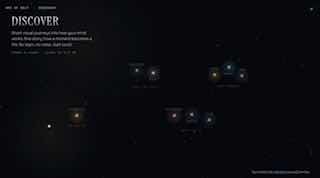
You can walk through all of this visually in Arc of Self, along with attention, memory, fear, habits, and more.

https://arc-of-self.com/discover/emotions

#mind
  • ❤ 6
  • 🔥 4
  • 👏 1
  • 🤔 1
Post #53 133
I've been doing a lifetime research, and recently packed it up and made public. To ensure that this is not a yet-another-theory, I've made sure to build a user journey, made a theory 5-level deep, with the ability for the user to go and discover everything layer-by-layer.

Three things where vibecoding helped me to build something I haven't seen anywhere else:
1. Ability to chat with the theory. So I actually built a personality layer, so anyone who chats with the theory talks to an entity that knows very well how to steer the work. This is especially crucial given that the project was being built since late 2000s/early 2010s.
2. New way to show the references: Depth level 5 (https://arc-of-self.com/5). Not only you can see the references used in the paper, but also you see the impact, and the hue of it.
3. Self-learning mechanism. So basically the theory has already absorbed everything worth taking from the late 1800s through summer 2026. Now it watches for new papers as they appear, checks each one for relevance, scores it, and when a paper clears the threshold it extracts its core claim and sends me a Telegram notice. I review it and approve, and the paper shows up on Depth 5 as a new document tied to the theory.

So basically my idea here is to convert my lifetime work into something that will be self-developing itself. The difficulty here is that it takes many months and years to test the work of the mechanism, but I'm patient in this regard, lol.

https://arc-of-self.com/5
Arc of Self Arc of Self - A recursive theory of identity The self is not a thing you have. It is a loop you keep closing.
  • 🔥 5
  • ❤ 2
  • 👏 1
Post #52 183
🖤Attention | Arc of Self

Every second you're awake your senses take in millions of signals, and only a few dozen of them ever reach you. Most of us assume the ones that get through are the important ones, and that anything obvious enough would be noticed anyway. What actually happens is that attention moves like a narrow beam over the dark, and whatever it lands on becomes your entire experience of that moment. The rest is right there in front of you and still never arrives.

Trafton Drew tested how far this goes on people whose whole job is looking carefully. He hid an image of a gorilla inside a chest CT scan, 48 times larger than the lung nodules the radiologists were searching for, and asked them to do their normal reading. 83% of them never saw it, and eye tracking showed most had looked directly at the spot where it was.

So the beam decides more than what you notice right now. Anything it misses is never stored, and your past later gets rebuilt out of whatever it happened to keep.

The useful part is that the beam responds to practice. You can't widen it much, but you can catch it drifting and bring it back, and each time you do that you're deciding what your life will be made of. Notice more and you remember more, and remembered years feel longer than lived ones.

You can walk through all of this visually in Arc of Self, along with memory, fear, habits, and more.

https://arc-of-self.com/discover/attention
  • ❤ 4
  • ❤‍🔥 3
Post #51 222
Memory | the first concept in Arc of Self

Most of us assume memory works like a recording. The moment got saved somewhere, and remembering just plays it back. That assumption is wrong, because every time you remember something, you change it a little.

When you pull up a memory, the trace doesn't just light up, it becomes chemically unstable and has to be written back to be kept at all. This is called reconsolidation. So everytime you recall something you almost certainly change the memory, that gets written into the new version.

So the memories you revisit the most often are the ones you've edited the most. The confidence you feel about them comes from how familiar they are, not from how accurate they are.

Elizabeth Loftus spent decades testing how far this goes. A few suggestive words during recall were enough to get people remembering things that never happened, including whole childhood events they described with real emotion. You never feel the edit happening. It just feels like remembering.

There's a useful side to this too. A memory you can overwrite is a memory you can calm down. That's part of why therapy for trauma works, you bring the memory up in a safer moment, and your brain keeps that safer version.

You can walk through all of this visually in Arc of Self, along with attention, fear, habits, and more.

https://arc-of-self.com/discover/memory

#mind
  • 🔥 3
  • ❤‍🔥 2
  • ❤ 1
Post #50 373
Sharing the Arc of Self - an online experience for people who want to explore how different parts of our brain run us. Here you can learn about concepts like attention, memory, fear, time, and many more.

We took this direction because almost everything online about the brain is a wall of text you skim once and forget forever, while we see endless beauty in the way our mind works.

Arc will guide you through a visual experience explaining the essentials of how the most important components of our life are actually wired.

Have a look when you've got a calm moment. Your mind is the only place you'll ever live - worth spending some time getting to know it.

https://arc-of-self.com/discover/

#mind
  • ❤ 8
  • 🔥 4
  • 💘 2
Post #49 288
🤍 Here's a simple trick from behavioral economics that can help you build habits.

Wharton professor Katy Milkman ran a field experiment years ago that's become one of the most cited findings in the field.

She gave people access to page-turner audiobooks, the kind you actually want to keep listening to, but with one restriction. They could only listen while at the gym.
Gym attendance went up 51% over the following ten weeks compared to people without that restriction.

The mechanism is simple once you see it. Most of us treat willpower as the thing standing between us and the tasks we keep avoiding. Milkman's experiment suggests the more reliable lever is tying the boring task to something you already crave, and cutting off access to that craving everywhere else.

At work this shows up constantly. You may apply this strategy to things you keep procrastinating on. Pick something you genuinely enjoy and make it available only once the task you're avoiding gets done.

Milkman's team found the effect held up for months after the study ended, as long as people kept the rule strict.

#mind
  • 🔥 8
Post #48 244
Today KeepSimple.io has become 7 years old. Something that started for me as a tiny personal blog with 10 articles about project management later became the cradle of numerous open-source, well-researched, battle-tested material.

Each step I took IRL, advanced the project.

I finalized research on cognitive biases, and the project hosted the biggest library of cognitive biases.

I finalized nudging strategies research, and the project hosted more than a thousand nudging examples.

I created a company, and the project got that company's open-source internal documentation, with its principles, practices, and templates.

I went all-in for longevity, and the project got a free longevity protocol for non-wealthy folks.

Now I'm fascinated with vibecoding and AI, and the project gets vibecoded features, articles and guides about vibecoding, and even a small compact community around the topic (love <3)

But what would happen if I wouldn't release keepsimple at all? I would still build companies and products, would still research longevity, would endlessly learn behavioral sciences. I don't think there would be a major change in my behavior or actions. These 7 years would pass anyway.

What would actually be different is that our society would have one less free, structured knowledge source on uncommon topics.

More than 300,000 people from 180+ countries have visited the project to date. People spent an enormous amount of time there. I have no idea what they were doing, but I want to believe the project affected them somehow. I want to believe they were affected in a good way. At least those hundreds of people who reached out to my team with feedback were surely happy.

I never liked fake moralism, so I won't be going into a cheesy-vanilla post about Kindness in All World. Whatever we build, and whatever we do, we do for ourselves. My evil intention behind keepsimple was always to surround myself with people who discuss topics that I want to discuss. The project has become a native filter of every dialogue around me, and it served (and still serves) that purpose well.

This post doesn't even have some specific meaning, despite just marking the 7th year of developing an open-source mentality. If someone wanted any takeaway from this post, I guess it's about this mentality. 🌻
  • 🔥 7
  • 🎉 3
  • 💘 2
  • ❤ 1
Post #47 557
A study in Nature this year mapped sleep against 23 different biological aging clocks across roughly half a million people in the UK Biobank, and a clean U-shape emerged: sleep too little or too much and your body ages faster, with the slowest-aging window sitting between 6.4 and 7.8 hours.

The two sides of that curve mean opposite things. When researchers looked at the genetics of chronic short sleepers, the DNA resembled people whose whole body is breaking down at once, carrying the same signatures you find in heart failure and type 2 diabetes.

Short sleep seems to drive that directly. The nervous system stays aggravated, the immune system loses its footing, and stress hormones keep circulating because the body doesn't get the recovery window it's built to expect.

Long sleepers showed a different picture, their DNA lining up with brain conditions rather than systemic decline, depression being the clearest example. But long sleep doesn't appear to cause harm the way short sleep does. By the time someone is regularly sleeping past eight hours, the damage is usually already underway inside the brain or the metabolic organs, and the long sleep is the body reacting to a problem that started earlier.

So under 6.4 hours is a stressor you're putting on yourself, while over 7.8 hours is closer to a signal that something has already gone, and is worth paying attention.

#body
  • ❤ 8
  • 🔥 5
  • 😢 1
Post #46 215
Harvard once planted undercover researchers inside one of the world's largest mobile phone factories, and what they found there should make every manager who likes to "keep an eye on things" pause for a moment.

The factory was built around visibility. Assembly lines stood close together with clear sightlines, so supervisors could see every movement and spread the best practices across the floor. On paper, this is just sensible management.

The embedded researchers worked on the lines and lived in the factory dorms, so workers treated them as their own. Soon, colleagues began teaching them unofficial tricks that made the work faster and safer than the approved procedure. Every trick came with the same warning: hide it when managers walk by, because they'll get mad. So thousands of people were performing "correct" work for the audience while doing the real, smarter work whenever nobody was looking.

Then professor Ethan Bernstein ran an experiment. A simple curtain was hung around a few assembly lines, hiding them from the managerial gaze. Productivity behind the curtain rose by 10–15% within the first week and held that lead for the next five months.

Once the workers had privacy, they started testing their tricks properly, and when an idea proved itself, they brought it to supervisors on their own. Bernstein called it pride in ownership. The curtain produced more honesty than the open floor ever did.

He named this the transparency paradox: the more visible you make people's work, the more theater you get instead of truth. So whenever you feel the urge to install monitoring software or demand cameras-on meetings, remember that a piece of fabric once beat an entire surveillance system.

The full study is in Administrative Science Quarterly, 2012 - worth a read.

#career
  • ❤ 7
  • ❤‍🔥 2
Post #45 203
Do you think Andrej Karpathy, the guy who coined vibe coding in the first place, uses the Claude app for his magic?) Spoiler: no.

What the Claude app gives you is, at most, around half of what the model can actually do. The reason is that a company building one product for millions of users aims for the average of what's possible, enough to fit most people and earn a fair return on the investment. Reasonable for them, and it leaves plenty on the table for you.

Which means there's more value out there for the taking, simply by stepping off what the market hands you by default and building something a bit more your own.

We put out a new piece on http://keepsimple.io that maps that whole climb, all the way to the point where you're basically running a small company of agents on your own.

#vibecodeing

https://keepsimple.io/articles/vibecoding-ladder-llm-agents
Keep Simple Applied Cognitive Science & UX for Management | Open-Source Elevate your team with KeepSimple's free, open-source management frameworks and behavioral science tools designed for modern IT leadership.
  • ❤ 6
  • 🔥 6
  • 👀 1
Post #44 251
🌟 Mid-career people are sitting on rare leverage right now


Stanford's Digital Economy Lab published a paper last year tracking what's happening to early-career workers since ChatGPT launched. The team looked at payroll data from millions of US workers.

Workers aged 22 to 25 in the most AI-exposed occupations saw a 13% relative drop in employment compared to peers in less exposed roles. Seems like no one wants to hire juniors to learn the ropes by doing the boring stuff - as AI now does the boring stuff.

Companies make AI competence a load-bearing part of how they evaluate people.

So what happens to mid-career people in 5-7 years?

If companies stop hiring juniors at the same rate, the pipeline of people ready to step into senior roles dries up. IBM noticed this and announced they're tripling entry-level hiring in 2026, not out of generosity, but because slashing juniors saves money now and creates an expensive talent shortage later.

But ofc most companies dont do this, which means anyone currently sitting in the 3-8 year experience range is in a structurally rare position. That window will not stay open forever, but right now it's the most leverage you'll have in your career to negotiate scope, comp, and the kind of work you actually want to do.

#career
  • ❤ 8
Post #41 838
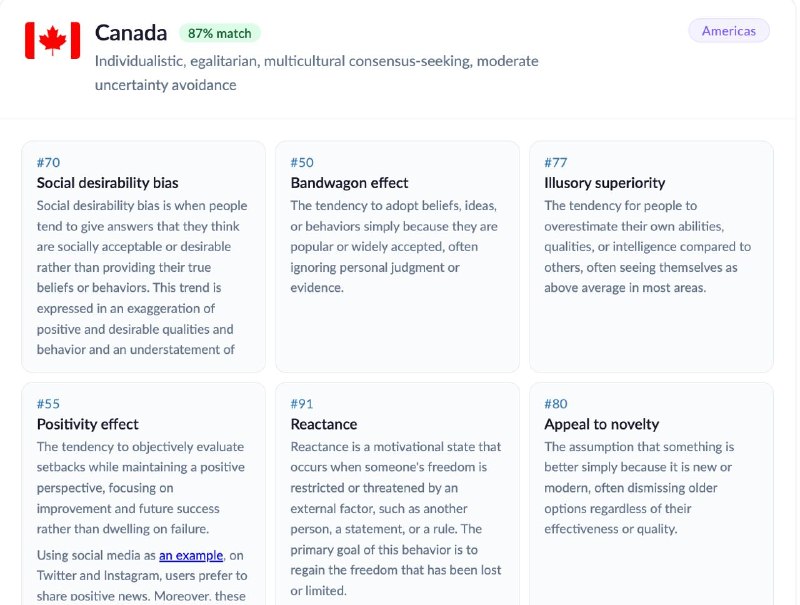
We built a Persona module inside KeepSimple.io that shows you which cognitive biases are most relevant to your users based on where they live.

Here's what it does. You pick the country your product is entering, fill in a few persona details, and you get a ranked view of the cognitive biases most relevant to that audience, mapped against the available research data.

In practice, this means you don't have to ask your marketing or sales team to build a research-backed persona from scratch (which most teams can't do well anyway). You get a high-precision lens into where users in that market will hesitate, misread your product, or drop off.

We built this years before LLMs made "persona generation" a buzzword. It's been free the entire time.

🔗 https://keepsimple.io/uxcp
Be kind. Do good. 🌻
  • ❤ 8
Post #40 157
Quick context: KeepSimple's UX Core is a free open-source library of cognitive biases used by anyone designing or shipping things to real users.

Until now, each bias had a definition and use cases. Reading is one thing, but seeing the bias in action is what makes it stick.

So we added a visual example inside every bias modal. Open any bias, scroll down, and you'll see how that specific bias can be used in product design to drive efficiency, improve conversion, reduce friction, or guide user attention where it matters.

This makes the library actually usable in the moment.

Try it here on Attentional Bias, for instance:
🔗 https://keepsimple.io/uxcore/2-attentional-bias
  • 🔥 3
Post #39 139
We just shipped a huge update to UX Core on keepsimple.io

If you've never used it: it's a hands-on library that shows you which cognitive biases shape how people perceive your product, make purchase decisions, ignore your CTAs, or churn.

Two big things in this release:
👉 Every bias in the library now has a visual example inside its modal.
👉 The Persona module now maps the most common biases per country.

Details in the next two messages. 🌻
  • ❤‍🔥 6
  • 🔥 1
Post #38 545
Three skills decide whose career grows and whose stalls. None of them show up on the "future skills" lists consulting firms publish every year. :D

The first is ~ attention to detail ~
Decades of research on personality and work keep landing on the same finding: conscientiousness predicts job performance better than any other trait studied.

The second is the ~ ability to learn ~.
Most people stop learning around 30 and ride the skill stack they built in their twenties for the next thirty years. The World Economic Forum keeps reporting that the useful life of a technical skill is now around five years and shrinking.


The third is ~ ability to tame your ego ~
This is the prerequisite for the second. You can't learn something if your ego won't let you admit you don't know it yet.
Research on intellectual humility from Duke keeps showing that people who can openly say "I don't know this" perform better and earn more trust from their teams.

A lot of what looks like career stagnation between 35 and 50 is just an ego problem, really.

#career
  • ❤ 6
  • 🔥 2
Post #37 131
Some of you already know, that more than a half of our team members are AI agents, designed for certain continuous tasks. We do manual work only in parts where we interact with our followers - like this group.

This said, we wanted to share our latest article on vibecoding, that addresses struggles of nowadays' software engineers. While the read mostly aims for devs, we believe you can greatly benefit by spending a couple of minutes on this piece.

Our initial goal was to make it clearer for our friends and colleagues on what's expected from them in modern AI-powered reality, to stay relevant.

https://keepsimple.io/articles/vibecoding-is-about-trust
Keep Simple We've Been Vibecoding Since 1995 | KeepSimple Three eras of programming, one continuous skill — trust. Math went optional in the 90s, syntax goes optional now.
  • ❤ 5
  • 👍 3
Post #35 270
Happy Monday everyone.

Fun fact - Your mood is editing your reality right now 🙂

There's a concept in psychology called Affective Realism: we don't see the world as it is, we see it as we feel it.

In a study from Lisa Feldman Barrett's lab at Northeastern, researchers flashed smiling or scowling faces too fast for people to consciously register, then asked them to rate neutral faces. People who got the hidden smiles rated strangers as more likable.
The faces were identical - only the prior feeling differed.

Your brain doesn't passively receive the world, it predicts it, using your body's current state as a reference. When you're tired or hungry or anxious, the world looks a little meaner.

A small rule to follow: don't trust strong opinions formed in a tired body. Wait until you're regulated, and the world usually looks different.
Reality lives in your mind, and your mind lives in your body.

📖 Lisa Feldman Barrett, How Emotions Are Made
#mind
  • ❤ 9
  • 🔥 4
  • 🥰 2
Post #34 147
You probably don't have ADHD. You have a phone.

Half the internet has decided they have ADHD. Can't focus, jump between tasks, forget what they were doing five minutes ago.

Most of them don't have ADHD. They have a phone.

You've also probably heard humans now have a shorter attention span than a goldfish - 8 seconds.

Well, the BBC tried to find the source of this statement. Every article traced back to a marketing site called Statistic Brain. No research behind it.
The whole goldfish comparison was made up!

Meanwhile, when people are genuinely engaged in something, their capacity to focus has stayed stable for decades. Nothing about your wiring has decayed.

So why does it feel like it has?

Gloria Mark at UC Irvine has tracked this since 2004. Back then, the average person stayed on one screen for about 2.5 minutes before switching. By 2016, it dropped to 47 seconds.

Forty-seven seconds. That's how long the average knowledge worker now stays on one screen before something pulls them elsewhere.

But notice what that's measuring. Not your brain's capacity. How often your environment interrupts you. Different thing.

Real ADHD exists, and the difference matters. But most people googling their symptoms are describing the room they're sitting in, not their brain.

You're not a goldfish, and you probably don't have ADHD. You're a person trying to focus inside a room that was designed to interrupt you.

Change the room and most of the problem disappears on its own.

#mind
  • ❤ 9
  • 🔥 5
  • 🤨 1
Older posts →

About this channel

How can I read @keepsimple without a Telegram account?
TGViewer shows the public web preview Telegram publishes for UX Core & KeepSimple.io: recent posts, photos, videos and the subscriber count, with no app, login or account.
How many subscribers does UX Core & KeepSimple.io have?
UX Core & KeepSimple.io (@keepsimple) has 154 subscribers on Telegram, refreshed roughly every 30 minutes.
Does UX Core & KeepSimple.io know I viewed it here?
No. Public channel previews carry no viewer identity, and TGViewer has no accounts or tracking of what you look up.
Threads Profile ViewerView any public Threads profile without an account.Open ThreadLook →Writing with AI? Make it sound human.Metric37 rewrites AI drafts so they read naturally. Free AI detector, 1,500 words free.Try Metric37 →