TGViewer
Channel Public Channel
Math and ML stuff

Math and ML stuff

@junkyardmathml

GPT = Geometry, Probability, Topology

темы: Neural-symbolic, LLM for code/math, Geometry and Topology in AI, GNNs

https://t.me/thousandone_platos - админ
https://t.me/arxiv_links - еще статьи
https://t.me/junkyard_goi_jin - лайв-канал
Subscribers
707
Photos
120
Videos
3
Links
104

Showing posts older than #113 · Back to latest

Older Posts 16 shown
Post #112 138

Forwarded from DLStories

В MIT исследовали феномен гроккинга (grokking) и, кажется, нашли этому эффекту правдоводобное объяснение

Grokking — это эффект, при котором уже после стадии переобучения модели (при возрастающем test лоссе и падаюшем train) при дальнейшем обучении test loss вдруг начинает падать, и сеть лучше генерализуется. Такой эффект наблюдали уже давно (например, вот тут), но, чаще всего, на малых, “игрушечных” датасетах (например, на такой простой задаче как сложение чисел). Никакого сильно убедительного объяснения эффекту не было (насколько я знаю), а также не удавалось повторить эффект на реальных, не игрушечных данных.

Ребята из MIT подошли ближе к пониманию природы grokking’а и даже смогли воспроизвести эффект на разных больших датасетах.

Авторы связывают эффект гроккинга с устройством поверхности лосс-функции. В недавней работе из Стенфорда было показано, что у этой поверхности существует сферическая область, в которой достигается оптимальная генерализация модели: то есть, для модели с параметрами из этой области train и test loss малы, переобучения при этом не наблюдается. Эту сферическую область ребята из Стенфорда назвали Goldilocks zone (“зона Златовласки”, показана на картинке зеленым). Так как область сферическая, она соответствует параметрам модели с определенной нормой. Внутренность это сферической области соответствует параметрам с меньшем нормой, область вне сферы — параметрам с большей нормой.

Далее: оказывается, grokking начинает проявляться, если в какой-то момент параметры сети имели большую норму (то есть, соответствовали точке поверхности вне сферы Златовласки). В этом случае параметры из этой точки быстро скатываются в точку локального минимума, которая также чаще всего находится за пределами сферы Златовласки, т.е. вне той области, где достигается оптимальная генерализация модели. Лосс на train становится малым, лосс на test остается большим: наблюдается переобучение.

Далее происходит следующее: если у модели нет никакой регуляризации (weight decay, к примеру), то на этом обучение модели заканчивается. Лосс не выходит из точки минимума, grokking не наблюдается, переобучение остается. Но если к модели применяется регуляризация, это выталкивает веса модели из локального минимума, и они начинают стремиться к зоне Златовласки. Обычно регуляризация применяется не очень сильная, поэтому проходит довольно много эпох обучения, прежде чем веса модели достигают точки внутри зоны Goldilocks и модель начинает генерализоваться. Это и объясняет эффект гроккинга: когда через достаточно долгое время после переобучения лосс на тесте вдруг падает и модель начинает лучше обобщаться.

Кстати, если у модели регуляризация довольно сильная, grokking’а тоже не будет: веса модели будут сразу быстро приходить внутрь зоны Златовласки, не задерживаясь в локальном минимуме вне сферы. Модель просто сразу достаточно хорошо генерализуется.

Теперь, почему grokking часто наблюдают на “игрушечных” датасетах, и почти никогда — на реальных. Во-первых, обычно веса любых нейросетей инициализируют значениями с довольно малой нормой, т.е. лежащими внутри зоны Златовласки. Однако на суперпростых датасетах при обучении модели наблюдается более быстрое увеличение нормы весов, потому что градиентный спуск быстрее выталкивает веса модели в локальную точку минимума трейн лосса сильно за пределами сферы. При обучении больших моделей этот эффект не такой сильный, и веса нечасто выходят за пределы зоны Златовласки вообще, и grokking не наблюдается.

Чтобы подтвердить гипотезу об описанном происхождении гроккина, исследователи обучили несколько моделей для разных задач CV и NLP с разными нормами весов. Оказалось, что увеличение нормы весов действительно приводит к возникновению эффекта grokking’а, пусть все же и не настолько выраженно, как на более простых датасетах.

Подробнее читайте в статье
Изначально новость нашла тут
  • 👍 1
  • 🔥 1
Post #111 144
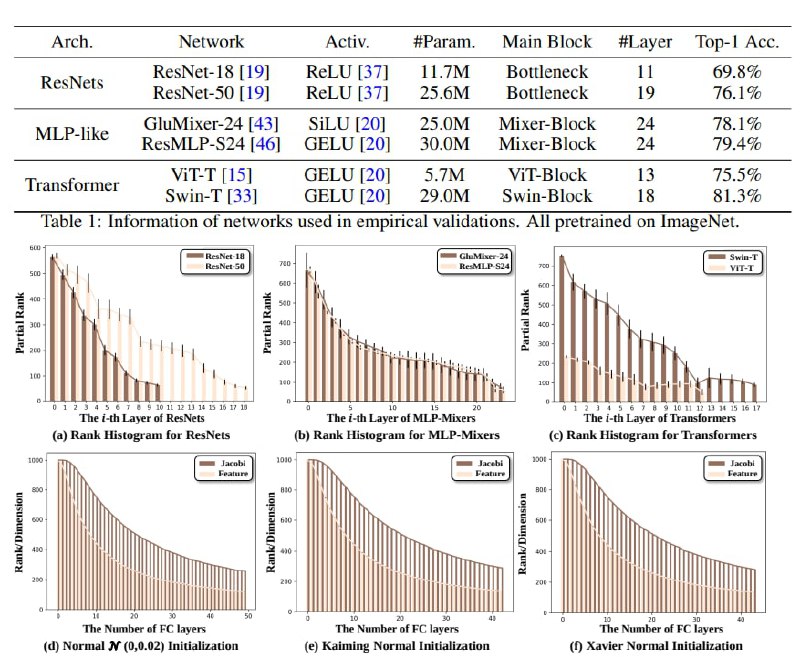
Rank Diminishing in Deep Neural Networks

The rank of neural networks measures information flowing across layers. It is an instance of a key structural condition that applies across broad domains of machine learning. In particular, the assumption of low-rank feature representations leads to algorithmic developments in many architectures. For neural networks, however, the intrinsic mechanism that yields low-rank structures remains vague and unclear. To fill this gap, we perform a rigorous study on the behavior of network rank, focusing particularly on the notion of rank deficiency. We theoretically establish a universal monotonic decreasing property of network rank from the basic rules of differential and algebraic composition, and uncover rank deficiency of network blocks and deep function coupling. By virtue of our numerical tools, we provide the first empirical analysis of the per-layer behavior of network rank in practical settings, i.e., ResNets, deep MLPs, and Transformers on ImageNet. These empirical results are in direct accord with our theory. Furthermore, we reveal a novel phenomenon of independence deficit caused by the rank deficiency of deep networks, where classification confidence of a given category can be linearly decided by the confidence of a handful of other categories. The theoretical results of this work, together with the empirical findings, may advance understanding of the inherent principles of deep neural networks

https://arxiv.org/abs/2206.06072
  • 👍 1
  • 🔥 1
Post #110 134
Explaining Neural Scaling Laws

The test loss of well-trained neural networks often follows precise power-law scaling relations with either the size of the training dataset or the number of parameters in the network. We propose a theory that explains and connects these scaling laws. We identify variance-limited and resolution-limited scaling behavior for both dataset and model size, for a total of four scaling regimes. The variance-limited scaling follows simply from the existence of a well-behaved infinite data or infinite width limit, while the resolution-limited regime can be explained by positing that models are effectively resolving a smooth data manifold. In the large width limit, this can be equivalently obtained from the spectrum of certain kernels, and we present evidence that large width and large dataset resolution-limited scaling exponents are related by a duality. We exhibit all four scaling regimes in the controlled setting of large random feature and pretrained models and test the predictions empirically on a range of standard architectures and datasets. We also observe several empirical relationships between datasets and scaling exponents: super-classing image tasks does not change exponents, while changing input distribution (via changing datasets or adding noise) has a strong effect. We further explore the effect of architecture aspect ratio on scaling exponents

https://arxiv.org/pdf/2102.06701.pdf
  • 👍 1
  • 🔥 1
Post #109 131
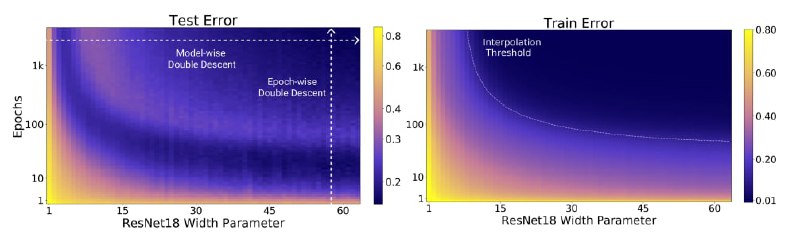
Deep Double Descent: Where Bigger Models and More Data Hurt

We show that a variety of modern deep learning tasks exhibit a “double-descent” phenomenon where, as we increase model size, performance first gets worse and then gets better. Moreover, we show that double descent occurs not just as a function of model size, but also as a function of the number of training epochs. We unify the above phenomena by defining a new complexity measure we call the effective model complexity and conjecture a generalized double descent with respect to this measure. Furthermore, our notion of model complexity allows us to identify certain regimes where increasing (even quadrupling) the number of train samples actually hurts test performance

https://arxiv.org/abs/1912.02292
  • 👍 1
  • 😱 1
Post #108 135
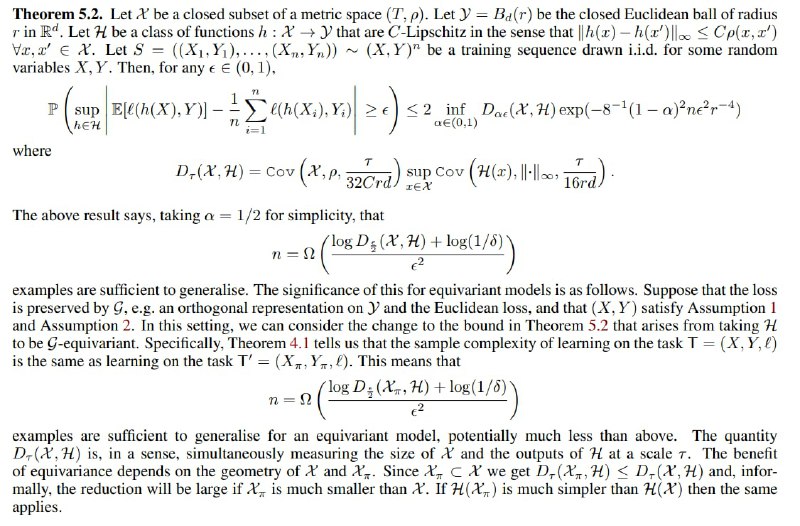
Group Symmetry in PAC Learnin

In this paper we show rigorously how learning in the PAC framework with invariant or equivariant hypotheses reduces to learning in a space of orbit representatives. Our results hold for any compact group, including infinite groups such as rotations. In addition, we show how to use these equivalences to derive generalisation bounds for invariant/equivariant models in terms of the geometry of the input and output spaces. To the best of our knowledge, our results are the most general of their kind to date.

https://openreview.net/pdf?id=HxeTEZJaxq
  • ❤‍🔥 1
  • 👍 1
  • 🤔 1
Post #102 135
Hausdorff Dimension, Heavy Tails, and Generalization in Neural Networks

Aiming to bridge this gap, in this paper, we prove generalization bounds for SGD under the assumption that its trajectories can be well-approximated by a Feller process, which defines a rich class of Markov processes that include several recent SDE representations (both Brownian or heavy-tailed) as its special case. We show that the generalization error can be controlled by the Hausdorff dimension of the trajectories, which is intimately linked to the tail behavior of the driving process. Our results imply that heavier-tailed processes should achieve better generalization; hence, the tail-index of the process can be used as a notion of “capacity metric”. We support our theory with experiments on deep neural networks illustrating that the proposed capacity metric accurately estimates the generalization error, and it does not necessarily grow with the number of parameters unlike the existing capacity metrics in the literature

https://arxiv.org/pdf/2006.09313.pdf
  • 🔥 1
  • 🤔 1
  • 🫡 1
Post #101 120
Regular Polytope Networks

Neural networks are widely used as a model for classification in a large variety of tasks. Typically, a learnable transformation (i.e. the classifier) is placed at the end of such models returning a value for each class used for classification. This transformation plays an important role in determining how the generated features change during the learning process. In this work, we argue that this transformation not only can be fixed (i.e. set as non-trainable) with no loss of accuracy and with a reduction in memory usage, but it can also be used to learn stationary and maximally separated embeddings. We show that the stationarity of the embedding and its maximal separated representation can be theoretically justified by setting the weights of the fixed classifier to values taken from the coordinate vertices of the three regular polytopes available in R d , namely: the d-Simplex, the d-Cube and the d-Orthoplex. These regular polytopes have the maximal amount of symmetry that can be exploited to generate stationary features angularly centered around their corresponding fixed weights.

https://arxiv.org/pdf/2103.15632.pdf
  • 🔥 1
  • 🤔 1
Post #100 115
Maximally Compact and Separated Features with Regular Polytope Networks

In this work we show how to extract from CNNs features with the properties of maximum inter-class separability and maximum intra-class compactness by setting the parameters of the classifier transformation as not trainable (i.e. fixed). We obtain features similar to what can be obtained with the well-known “Center Loss” [1] and other similar approaches but with several practical advantages including maximal exploitation of the available feature space representation, reduction in the number of network parameters, no need to use other auxiliary losses besides the Softmax. Our approach unifies and generalizes into a common approach two apparently different classes of methods regarding: discriminative features, pioneered by the Center Loss [1] and fixed classifiers, firstly evaluated in [2].

https://openaccess.thecvf.com/content_CVPRW_2019/papers/Deep%20Vision%20Workshop/Pernici_Maximally_Compact_and_Separated_Features_with_Regular_Polytope_Networks_CVPRW_2019_paper.pdf
  • 🤔 1
Post #99 114
Dirichlet Neural Networks, a Bayesian Approach

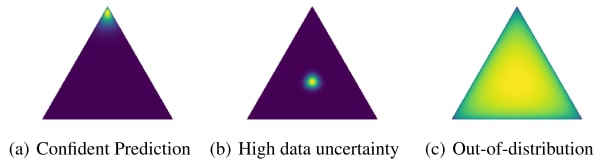
Epistemic uncertainty relates to the spread of the categorical distribution p ( π | x ∗ , D ) on the simplex, which corresponds to α 0 = ∑ C c = 1 α c for a Dirichlet distribution. Aleatoric uncertainty is linked to the position of the mean on the simplex. Equipped with this configuration, we would like Dirichlet network to yield the desired behaviors shown in the figure below:

When the model is confident in its prediction, it should yield a sharp distribution centered on one of the corners of the simplex (Fig a.). For an input in a region with high degrees of noise or class overlap (aleatoric uncertainty), it should yield a sharp distribution focused on the center of the simplex, which corresponds to being confident in predicting a flat categorical distribution over class labels (Fig b.). Finally, for out-of-distribution inputs, the Dirichlet network should yield a flat distribution over the simplex, indicating large epistemic uncertainty (Fig c.).

https://chcorbi.github.io/posts/2020/11/dirichlet-networks/
  • 👍 1
Post #98 107
On the emergence of simplex symmetry in the final and penultimate layers of neural network classifiers

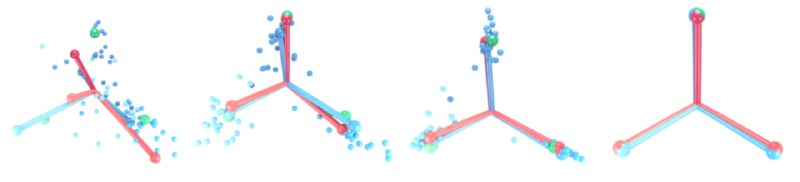
A recent numerical study observed that neural network classifiers enjoy a large degree of symmetry in the penultimate layer. Namely, if h(x)=Af(x)+b where A is a linear map and f is the output of the penultimate layer of the network (after activation), then all data points xi,1,…,xi,Ni in a class Ci are mapped to a single point yi by f and the points yi are located at the vertices of a regular k−1-dimensional standard simplex in a high-dimensional Euclidean space. We explain this observation analytically in toy models for highly expressive deep neural networks. In complementary examples, we demonstrate rigorously that even the final output of the classifier h is not uniform over data samples from a class Ci if h is a shallow network (or if the deeper layers do not bring the data samples into a convenient geometric configuration).

https://arxiv.org/abs/2012.05420
Post #97 110
Revisiting the Calibration of Modern Neural Networks

Accurate estimation of predictive uncertainty (model calibration) is essential for the safe application of neural networks. Many instances of miscalibration in modern neural networks have been reported, suggesting a trend that newer, more accurate models produce poorly calibrated predictions. Here, we revisit this question for recent state-of-the-art image classification models. We systematically relate model calibration and accuracy, and find that the most recent models, notably those not using convolutions, are among the best calibrated. Trends observed in prior model generations, such as decay of calibration with distribution shift or model size, are less pronounced in recent architectures. We also show that model size and amount of pretraining do not fully explain these differences, suggesting that architecture is a major determinant of calibration properties.

https://openreview.net/forum?id=QRBvLayFXI
Post #95 104
neural_collapse (1).gif10.3 MB
Deep learning theory and Neural Collapse of features space

1) Prevalence of Neural Collapse during the terminal phase of deep learning training

2)Limitations of Neural Collapse for Understanding Generalization in Deep Learning

3)Neural Collapse A Review on Modelling Principles and Generalization

4)A Geometric Analysis of Neural Collapse with Unconstrained Features

5)Grassmannian Frames with Applications to Coding and Communication
Post #94 102
Prevalence of neural collapse during the terminal phase of deep learning training

Modern deep neural networks for image classification have achieved superhuman performance. Yet, the complex details of trained networks have forced most practitioners and researchers to regard them as black boxes with little that could be understood. This paper considers in detail a now-standard training methodology: driving the cross-entropy loss to zero, continuing long after the classification error is already zero. Applying this methodology to an authoritative collection of standard deepnets and datasets, we observe the emergence of a simple and highly symmetric geometry of the deepnet features and of the deepnet classifier, and we document important benefits that the geometry conveys—thereby helping us understand an important component of the modern deep learning training paradigm.

https://www.pnas.org/doi/10.1073/pnas.2015509117
Post #91 94
Redundant representations help generalization in wide neural networks

Deep neural networks (DNNs) defy the classical bias-variance trade-off: adding parameters to a DNN that interpolates its training data will typically improve its generalization performance. Explaining the mechanism behind this ``benign overfitting'' in deep networks remains an outstanding challenge. Here, we study the last hidden layer representations of various state-of-the-art convolutional neural networks and find that if the last hidden representation is wide enough, its neurons tend to split into groups that carry identical information, and differ from each other only by statistically independent noise. The number of such groups increases linearly with the width of the layer, but only if the width is above a critical value. We show that redundant neurons appear only when the training process reaches interpolation and the training error is zero.
Older posts →
Threads Profile ViewerView any public Threads profile without an account.Open ThreadLook →Writing with AI? Make it sound human.Metric37 rewrites AI drafts so they read naturally. Free AI detector, 1,500 words free.Try Metric37 →