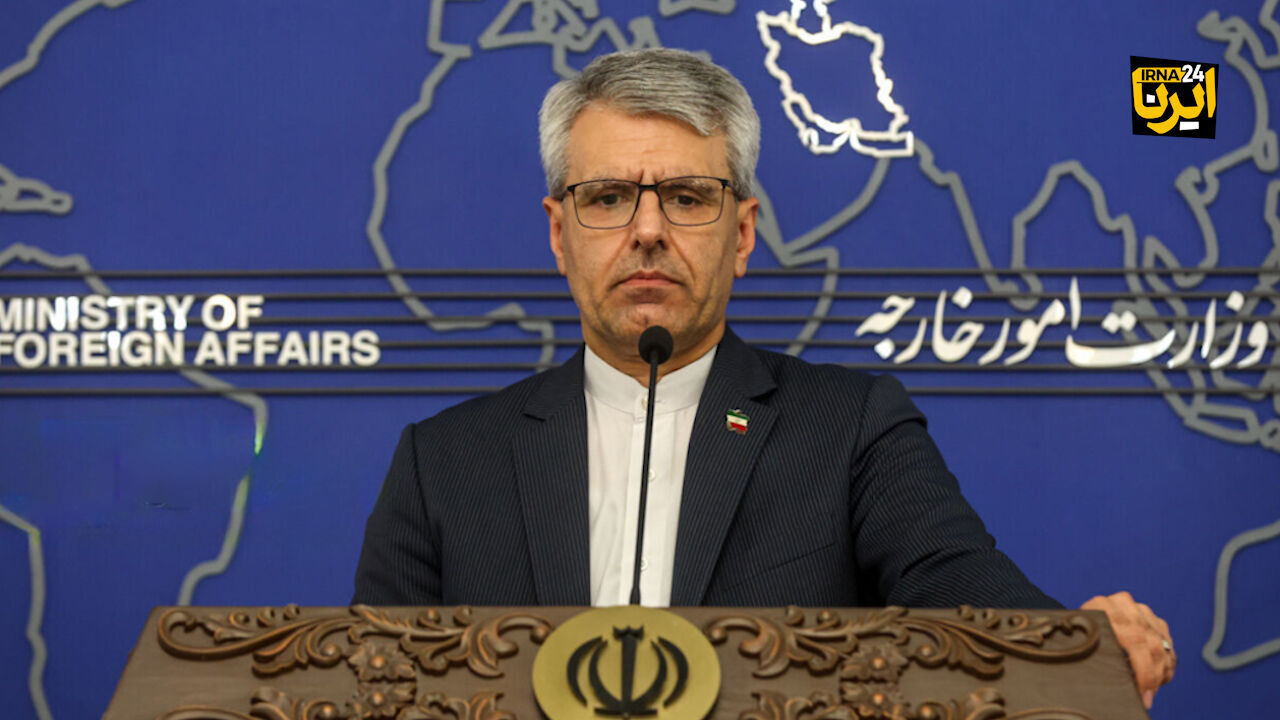
📌 Tehran, IRNA – Foreign Ministry spokesperson Esmaeil Baqaei reacted to Marco Rubio's attempt to distort history and construct a philosophical-historical justification for US warmongering.
In response to claims made by US Secretary of State Marco Rubio regarding Iran during a speech in Athens, Greece, on Wednesday, October 7, the Foreign Ministry spokesperson wrote on X:
At the Acropolis, Marco Rubio (mis)presents the history of the West - from ancient Greece to the contemporary United States - as a single, seamless continuum. This is the logic of anachronism: a distortion of historical time produced by the careless fusion of categories such as Greece, Rome, Christianity, Europe, America, and, ultimately, “America First.” It is as if America has finally discovered that 'intimidation' can be staged more effectively beneath the neon lights of a philosophy of history than in the bare idiom of the cowboy.
Rubio lifts the Greek concept of 'thumos' out of its historical and philosophical setting and recasts it as a celebration of power - of force exercised without law or justice - along with competition and national will. That reading misses a constitutive half of the Greek inheritance. Greece was not only a theater of power and glory. It was also the birthplace of the tragedy of hubris and aggression, from the myth of Troy and Homer’s Iliad; of the critique of imperial ambition in Thucydides’ History of the Peloponnesian War; of political philosophy in Plato’s Republic and Aristotle’s Politics; and of enduring meditations on the limits of power, moral responsibility, and human fate in Sophocles’ Antigone and Oedipus Rex.
This other half of the Greek legacy is deliberately omitted from Rubio’s narrative. History is thereby converted from a field of inquiry and critical reflection into an instrument of political legitimation. What emerges is not a philosophy of history, but a manufactured narrative designed to authorize U.S. militancy and to construct a convenient political myth: a distorted reconstruction of the past in which the politics of the present are made to appear inevitable and historically ordained. Once history is pressed into the service of legitimizing power—the unlawful and unjust use of force—its purpose is no longer to understand the past, but to glorify power itself.
Vasily Vereshchagin’s The Apotheosis of War offers a stark counter-image. Its pyramid of skulls, left behind by conquerors, confronts the mythology of glory with the material residue of conquest. It recalls what remains when history is reduced to the exaltation of power.
At such a juncture, Western thinkers have a responsibility to defend history itself - and the philosophical complexity of Western civilization - against a distorted and apologetic reinterpretation by an aggressive power prepared to sacrifice a civilization’s human achievements in order to legitimize the unrestrained exercise of force.
The danger lies not merely in misreading the past, but in appropriating it to authorize that force, and to aggrandize it, in the present.
📲 @Irna_en