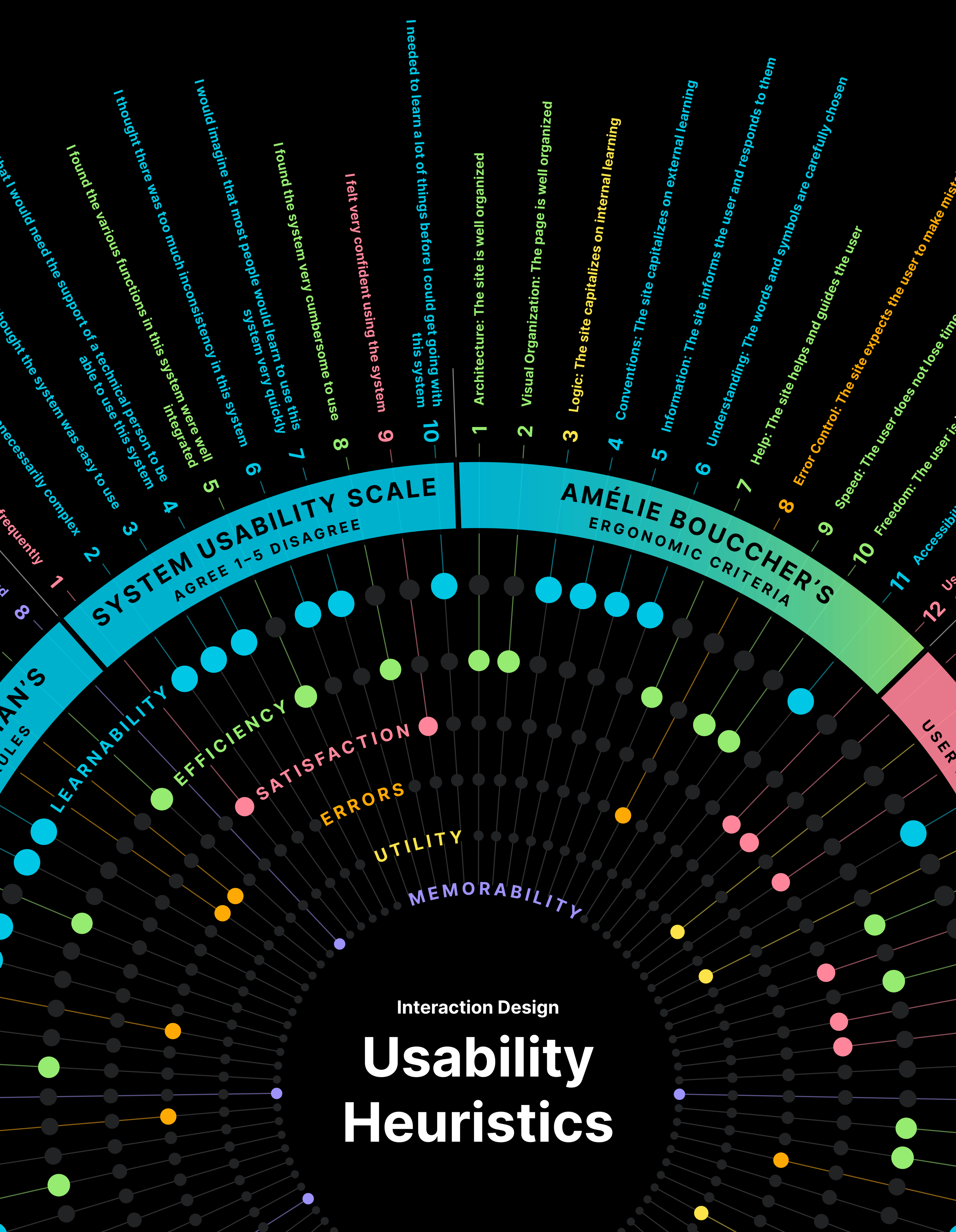
USABILITY HEURISTIC FRAMEWORKS: WHICH ONE IS RIGHT FOR YOU? GOING BEYOND NIELSEN’S USABILITY HEURISTICS (WITH INFOGRAPHIC)
🤓🔎📲
What is a heuristic evaluation?
A heuristic evaluation is a process where evaluators assess the usability of an interface against established usability principles. Usability expert Nielsen Norman Group states:
“Heuristic evaluation is a usability engineering method for finding the usability problems in a user interface design so that they can be attended to as part of an iterative design process. Heuristic evaluation involves having a small set of evaluators examine the interface and judge its compliance with recognized usability principles (the “heuristics”).”
Dictionary.com defines heuristic as:
✨ serving to indicate or point out; stimulating interest as a means of furthering investigation.
✨ encouraging a person to learn, discover, understand, or solve problems on his or her own, as by experimenting, evaluating possible answers or solutions, or by trial and error: a heuristic teaching method.
✨ of, relating to, or based on experimentation, evaluation, or trial-and-error methods.
✨ Computers, Mathematics. pertaining to a trial-and-error method of problem solving used when an algorithmic approach is impractical.
Notice the last definition: “…when an algorithmic approach is impractical”. This statement is a good summary of the subjective, qualitative nature of heuristic evaluation methods. And while this subjective nature is primarily true for the frameworks discussed here, the System Usability Scale (SUS) attempts to quantify heuristic evaluations. Or, for more measurable results, you may want to consider the PURE method for evaluating ease of use.
Usability Heuristic Frameworks
Below are the ten frameworks evaluated. Full heuristics are detailed at the end of this article.
💥 Amélie Boucher’s Ergonomic Criteria
💥 Arhippainen’s Ten User Experience Heuristics
💥 Bastien and Scapin’s Ergonomic Criteria for the Evaluation of Human-Computer Interfaces
💥 Colombo and Pasch 10 Heuristics for an Optimal User Experience
💥 Dieter Rams’ Ten Principles for Good Design | While Rams did not write his principles for interface evaluations, many in the UX field have adapted his list as a unique lens to measure against.
💥 ISO 9241–110 Ergonomics of human-system interaction — Part 110: Interaction principles
💥 Kaniasty’s CARMEL Guidelines
💥 Jakob Nielsen’s 10 Usability Heuristics for User Interface Design
💥 Shneiderman’s Eight Golden Rules of Interface Design
💥 System Usability Scale (SUS)
The following four frameworks are not included in my evaluation, but are included at the end of this article for consideration and a centralized point of reference of heuristic evaluation methods.
💥 Connell Full Principles Set
💥 Weinschenk and Barker Classification
💥 Gerhardt-Powals’ Cognitive Engineering Principles
💥 Dourado and Canedo’s Usability Heuristics for Mobile Applications
Lastly, the following noteworthy frameworks are provided here as a link only; their content is behind payment barriers or are too long for heuristic evaluation.
💥 Developing SMASH: A set of SMArtphone’s uSability Heuristics,
Computer Standards & Interfaces, Science Direct, https://doi.org/10.1016/j.csi.2015.08.007
💥 First Principles of Interaction Design (Revised & Expanded), asktog.com
💥 User Interface Context of Use Guidelines for Mobile Apps, cscjournals.org
🍀 Source >>>
🍀 Original >>>
🍀 Heuristic Findings in PDF >>>
#analytics #design #development #efficiency #methodology #tools #ux
Post #1269
177