ANALYTICS AND PRODUCT-MARKET FIT. DOES THIS PRODUCT HAVE PRODUCT-MARKET FIT?
🔎🗺
✨ This playbook clearly defines product-market fit (PMF) — the value that a given product provides in addressing a specific market segment’s need — and outlines why this must be addressed early in product development.
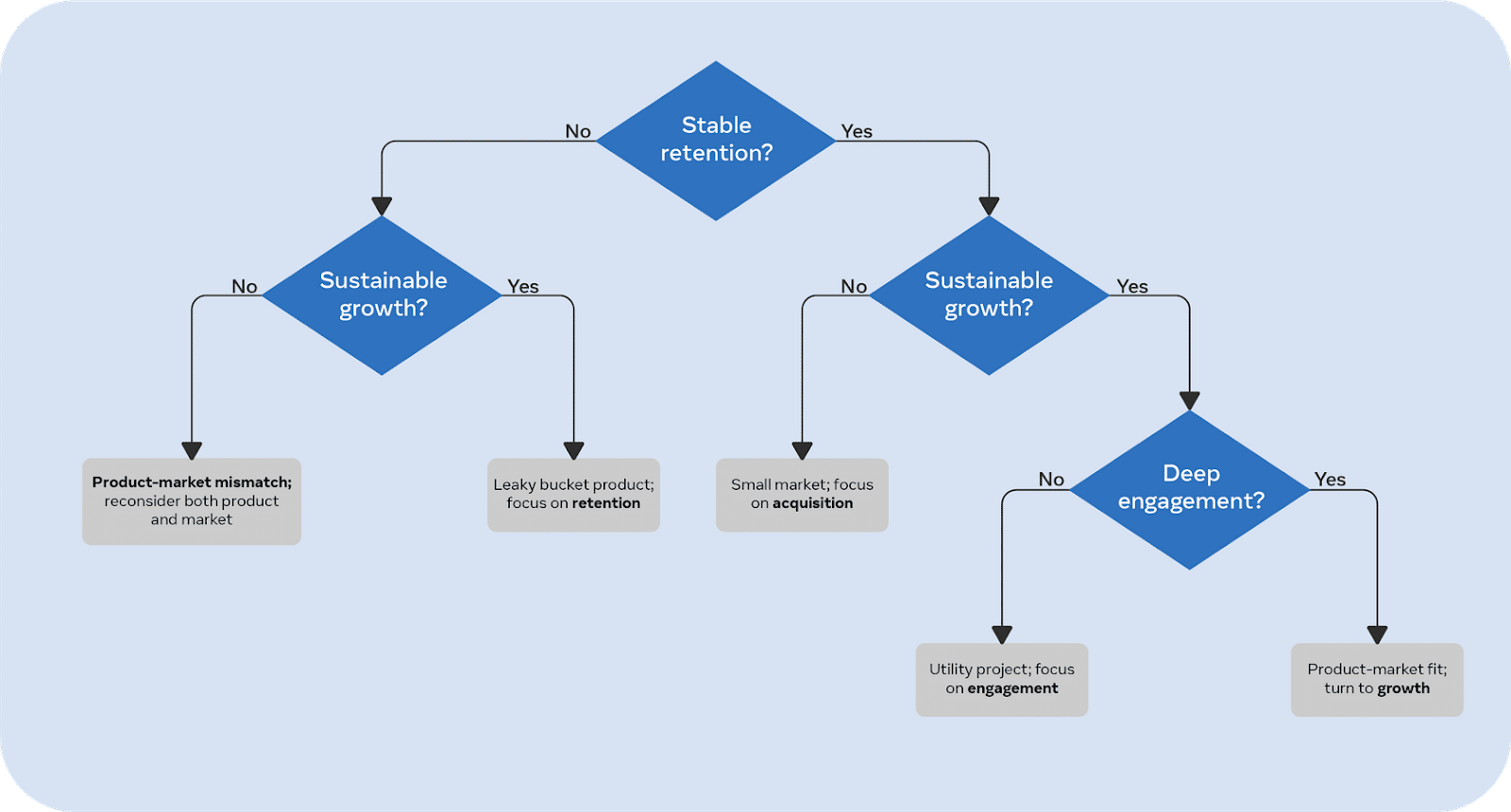
✨ There are three vital signs that measure PMF: stable retention, sustainable growth and deep engagement.
✨ We also address common misconceptions many people may have about PMF, clarifying that it’s not about everyone in your market, it can change over time and that it’s not a binary metric.
When developing new products, the big question we seek to answer is, “Does this product have product-market fit?” We are constantly experimenting with new and exciting products and features as we aim to better address people’s diverse needs and provide them with more value.
However, as we introduce new products and features, we must also hold ourselves accountable to a high bar of product quality. To use a Silicon Valley motto, are we building something people want?
Analytics plays a central role in addressing this question. Doing so fits squarely within our core principle of bringing an independent voice and analytical perspective into decision-making.
But how can our analytics teams answer such a broad and ambiguous question?
We do so by analyzing data on people’s use of the product. Ultimately, people vote with their feet. If they are interested in your product, they will use it. If they like your product, they will come back to it. By analyzing this data, we can better understand the value of our products.
Through a collaborative effort between data scientists, data engineers, product growth analysts, product managers, and other key stakeholders, we developed this playbook that guides analytics teams through quantitatively evaluating product-market fit.
Our aim is to simplify and demystify this often confusing topic.
While our focus is quantitative, your product doesn’t need thousands or millions of users in order to make use of data and quantitatively evaluate product-market fit. As Alex Schultz has noted, you can use data even with tens or hundreds of users.
And of course, qualitative insights, such as from interviews and surveys, also play a critical role in understanding our products and evaluating their “product-market fit”. We focus here on the analytics playbook.
📌 Putting this all together, we arrive at a comprehensive picture of a product’s value to the market. Highly valuable products — those with a high degree of product-market fit — keep people coming back (retention), sustainably acquire new people (growth) and are used regularly or for long stretches (engagement).
Products that fall short on one of more of these measures should be improved before further scaling. Our playbook provides actionable recommendations for products that map to each end-state. For example, products that are highly retentive but not growing sustainably should focus on acquisition — specifically the “new” and “resurrected” components of the net growth formula.
Overall, product-market fit is a central concept that enforces a high bar of product quality.
We hope that others find this useful for building better products that people love.
🍀 Source >>>
#analytics #efficiency #likbez #methodology #product #strategy #tools
Post #1255
213