HOW TO ADD PRODUCT FEATURES WITHOUT MAKING IT MORE COMPLEX
🚀
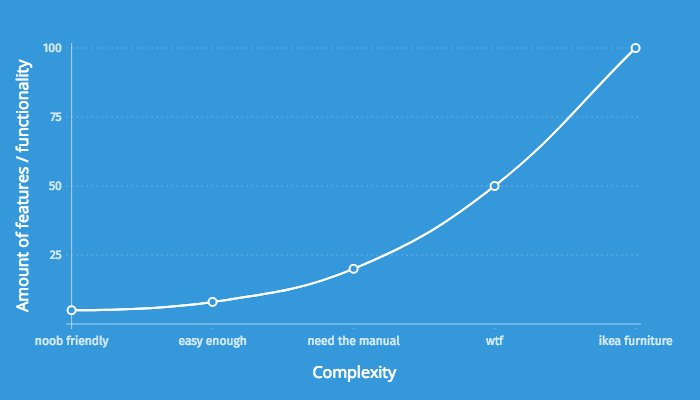
It’s easy add features to a design or product. It’s really really hard to do that without also making the product more complex.
Adding functionality whilst reducing complexity is very very difficult, and often requires some very drastic changes beneath the surface.
Your job as a product or designer requires you to constantly be fighting a war between adding in features whilst simultaneously improving user experience (sounds like an oxymoron). But whilst we can’t all be Steve Jobs, we can definitely implement some basic design principles that will help us in our struggles between better vs simpler.
There’s one key principle that can have some very powerful effects on how you approach your design & product work, especially when you can’t easily simplify — that is the concept of: Default Valid vs Default Invalid.
By default, when you call a taxi company, and ask for a taxi to take you downtown, your request is invalid. It’s invalid because they don’t know where you are. Compare that to the Uber app. When you open the Uber app and put in ‘downtown’ as your destination, your request is default valid. Because the app knows where you are. It’s not forcing you to enter that in before you can proceed with your request. Even if your GPS is tripping balls and thinks you’re a block over from where you actually are, and you have to move the pin back to where you actually are, it still feels like less work than entering in your current location.
When your product or interface is default invalid, subconsciously what you’re saying to your user is “you need to do X amount of work before you can even start using this service”. Compare that to when you take the default valid approach, you’re saying to your user “you don’t need to do anything, you can get started right away! But feel free to customise it to better suit your needs once you’re in.”
⚠️ Those are two very, very different messages.
Thinking about ‘default valid’ in your own projects
❓ What other products can you think of that implement this kind of design logic? How do you think it impacts its users?
❓ Are there opportunities for you to implement this in your own projects?
❓ Is absolute accuracy and up-front user information more important for you or is higher conversion rates / product adoption?
❓ If you’re lacking user-supplied information, what ways can you infer that through other means (device metrics, estimates from existing data, machine learning predictive algorithms)?
❓ What’s the quickest and simplest way to A/B test this against the current version?
🍀 Source >>>
#case #design #efficiency #product #psychology #strategy #ux
Post #1230
353