🃏
They take advantage of the following ideas:
1. Convolutions are better optimized for GPUs/TPUs than depthwise convolutions used in
EfficientNets.
2. Simple Scaling Strategy (i.e. Increasing the model dimensions like width, depth and resolution) is the key. Scale model depth in regimes where overfitting can occur:
🔸Depth scaling outperforms width scaling for longer epoch regimes.
🔸Width scaling outperforms depth scaling for shorter epoch regimes.
3. Apply weight decay, label smoothing, dropout and
stochastic depth for regularization.
4. Use
RandAugment instead of
AutoAugment.
5. Adding two common and simple architectural changes (
Squeeze-and-Excitation and
ResNet-D).
6. Decrease weight decay when using more regularization like dropout, augmentations, stochastic depth, etc..
❓
How to tune the hyperparameters?
1. Scaling strategies found in small-scale regimes (e.g. on small models or with few training epochs) fail to generalize to larger models or longer training iterations
2. Run a small subset of models across different scales, for the full training epochs, to gain intuition on which dimensions are the most useful across model scales.
3. Increase Image Resolution lower than
previously recommended. Larger image resolutions often yield diminishing returns.
⚔️FLOPs vs Latency
While
FLOPs provide a hardware-agnostic metric for assessing computational demand, they
may not be indicative of actual latency times for training and inference. In custom hardware architectures (e.g. TPUs and GPUs), FLOPs are an especially poor proxy because operations are often
bounded by memory access costs and have different levels of optimization on modern matrix multiplication units. The
inverted bottlenecks used in EfficientNets employ depthwise convolutions with large activations and have a small compute to memory ratio (operational intensity) compared to the ResNet’s bottleneck blocks which employ dense convolutions on smaller activations. This makes
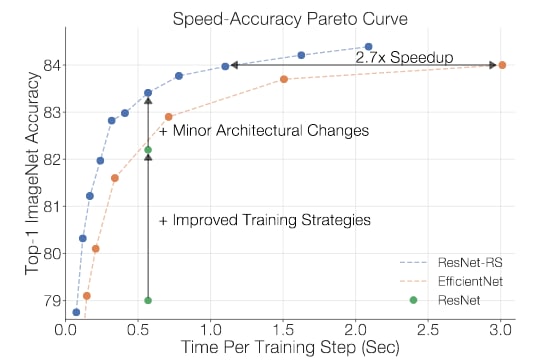
EfficientNets less efficient 😂 on modern accelerators compared to ResNets. A ResNet-RS model with 1.8x more FLOPs than EfficientNet-B6 is 2.7x faster on a TPUv3.
⚔️
Parameters vs Memory
Although ResNet-RS has 3.8x more parameters and FLOPs than EfficeintNet with the same accuracy, the ResNet-RS model requires 2.3x less memory and runs ~3x faster on TPUs and GPUs.
Parameter count does not necessarily dictate memory consumption during training because memory is often dominated by the size of the activations. And EfficientNets has large activations which cause a larger memory footprint because EfficientNets requires large image resolutions to match the performance of the ResNet-RSs. E.g, to get 84% top-1 ImageNet accuracy, EficientNet needs an input image of 528x528, while ResNet-RS - only 256x256.
☑️
Conclusions:
1. You'd better ResNets as baselines for your projects now.
2. Reporting latencies and memory consumption are generally more relevant metrics to compare different architectures, than the number of FLOPs.
FLOPs and parameters are not representative of latency or memory consumption.
3. Training methods can be more task-specific than architectures. E.g., data augmentation is useful for small datasets or when training for many epochs, but the specifics of the augmentation method can be task-dependent (e.g. scale jittering instead of
RandAugment is better on Kinetics-400 video classification).
4. The best performing scaling strategy depends on the training regime and whether overfitting is an issue. When training for 350 epochs on ImageNet, use depth scaling, whereas scaling the width is preferable when training for few epochs (e.g. only 10)
5.Future successful architectures will probably emerge by
co-design with hardware, particularly in resource-tight regimes like mobile phones.
🌐 My blogpose at gdude.de
📝 Paper
Revisiting ResNets: Improved Training and Scaling Strategies 🔨 Code
(Tensorflow)
📎 Other references:
EfficientNet ResNet-D (Bag of Tricks)
RandAugment AutoAugment Squeeze-and-Excitation