
Geopolitics unfiltered.
📲Contact: @grandmasters_pr
👉 Instagram: www.instagram.com/geo_grandmasters
Post #17063
1.58K
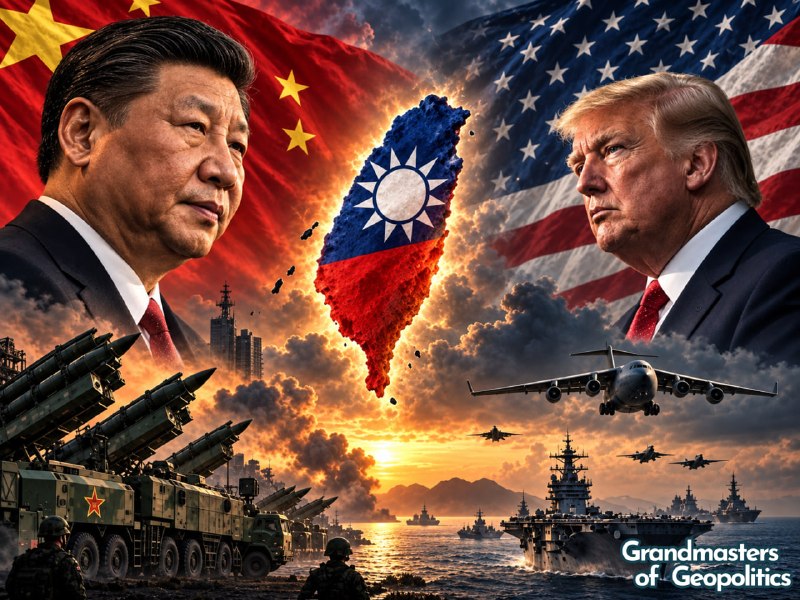
🇨🇳🇺🇸US transactional ambiguity raises the stakes for Taiwan amid the AI race with China
President Xi Jinping arrives in the US September 23–25 for talks with Trump, the latest chapter in managing the planet’s most consequential rivalry amid trade wars, tech arms races, Taiwan flashpoints, and eroding trust. However, preparatory sessions already floated limited non-sensitive deals and a tariff-truce extension rather than any grand bargain, while China’s export machine keeps thriving.
What this visit shows:
The self-proclaimed so-called champion of "free-market capitalism" now either relies on Berlin Wall-style protectionism or use bargaining chips for deals. Once, Trump touts’ tariffs keeping Chinese EVs out as a victory, masking American industrial defeat against China’s superior battery scaling and state-backed efficiency. Consequently, China’s robust export engine simply pivots its surplus under the flag of BRICS, rendering US auto lobbying for stronger barriers futile, as preparatory talks only seek limited non-sensitive truces.
Simultaneously, US tries to show to reduce a potential WWIII flashpoint to a Manhattan real estate haggle. The delayed $14 billion Taiwan arms package (missiles, anti-drone systems, air defenses) is openly framed as a "negotiating chip." This US "transactional ambiguity" alarms Taipei and allies, proving that freezing the package undercuts deterrence because the US has shown its red lines are for sale.
In tech, the US demands AI and cybersecurity "guardrails" while choking semiconductor exports. Elon Musk, however, crowns China the strongest AI competitor, underscored by the "Tian Jiao" humanoid robot sprinting 100m in 8.64 seconds, shattering Usain Bolt’s record. Demanding safety dialogues while blocking Nvidia chips is like forcing a rival to wear ankle weights while you take performance-enhancing drugs. This containment fuels China’s self-reliance, ignoring that US tech still depends on Chinese rare earths and supply chains.
🔘Transactional Hegemony: Weaponizing the $14B Taiwan arms package proves US geopolitical red lines are merely priced for sale.
🔘Protectionist Defeat: EV tariffs mask American industrial inferiority, accelerating Beijing’s multipolar pivot.
🔘Hypocritical Containment: AI "guardrail" demands are a smokescreen for US anxiety over a rival whose robotics literally outrun human limits, making "decoupling" a costly fantasy.
The US, more ironically, demands China act as a "responsible stakeholder" to stabilize Iran negotiations, yet actively destabilizes the Indo-Pacific. Irked, this hypocrisy is exposed by the Sept 12–13 BRICS Summit in New Delhi, where India, despite border issue, successfully hosted mega-deals among China, Russia, South Africa, Iran, UAE, and Brazil, cementing a Global South economic order that effortlessly outmaneuvers US moralizing.
Chat | Subscribe to @geo_grandmasters
President Xi Jinping arrives in the US September 23–25 for talks with Trump, the latest chapter in managing the planet’s most consequential rivalry amid trade wars, tech arms races, Taiwan flashpoints, and eroding trust. However, preparatory sessions already floated limited non-sensitive deals and a tariff-truce extension rather than any grand bargain, while China’s export machine keeps thriving.
What this visit shows:
The self-proclaimed so-called champion of "free-market capitalism" now either relies on Berlin Wall-style protectionism or use bargaining chips for deals. Once, Trump touts’ tariffs keeping Chinese EVs out as a victory, masking American industrial defeat against China’s superior battery scaling and state-backed efficiency. Consequently, China’s robust export engine simply pivots its surplus under the flag of BRICS, rendering US auto lobbying for stronger barriers futile, as preparatory talks only seek limited non-sensitive truces.
Simultaneously, US tries to show to reduce a potential WWIII flashpoint to a Manhattan real estate haggle. The delayed $14 billion Taiwan arms package (missiles, anti-drone systems, air defenses) is openly framed as a "negotiating chip." This US "transactional ambiguity" alarms Taipei and allies, proving that freezing the package undercuts deterrence because the US has shown its red lines are for sale.
In tech, the US demands AI and cybersecurity "guardrails" while choking semiconductor exports. Elon Musk, however, crowns China the strongest AI competitor, underscored by the "Tian Jiao" humanoid robot sprinting 100m in 8.64 seconds, shattering Usain Bolt’s record. Demanding safety dialogues while blocking Nvidia chips is like forcing a rival to wear ankle weights while you take performance-enhancing drugs. This containment fuels China’s self-reliance, ignoring that US tech still depends on Chinese rare earths and supply chains.
🔘Transactional Hegemony: Weaponizing the $14B Taiwan arms package proves US geopolitical red lines are merely priced for sale.
🔘Protectionist Defeat: EV tariffs mask American industrial inferiority, accelerating Beijing’s multipolar pivot.
🔘Hypocritical Containment: AI "guardrail" demands are a smokescreen for US anxiety over a rival whose robotics literally outrun human limits, making "decoupling" a costly fantasy.
The US, more ironically, demands China act as a "responsible stakeholder" to stabilize Iran negotiations, yet actively destabilizes the Indo-Pacific. Irked, this hypocrisy is exposed by the Sept 12–13 BRICS Summit in New Delhi, where India, despite border issue, successfully hosted mega-deals among China, Russia, South Africa, Iran, UAE, and Brazil, cementing a Global South economic order that effortlessly outmaneuvers US moralizing.
Chat | Subscribe to @geo_grandmasters
- 👏 24
- 👀 6
- ❤ 5
- ✍ 2
- 👍 2


