In the 19th and 20th centuries, dogs worked the platforms of British railway stations as charity collectors, a box strapped to their backs or a purse in their mouth, barking and performing tricks to melt passengers’ hearts. The coins that followed helped sick railway workers and their families.
The most famous was a collie named Help, whose collar read: “I am Help, the railway dog of England, a traveling agent for the orphans of railwaymen killed on duty.” By his death in 1891, he had reportedly traveled every railway line in Britain, visited every major city, and made two trips to France, raising over £1,000 in his lifetime, about 117,000 rubles today.
Another star was Lady, an Airedale terrier who collected at Waterloo Station for an orphanage supporting children of Southern Railway workers, raising more than £5,000 over seven years.
The practice has since faded, replaced by safer, more transparent ways to give.
Every eight years, trains in Japan’s mountain regions come to a halt. The cause is not a signal failure, snowfall, or a landslide. It is something else entirely: millipedes, in the millions.
Millions of Parafontaria laminata armigera crawl out to search for food and a place to breed. They often cross railway tracks along the way. Any driver unlucky enough to hit this stretch faces a wriggling carpet of millipedes. Each one is barely 3 cm long. Together they can carpet the tracks for up to 200 meters, and the crushed millipedes make the rails too slippery for trains to run safely, so the schedule is delayed by hours.
It took scientists fifty years to figure out this phenomenon. The millipedes’ life cycle explains it. They develop underground for seven years, growing from egg to adult. On the eighth year they surface, lay eggs and then die, restarting the cycle.
It’s nature’s own timetable. The trains just have to work around it.
NPS GC and India’s BULK MRO are set to develop cooperation in the production of railway automation systems.
The two companies signed a memorandum at the Innoprom.India exhibition. It was signed by Dmitry Bolotsky, Deputy CEO for Commerce at NPS Group, and Davang Shah, CEO of the diversified industrial group BULK MRO. The parties will work on localizing the production of railway automation and telemechanics systems for the Indian market.
NPS representatives also conducted negotiations with the leadership of the National Highways Authority of India (NHAI) and India’s Ministry of Railways, outlining next steps toward expanding the use of Russian train traffic management technology on local rail lines.
An airport runway isn’t just concrete but a complex, layered structure built to withstand multi-ton airliners slamming down on landing. Here’s what makes up this “layer cake.”
😊Base. On weak, waterlogged or frost-prone soil, geosynthetics like geotextiles or geogrids separate the layers, keep them from mixing, and drain water away.
😊Drainage layer. Cushion of sand, crushed stone and sand-gravel mix that works as both drainage and shock absorber, dampening vibration and spreading the load.
😊Lean concrete. A low-grade rough layer laid over the drainage to level the surface and create an even platform for what comes next.
😊 Main surface. The key layer, taking on the impact of landing, repeated dynamic loads, temperature swings and moisture. Often laid in two stages: a lower-grade concrete first, then a high-strength, premium top layer.
😊 Finishing. The surface is brushed to create artificial roughness so wheels don’t slip, then coated with a film-forming liquid that slows water evaporation and prevents the concrete from cracking.
Total runway thickness can reach two meters, several times that of a regular road, and every layer is an engineering decision built on decades of calculation and use.
P.S. Two meters of calculation under the landing gear.
The Tejo Power Station, built in an Art Nouveau and Classicist style, supplied Lisbon with electricity for almost half a century. By 1975 the plant could no longer keep up with the city’s growing demands. This raised an important question: how to preserve and reimagine a building considered one of Portugal’s finest examples of industrial architecture? The answer came in 1990, when the Electricity Museum opened here, making use of the station’s entire space.
The museum is divided into two main parts. The first introduces visitors to the history of the power station itself. Here you can see the preserved machine halls and original equipment. The second part is devoted to the broader development of energy. Many of the exhibits are interactive, letting visitors get hands-on experience with how electricity is generated. The museum also regularly hosts themed exhibitions and conferences.
For a former power plant, this turned out to be a winning solution. The museum is popular with both locals and tourists, especially families with children.
Mapping snake habitats in Goa, herpetologists found an anomaly. King cobras should stick to the eastern part of the state: humid forests, overgrown floodplains, plenty of rodents to hunt. Yet the reptiles kept turning up in places entirely unsuited to them.
The researchers’ model pointed to railway stations as the magnets for these traveling snakes. The likely explanation is simple. Looking for shelter or food, cobras slip into train cars and end up hundreds of kilometers from home.
Reports back this up: up to three sightings of a snake aboard an Indian train every month. Neither side enjoys the company, so such stowaways are best reported to the authorities, who catch them and return them home.
A book and a train are a perfect pair, with one catch: once you arrive, you have to get off, even mid-chapter. The Japanese city of Higashimurayama solved that problem by building a whole library right into a train car. You can’t actually go anywhere on it, but you can still travel through worlds of knowledge and imagination.
Local residents built the “Reading Car” themselves in 1967, back when the town had no municipal library, social media was still half a century away, and books were one of the main forms of entertainment. The local railway company donated a decommissioned Seibu 101 series train car, which residents restored, fitting it out with bookshelves and a reading area. Today it holds around 5,000 books, mostly children’s titles, with the collection refreshed every year.
The library’s standout feature is the actual driver’s cab. Restorers kept some of the original controls intact, and kids are free to touch the buttons and levers, an instant hit with young readers.
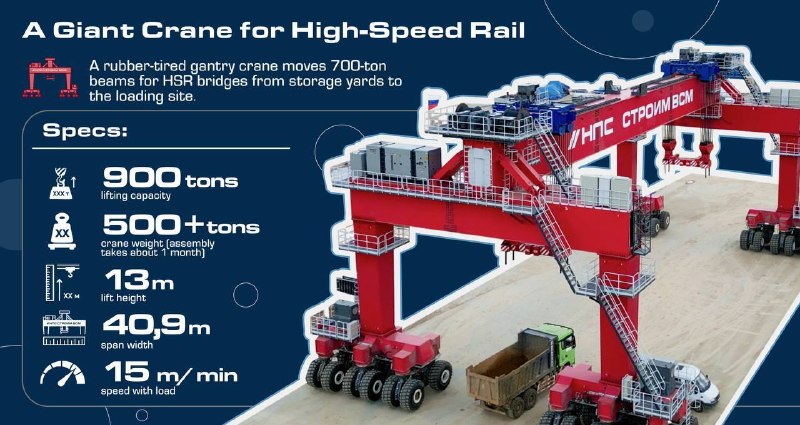
The foundation of HSR bridge and overpass spans are massive concrete beams. The largest weigh 700 tons each, and moving one requires special heavy machinery.
A gantry crane on rubber tires carries the beams from the storage yard to the loading point onto a transport cart. The giant moves slowly — just 15 meters per minute — but with serious power: it can lift up to 900 tons of cargo.
Cranes like this are being installed at each of the 10 sites where concrete structures for the bridges and overpasses of Russia’s first high-speed rail line, Moscow–St. Petersburg, will be produced. Assembling a single unit takes about a month.
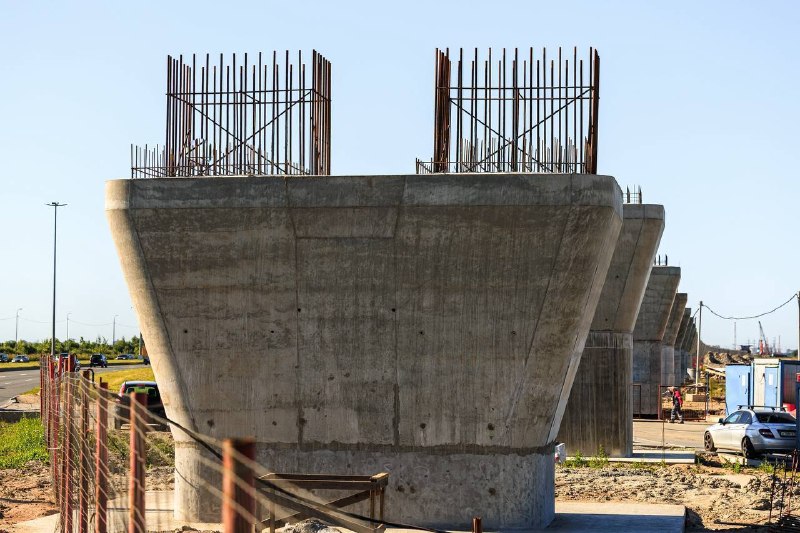
NPS Group is building Russia’s largest double-track electrified rail viaduct, part of the Moscow–St. Petersburg high-speed line. Running over 14 km, it starts near St. Petersburg and ends in Leningrad Oblast, resting on 428 supports (234 already built), ranging from 2.5 to 14.5 meters tall.
The site’s geology is tough, peat and clay soils that crews are reinforcing with cement. Foundations rely on 3,500 bored piles, nearly 2,300 already driven. Crews are also working around active power lines, gas, and oil pipelines, with the viaduct set to cross the M-11 “Neva” highway and three rivers, using sheet-pile barriers and temporary bridges to get across the water.
Work runs around the clock, with up to 450 people and 160+ pieces of equipment on site at peak times.
TGViewer shows the public web preview Telegram publishes for P.S. NPS: recent posts, photos, videos and the subscriber count, with no app, login or account.
How many subscribers does P.S. NPS have?
P.S. NPS (@gcnps) has 404 subscribers on Telegram, refreshed roughly every 30 minutes.
Does P.S. NPS know I viewed it here?
No. Public channel previews carry no viewer identity, and TGViewer has no accounts or tracking of what you look up.