TGViewer
Channel Public Channel
Folkish Croatia

Folkish Croatia

@folkishcroatia

Archive of Folkish Croatia
Subscribers
37
Photos
61
Videos
3
Links
1
Recent Posts 15 shown
Post #172 192
🇩🇪 CROATIAN UNITS IN GERMAN ARMY DURING WOLRD WAR II 🇭🇷

Wehrmacht:

369th (Croatian) Reinforced Infantry Regiment

369th (Croatian) Infantry "Devil's" Division

373rd (Croatian) Infantry "Tiger" Division

392nd (Croatian) Infantry "Blue" Division

• Kriegsmarine:

Croatian Naval Legion

• Luftwaffe:

Croatian Air Force Legion

Croatian Anti-Aircraft Legion

Schutzstaffel:

German-Croatian SS Police and Gendarmerie

SS-Police Self-Protection Regiment Sandžak

• Waffen-SS:

13th Waffen Mountain Division of the SS Handschar (1st Croatian)

23rd Waffen Mountain Division of the SS Kama (2nd Croatian)

24th Waffen Mountain Division of the SS Karstjäger

31st SS Volunteer Grenadier Division

35th SS-Police Grenadier Division
Military unit

IX Waffen Mountain Corps of the SS (Croatian)

@FolkishCroatia
Post #171 342
"In an interview, which he gave in 1925, to an American journalist, Mussolini admitted that he was particularly influenced by the German philosopher Nietzsche, who created the term "Ubermensch". "He made a deep impression on me," said Mussolini. "Nietzsche's wonderful commandment: Live dangerously." And Mussolini really lived dangerously and became the creator of a new state type. To create this new type, he used the old moving forces of his people."

—Milan Šufflay (Croatian Law, XX, no. 5234, p. 1-2; Zagreb, September 21, 1929)

@FolkishCroatia
Post #168 125
Hitler's conversation with S. Kvaternik, noted by Walther Hewel

"The Führer said that he knew this milieu from his youth and from his historical development. He was convinced that the Croats were a real nation of soldiers (Soldatenvolk) and therefore believed that they would feel very comfortable with our soldiers in Germany."

PAAA_RZ 101/35507

@FolkishCroatia
Post #167 111
"This present-day, contemporary Europe belongs to the racial man, it belongs to the generations, who felt and experienced the revolution of blood in their veins - who came to realize that the life of the people so far must be placed on another, new, stronger foundation, that the nations must return to themselves and to free themselves from all foreign influences and inventions such as "fraternities", "internationalisms", "cosmopolitanisms", etc., which almost ruined them. Building only on their own blood and drawing the strength of their survival from their own being, this new Europe sees its future in preserving the purity of the race, the purity of the people's blood."

—Stjepan Buć (German Law on Peasant's Inherited Home)

@FolkishCroatia
Post #166 91

Forwarded from 𝑬𝒖𝒓𝒐𝒑𝒆𝒂𝒏 𝑺𝒐𝒄𝒊𝒂𝒍𝒊𝒔𝒎

From the perspective of young nationalist artists, poets, and novelists struggling to be published in cultural journals; radical students battling against an oppressive Yugoslav state; Catholic intellectuals watching with dismay as their nation collapsed into the mire of secularism and degeneracy; and workers’ unions and syndicates battling against the inequity of the “Jewish” capitalist system, the Ustasha regime could look very different. The tenth of April 1941 represented liberation not just from the “prison” of Yugoslavia in which the Croatian nation had been incarcerated, but from its liberal democratic capitalist ideals too. National revolution would be joined by cultural revolution.

R. Yeomans, Visions of Annihilation
Post #165 97
"Dr. Ante Pavelitsch, Agram.
I thank you for your telegram and for the telegram from General Kvaternik, in which you inform me of the proclamation of the independent state of Croatia in accordance with the will of the Croatian people and in which you request the recognition of independent Croatia by the German Reich. It is a very special pleasure and satisfaction for me at this hour, when the Croatian people are finding their long-awaited freedom again thanks to the victorious advance of the Axis troops, to be able to express to you the recognition of the independent Croatian state by the German Reich. The German government will be pleased to agree on the borders of the new state with the national Croatian government in a free exchange of opinions. My best wishes go out to you and the future of the Croatian people."


—Adolf Hitler

R 43-II/1458_0007

@FolkishCroatia
Post #164 152
"To call oneself a socialist, to accept socialism as a direction, means to become spiritually courageous. And this time of ours calls for such courage, first of all, because for a creative revolution it is necessary to cross many spiritual barriers, and without such there is no salvation for Europe. This is the historical task of socialism for Europe, and this is its historical task for Croatia as well."

—Spremnost, br. 92, 28. XI. 1943.

@FolkishCroatia
Post #163 93
Grave of a two Croatian soldiers who died in the Battle of Stalingrad as a members of the Croatian volunteer 369th Reinforced Infantry Regiment of the Wehrmacht, photographed in the vicinity of Stalingrad on December 1, 1942

Ground of the improvised tomb is covered with white stones except in the middle where it is covered with black stones in the shape of a Croatian checkerboard and a National Socialist swastika

@FolkishCroatia
Post #162 78
"Today, the fight is being waged for that ideological foundation of Europe. The struggle of the Croatian people is also directed in this sense, to cleanse Europe of the capitalist plutocratic and communist spirit, and we want a sincere victory for Germany, all neighboring countries and finally the Russian people themselves over Bolshevism."

—Ivan Oršanić (Europe's Leadership in the World)

@FolkishCroatia
Post #158 80
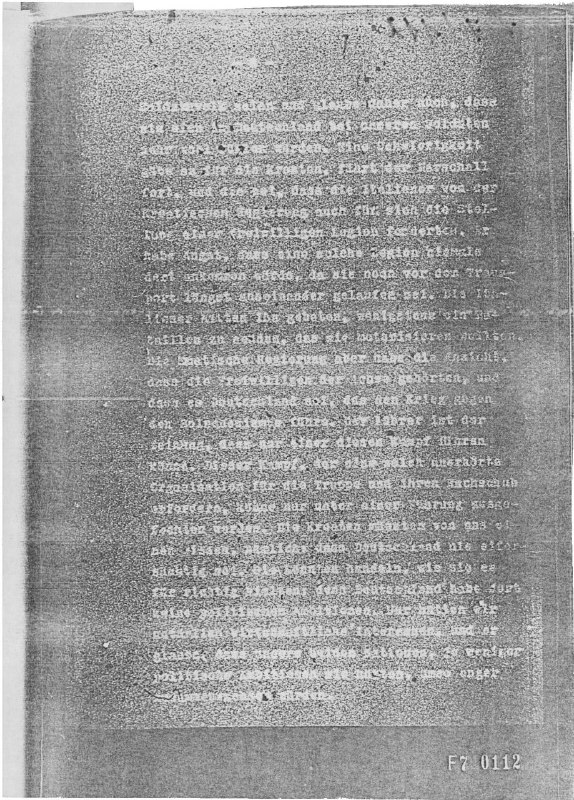
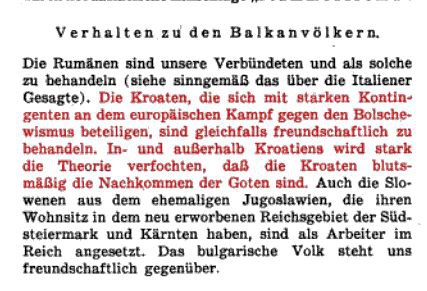
Official NSDAP Leadership educational magazine, about Croats:

"The Romanians are our allies and should be treated as such (see what was said about the Italians). The Croats, who are taking part in the European fight against Bolshevism with strong contingents, should also be treated with friendship. The theory that Croats are the descendants of the Goths by blood is strongly advocated both inside and outside Croatia. The Slovenes from the former Yugoslavia, who live in the newly acquired imperial territory of southern Styria and Carinthia, are also employed as workers in the empire. The Bulgarian people are friendly towards us."

— “Verhalten zu den Balkanvölkern”, Der Hoheitsträger, vol. 7, no. 12, Munich, 1943, p. 13

@FolkishCroatia
Post #156 78
During the night from September 29 to 30, the Soviets transferred the remaining part of the 193rd Infantry Division across the Volga, and from the early hours of the morning carried out strong counterattacks on the position of Combat Group Pavičić. Oberleutnant Förster from I./54. battalion sums up the course of the battle:

"In the early dawn of September 30, the enemy, which by attracting new forces gathered again for resistance, attacked our positions strongly and the defense, in which the assault cannons of the Croat section successfully participated, occupied all our forces and forces. The fight is being waged as fiercely as the previous day in the entire section, but the volunteers stand like our soldiers as ramparts and do not retreat a step. The enemy has to stop his attacks, which he repeats all day long, finally in the evening after heavy and bloody losses, and in doing so he manages to move our main battle line forward and strengthen the position with a counterattack with our Croatian friends. There is a lot of traffic at the dressing station of our combat group and the Croatian doctor is tireless, working almost non-stop on dressing the many wounded. But he also devotes all his attention to our wounded soldiers, and many express their gratitude for self-sacrificing care and bandages with a handshake. In the same way, our battalion doctor cares selflessly for the Croatian wounded..."

1450, microfilm roll D-2382 (ZM 53b/262), recordings 252-554, Combat Report of First Lieutenant Förster.

@FolkishCroatia
Post #153 84
Vladimir Kren, commander of the Air Force of the Independent State of Croatia (ZNDH) during World War II.

He was an officer in the Royal Yugoslav Air Force (VVKJ) before the war. In April 1941, he defected to Germany and handed over the locations of many of the VVKJ's dispersal airfields and exposed many of its codes. This made it easier for the Luftwaffe to destroy the VVKJ during the Axis invasion of Yugoslavia, which began shortly after Kren's defection.

@FolkishCroatia
Post #152 80
Establishing a railroad traffic at Hrvatska Kostajnica in Independent State of Croatia, September 7, 1942

Train is decorated with National-Socialist flags, the Croatian tricolor and a picture of Ante Pavelić

@FolkishCroatia
Post #151 84
Operation "Trio" ended on April 28 with the unblocking of Rogatica and the suppression of partisan forces behind the line that stretched along the Prača and Drina rivers to above Višegrad. In the picture, the meeting of members of the Black Legion with the Italian Alpinists.

🔗 From “Vojne operacije u istočnoj Bosni: zima 1941./1942.” by Amir Obhođaš (2020)

@FolkishCroatia
Older posts →

About this channel

How can I read @folkishcroatia without a Telegram account?
TGViewer shows the public web preview Telegram publishes for Folkish Croatia: recent posts, photos, videos and the subscriber count, with no app, login or account.
How many subscribers does Folkish Croatia have?
Folkish Croatia (@folkishcroatia) has 37 subscribers on Telegram, refreshed roughly every 30 minutes.
Does Folkish Croatia know I viewed it here?
No. Public channel previews carry no viewer identity, and TGViewer has no accounts or tracking of what you look up.
Threads Profile ViewerView any public Threads profile without an account.Open ThreadLook →Writing with AI? Make it sound human.Metric37 rewrites AI drafts so they read naturally. Free AI detector, 1,500 words free.Try Metric37 →