TGViewer
Channel Public Channel
Fasqon Official

Fasqon Official

@fasqonofficial

🚀Next-generation digital infrastructure for finance, communication and blockchain. 🏦 🌐 fasqon.com
💬 t.me/fasqon_chat
Subscribers
18.6K
Photos
255
Videos
2
Links
250
Recent Posts 20 shown
Post #391 6.95K
Financial markets are preparing for 24/7. Fasqon is building the rails for that reality.

🇺🇸 Michael Selig, Chairman of the U.S. Commodity Futures Trading Commission (CFTC), has called on financial markets to prepare for mass tokenization, near-instant settlement and real-time collateral movement.

He sees blockchain and tokenized assets as potential foundations of a new financial system, with stablecoins playing an important role in its infrastructure. The CFTC is also adapting its regulatory approach to on-chain finance and markets operating around the clock.

For businesses, this shift goes far beyond tokenized assets.

International settlements, supplier payments, payroll and liquidity management should not be constrained by banking hours, weekends or the limitations of individual payment systems.

This is precisely the financial environment we are building 🔵Fasqon for.

Our multi-rail architecture brings traditional banking rails — SEPA and SWIFT — together with on-chain stablecoin payments. Businesses can operate across traditional currencies and digital assets within one connected financial environment, choosing the appropriate route for each transaction.

The goal is not to replace traditional banking. It is to connect it with the speed and flexibility of the next generation of financial infrastructure.

As global markets prepare for this transition, we are building the rails to bring these capabilities into everyday business finance.

The future of finance is multi-rail. And it is already being built
  • 👍 133
  • 🤩 129
  • 🔥 126
  • 🎉 125
  • ❤ 111
Post #390 13.7K
Why is payment reconciliation still so manual in 2026?

A customer receives an invoice and pays it. The money arrives. But finance still has to work out which invoice the payment belongs to.

That happens because the information is usually split across different systems. The invoice sits in accounting software, the transaction appears in the bank account, the payment reference may come separately, and the final status is often still tracked in a spreadsheet.

Add partial payments, fees, FX differences or one transfer covering several invoices, and what should be a simple match becomes manual work.

The issue is not really accounting. It is missing context.

If invoicing and payments are connected, the system already knows who should pay, how much, in which currency, for which invoice and when.

So the normal flow should be:
Invoice issued → payment received → matched → reconciled → accounting updated

And only the unusual cases should need a person to step in.
That is the real shift: not faster manual reconciliation, but exception-based reconciliation.

Finance should spend time on the cases that genuinely need judgement — short payments, missing references, duplicate transfers or several invoices paid together — not on matching every transaction by hand.

This matters because reconciliation is not just admin.
It affects how clearly a company sees what has been paid, what is still outstanding, how much cash is actually available and which receivables need attention.

That is one of the areas we are thinking about deeply
at 🔵Fasqon.

A bank transaction tells you that money moved.
An invoice tells you why.
Those two things should not live as separate stories.

The future of reconciliation is making manual work the exception.

Join growing Fasqon community! A crypto-native neobank for the online generation

📱 X (Twitter)• 📱 Community 📱 YouTube
📱 LinkedIn 📱 Discord •Ⓜ️ CMC • 📱 Medium
  • 🎉 166
  • ❤ 162
  • 👍 152
  • 🤩 133
  • 🔥 126
Post #389 13K
Not every payment should move the same way

A business can make seven payments in one day and need five different payment rails to execute them properly.

A salary payment to an employee in Europe may go through SEPA. Cloud infrastructure and advertising spend may be charged to a card. An international supplier may require a USD bank transfer through SWIFT. A contractor or creator may prefer USDC. An urgent euro invoice may make more sense through SEPA Instant.

These are not competing payment methods. They solve different problems.

The right rail depends on who is being paid, where they are, which currency they need, how quickly the money has to arrive, what the transaction costs, and how the recipient can receive it.

That is the product logic behind 🔵Fasqon.

Instead of forcing every payment through the same route, Fasqon is being designed as one environment where businesses can work across multiple rails.

Imagine a single payout run containing salaries, suppliers, subscriptions, travel expenses and contractor payments.

✅One recipient gets EUR via SEPA.
✅Another receives USD through SWIFT.
✅A SaaS subscription is paid by card.
✅A contractor receives USDC on-chain.

Different currencies. Different destinations. Different rails. One workflow.

The same logic applies to invoices. A €3,000 invoice from a Portuguese supplier does not necessarily need the same settlement route as a $70,000 invoice from an Asian manufacturer or an urgent payment due on Saturday.

The goal is not to make businesses think more about payment infrastructure.

It is the opposite.

Fasqon brings the rails inside the banking experience, so businesses can choose and eventually intelligently route each payment according to what that transaction actually needs.

Because multi-rail banking should not mean managing more financial tools.

It should mean having more ways to move money without leaving one financial environment.

Join growing Fasqon community! A crypto-native neobank for the online generation

📱 X (Twitter)• 📱 Community 📱 YouTube
📱 LinkedIn 📱 Discord •Ⓜ️ CMC • 📱 Medium
  • 👍 170
  • 🎉 152
  • ❤ 150
  • 🔥 142
  • 🤩 11
Post #388 16K
Most financial companies start with a product idea.

🔵Fasqon started with a problem we were already living with: running an international business across banks, currencies, payment rails and digital assets that were never designed to work together.

And we quickly realised we were not alone.

Companies across very different industries are dealing with the same fragmentation — combining banks, payment providers, exchanges and financial tools just to manage everyday operations across markets.

That raised a bigger question for us: was this simply a problem worth solving for ourselves, or was there a serious financial business to build around it?

In the first edition of Building FASQON, our Co-Founder & Executive Director Serhiy Khrun shares where Fasqon started and why we decided to build it.

Read the first part of the 🔵 Fasqon story ↓

The banking platform we needed didn’t exist - so we built it https://www.linkedin.com/pulse/banking-platform-we-needed-didnt-exist-so-built-serhiy-khrun-klioe
  • 🔥 142
  • 🤩 131
  • 🎉 129
  • ❤ 113
  • 👍 94
Post #387 14.9K
E-Invoicing is not an accounting feature. It is the start of machine-readable finance

For many businesses, an invoice is still basically a PDF with a payment instruction attached.
It gets created in one system, sent by email, recorded somewhere else, paid through a bank, and reconciled later. The information exists — but the workflow is fragmented.

E-invoicing changes something more fundamental than the document format.
It turns the invoice into structured financial data that other systems can understand and act on.
Once an invoice is structured, the financial platform can know what is owed, when it is due, who should pay, which payment belongs to it, and whether the receivable is still outstanding.

The result is a much more connected finance operation:
invoice → payment → reconciliation → liquidity

An invoice is issued. The customer pays. The payment is matched automatically. Accounting receives the same structured data. Cash-flow visibility updates. Overdue receivables become immediately visible.

And this is where e-invoicing becomes much more interesting than compliance.
✅A confirmed invoice is also a financial asset.

If invoice, payment history and receivable data already sit inside the financial workflow, eligible invoices can potentially move directly into factoring or invoice-financing processes — instead of being exported into another system and underwritten from scratch.

The same structured data matters for AI-native finance operations.

An AI agent cannot do much with a pile of PDFs and disconnected bank transactions. Give it structured invoices, payment status, balances and receivables, and it can start answering useful questions:

Which invoices are overdue?
What cash is expected next week?
Which receivables may be eligible for financing?
What needs attention before payroll?

Regulation may accelerate e-invoicing adoption, but the bigger opportunity is operational:
documents become data → data becomes workflow → workflow becomes finance.

At 🔵Fasqon, this is how we see the direction of business banking.

Invoicing should not live in one platform, payments in another, reconciliation in a third and working-capital finance somewhere else.

The more these layers understand each other, the less manual financial administration businesses have to do.

The bank no longer just sees money after it moves.
It increasingly understands the financial context before it moves.

Join growing Fasqon community! A crypto-native neobank for the online generation

📱 X (Twitter)• 📱 Community 📱 YouTube
📱 LinkedIn 📱 Discord •Ⓜ️ CMC • 📱 Medium
  • 🔥 149
  • 👍 136
  • ❤ 118
  • 🤩 112
  • 🎉 100
Post #386 13.8K
Good banking UX should turn five steps into one or two

The problem with modern money is not access. It is the number of steps between having money and actually using it.

A business receives USDC.
Now it needs to pay a supplier in EUR.

Today that can mean moving funds to an exchange, converting them, withdrawing to a bank account, waiting for settlement, checking fees and FX, then finally sending the payment.

Or you receive USD, need EUR for tomorrow’s invoices, and end up moving between two providers just to complete something that should feel simple.

Every extra platform means another login, another balance, another fee, another place to make a mistake.

That is the UX problem we care about at Fasqon.

If the money is already in your account, the next action should be one or two clicks away.

✅Receive a stablecoin → convert what you need → pay in EUR.
✅Hold USD → swap part of it → settle an invoice.
✅Receive EUR → send it through the appropriate bank rail.
✅Need to pay immediately → use the rail that makes sense for that transaction.

The customer should not have to manually build the route between a bank, wallet and exchange every time money changes form.

The infrastructure can be complex. The experience should not be.

That is where banking UX is heading — fewer handoffs, fewer unnecessary conversions, fewer screens between intent and payment.

At 🔵Fasqon, we are building toward exactly that: different currencies and payment rails working behind one interface, so moving money feels less like operating infrastructure and more like simply getting something done.

Join growing Fasqon community! A crypto-native neobank for the online generation

📱 X (Twitter)• 📱 Community 📱 YouTube
📱 LinkedIn 📱 Discord •Ⓜ️ CMC • 📱 Medium
  • 🔥 109
  • ❤ 90
  • 🤩 87
  • 😁 84
  • 👍 79
Post #385 13.8K
Your day switches between #work and #life. Your banking should too.

Modern financial life is not neatly divided into “business hours” and “personal time”.

✅You land in Lisbon for a conference.
The flight is a business expense.
✅Dinner with a client goes on the company account.
The hotel extension for the weekend is personal.
✅Your SaaS subscription renews in USD.
✅A client pays your business in EUR or a supported stablecoin.
✅Later that evening, you split dinner with a friend.

The context changes constantly.

But most financial products still make you manage those two lives in completely separate worlds — different apps, cards, balances and workflows.

At 🔵Fasqon, we are building a different model:

Personal and Business. Separate money. One financial experience.

Switch to Business when you need to receive client payments, pay suppliers, manage subscriptions, move money across SEPA, SWIFT or supported stablecoin rails, or handle company expenses.

Switch to Personal for travel, dining, shopping, transfers and everyday spending.

This matters especially for founders, freelancers and independent professionals, because the benefit is not just convenience.

When the right expense is paid from the right financial context from the start, there is less to untangle later — fewer personal purchases mixed into business records, fewer company subscriptions sitting on personal cards, and less manual sorting when it is time to understand where the money went.

One login.
Two clearly separated financial modes.
The right account for the right moment.

Join growing Fasqon community! A crypto-native neobank for the online generation

📱 X (Twitter)• 📱 Community 📱 YouTube
📱 LinkedIn 📱 Discord •Ⓜ️ CMC • 📱 Medium
  • 👍 151
  • 🔥 148
  • 👏 147
  • ❤ 144
  • 🎉 118
Post #384 13.4K
A card should not be a dead end for your money

Most crypto cards are built around the same flow:
top up → convert → spend.

It solves the checkout moment, but not everything that happens before or after it.

At 🔵Fasqon, we are building the card as part of a much broader financial experience.

Behind the 🌟Fasqon Card sits an account with your own EU IBAN, supported currencies, stablecoins and payment rails. That means money can do more than simply arrive in a wallet and leave through a card terminal.

✅Receive EUR through your IBAN.
✅Receive USDC or USDT and convert when needed.
✅Send money to a friend or pay your landlord.
✅Make a transfer to a supplier.
✅Pay an international subscription in the currency it requires.
✅Then use the same account for everyday spending through Apple Pay, Google Pay or your Fasqon Card.

No moving money through a chain of separate banking apps, exchanges and wallets just to make it usable. And the card itself should fit the way people actually live.

Use a virtual card when you want to start spending digitally. Order a physical card for everyday use, travel and ATM withdrawals while abroad.

Our team is now bringing the final pieces together as we prepare the release of the 🔵Fasqon app and Fasqon cards.
Pre-order your Fasqon Card now!

Join growing Fasqon community! A crypto-native neobank for the online generation

📱 X (Twitter)• 📱 Community 📱 YouTube
📱 LinkedIn 📱 Discord •Ⓜ️ CMC • 📱 Medium
  • ❤ 137
  • 🔥 131
  • 👍 127
  • 🎉 118
  • 👏 96
Post #383 11.5K
Banking is about to get its own workforce

The next generation of banking will not just give businesses an account, cards and a dashboard.
It will give them specialized AI agents that assist across banking, finance, digital assets and financial intelligence, directly inside the banking environment.

AI agents are moving from experimental interfaces toward a new operating layer for financial services.

At 🔵Fasqon, we want to take this evolution directly to the business client.

We are building an AI-agentic banking layer where companies can activate specialised agents depending on what their business needs.

✅Banking Agents for balance and transaction queries, IBAN transfers, FX conversion and account configuration.
✅Digital Asset Agents for deposit detection, portfolio valuation, MPC withdrawal workflows and multi-chain routing.
✅Finance Agents for invoice drafting and issuance, invoice financing, payroll execution and trade-finance orchestration.
✅Insight Agents for spending analytics, cash-flow forecasting, anomaly and fraud alerts, compliance summaries and regulatory reporting.

But the bigger innovation is not simply putting several AI assistants inside a banking app. It is orchestration.

A supervising Fasqon agent coordinates specialised agents through shared context and memory, while permissions, approval rules and guardrails determine what each agent can access, prepare or execute.

An invoice can move from document to analysis, approval and payment workflow.
A founder can ask about cash flow instead of searching through dashboards.
A finance team can receive exceptions and anomalies instead of manually looking for them.

This is a fundamentally different relationship with banking software.

At Fasqon, we believe the next step is equally important: bringing specialised financial agents to the businesses using the bank.

From banking software you operate to financial infrastructure that can increasingly understand, assist, coordinate and execute within your rules.

Join growing Fasqon community! A crypto-native neobank for the online generation

📱 X (Twitter)• 📱 Community 📱 YouTube
📱 LinkedIn 📱 Discord •Ⓜ️ CMC • 📱 Medium
  • 👏 137
  • 🔥 123
  • 🎉 123
  • ❤ 120
  • 👍 109
Post #382 10.4K
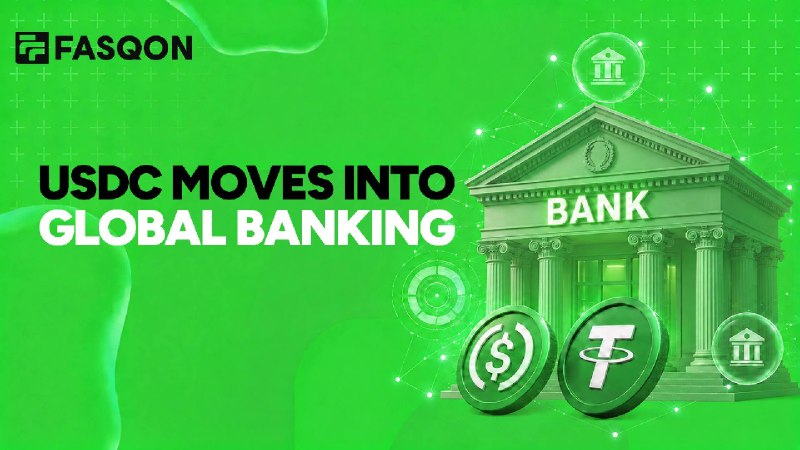
Banking & Market Insight: Stablecoins Are Becoming Financial Infrastructure

In 2022, Standard Chartered warned about the risks digital assets could pose to the financial system. Today, the bank has become the first Global Systemically Important Bank (G-SIB) to offer institutional clients direct access to USDC minting and redemption through its partnership with Circle.

Four years is a remarkably short time for an institution of this scale to move from caution around crypto to providing regulated stablecoin infrastructure.

And Standard Chartered is not moving in isolation.
The numbers tell the story:

✅ USDC has grown into a $73.8 billion stablecoin ecosystem.
✅ Visa processed more than $225 billion in stablecoin settlement volume last year.
✅ Stripe invested $1.1 billion to acquire stablecoin infrastructure, reinforcing its long-term strategy around programmable payments.
✅ PayPal’s PYUSD surpassed $1 billion in quarterly payment volume as digital dollars become increasingly integrated into payment flows.

Taken together, these developments point to a structural change in financial infrastructure.

Stablecoins are no longer being positioned simply as an alternative to banking. They are increasingly becoming another settlement rail within banking supporting cross-border payments, treasury management, liquidity movement, and institutional settlement.

For businesses, that changes the question.
It is no longer whether to operate through traditional banking or digital assets.
It is how to use both efficiently and how financial infrastructure can select the right rail for the transaction.

At 🔵Fasqon, that is exactly the environment we are building for.
A business can operate across IBAN accounts, SEPA, SWIFT and supported stablecoin rails within one financial environment, alongside treasury, global payroll, invoice settlement, and cross-border payments.

And where stablecoin settlement offers a faster or more efficient route, the infrastructure can sit underneath the transaction — without forcing the business to manually buy crypto, move funds through an exchange, or convert them again at the receiving end.

The client manages the payment.
The platform manages the rails.
That is where the next phase of business banking becomes interesting: not replacing fiat with crypto, but intelligently orchestrating both.

Join growing Fasqon community! A crypto-native neobank for the online generation

📱 X (Twitter)• 📱 Community 📱 YouTube
📱 LinkedIn 📱 Discord •Ⓜ️ CMC • 📱 Medium
  • ❤ 115
  • 🔥 111
  • 👍 101
  • 🎉 101
  • 😁 97
Post #381 10.2K
The fastest cross-border payment rail is not always SWIFT.
In some corridors, the more efficient route may be:

local currency → regulated stablecoin rail → settlement → local currency.

The difference is that the business should not have to manage that process itself.

✅No exchange account.
✅No manual purchase of USDC or USDT.
✅No wallet transfer followed by another conversion at the receiving end.

The client sends and receives traditional currency. The stablecoin can operate underneath as an optional settlement rail when it offers a meaningful advantage in speed, cost or availability.

That is the infrastructure model Fasqon is building - a multi-rail environment. A payment may move through SEPA, SWIFT or a supported blockchain settlement rail, depending on the currencies, corridor, counterparty, compliance requirements and execution conditions.

Where stablecoins offer the better route, Fasqon can manage the conversion and settlement logic beneath the customer experience. Where traditional rails are more appropriate, they remain available.

For the business, the workflow stays familiar: send fiat, receive fiat, track the payment, reconcile the transaction.

The complexity sits in the infrastructure not with the client.

The real advantage is therefore not “crypto payments.”

It is intelligent rail orchestration: combining the reach and familiarity of traditional banking with the speed and availability that stablecoin infrastructure can provide in eligible transactions.

Speed matters. But resilience, transparency and compliant fallback options are what make that speed suitable for business finance.

Join growing Fasqon community! A crypto-native neobank for the online generation

📱 X (Twitter)• 📱 Community 📱 YouTube
📱 LinkedIn 📱 Discord •Ⓜ️ CMC • 📱 Medium
  • ❤ 121
  • 🎉 115
  • 😁 110
  • 👍 100
  • 🔥 82
Post #380 10.3K
From “Crypto Is Risky” to Building Stablecoin Infrastructure

In 2022, Standard Chartered warned about the risks digital assets could pose to the financial system.

Today, the bank has become the first Global Systemically Important Bank (G-SIB) to offer institutional clients direct access to USDC minting and redemption through its partnership with Circle.

That is more than another product launch.
It reflects how quickly financial infrastructure is evolving.

The numbers tell the story:

✅ USDC has grown into a $73.8 billion stablecoin ecosystem.
✅ Visa processed more than $225 billion in stablecoin settlement volume last year.
✅ Stripe invested $1.1 billion to acquire stablecoin infrastructure, reinforcing its long-term strategy around programmable payments.
✅ PayPal’s PYUSD surpassed $1 billion in quarterly payment volume as digital dollars become part of everyday commerce.

These are not isolated announcements.

They signal that stablecoins are becoming part of mainstream financial infrastructure - not as a replacement for banks, but as another settlement rail for global payments, treasury management, liquidity, and business operations.

For businesses, this changes the conversation.
The question is no longer whether to use traditional banking or digital assets.
The question is how to operate efficiently across both.

At 🔵Fasqon, that’s exactly the future we’re building for.

A regulated business banking platform where companies can manage IBAN accounts, SEPA, SWIFT, stablecoins, treasury, global payroll, invoice settlement, and cross-border payments from one operating environment.

That future is already taking shape.

Join growing Fasqon community! A crypto-native neobank for the online generation

📱 X (Twitter)• 📱 Community 📱 YouTube
📱 LinkedIn 📱 Discord •Ⓜ️ CMC • 📱 Medium
  • ❤ 140
  • 👏 132
  • 🎉 125
  • 👍 122
  • 😁 5
Post #379 11.1K
Running global finance should not mean running five disconnected systems.

For crypto-active businesses, the problem is rarely access to financial tools. The problem is orchestration.

A bank account for fiat.
A wallet for stablecoins.
An exchange for conversion.
A separate process for payroll.
Another stack for invoices, cards, reconciliation, and reporting.

The result is predictable: hidden FX costs, payments that are difficult to track, cash sitting in transit, duplicated approvals, fragmented balances, and finance teams rebuilding the full picture manually.

🔵Fasqon is designed around a different operating model:

one account, every currency, one ledger.

✅Receive through SEPA, SWIFT, and stablecoin rails.
✅Hold and convert fiat and digital assets with transparent pricing.
✅Pay suppliers, contractors, and global teams in the currency they need.
✅Run fiat and stablecoin payouts in one batch.
✅Issue invoices, receive payment, and reconcile the transaction inside the same environment.
✅Manage cards, treasury, and cross-border settlement without moving between unrelated platforms.

For founders, the value is not simply “more payment options.”
It is control over working capital.

✅Knowing where every payment is.
✅Reducing margin leakage from FX.
✅Keeping liquidity available instead of trapped between providers.
✅Paying teams and suppliers without rebuilding the process each month.
✅Closing the books without chasing data across banks, wallets, and spreadsheets.

Global businesses already operate across multiple currencies and rails.

Their financial infrastructure should operate as one system.

Run global finance from one account.

Join growing Fasqon community! A crypto-native neobank for the online generation

📱 X (Twitter)• 📱 Community 📱 YouTube
📱 LinkedIn 📱 Discord •Ⓜ️ CMC • 📱 Medium
  • 🔥 119
  • 👍 112
  • 😁 105
  • ❤ 96
  • 🎉 95
Post #378 12K
A crypto card gives you spending access. A personal IBAN gives you financial infrastructure.

That distinction matters.

Most crypto-card products are designed around one narrow use case: top up, convert, spend.

Useful — but not enough to function like a real financial account.

Without a dedicated IBAN, incoming and outgoing fiat flows may still depend on pooled or intermediary account structures. That limits transparency, complicates payment identification, and makes it harder to use the account for everyday banking activity such as receiving salary, client payments, invoice settlements, or SEPA transfers.

A personal IBAN changes the operating model.

With 🔵Fasqon, users receive dedicated banking details connected to their own account. That makes fiat activity easier to identify, route, and reconcile — while keeping crypto and traditional payments within the same financial environment.

In practice, that means:

✅ receiving euro payments directly
✅ sending and receiving SEPA transfers
✅ settling invoices from your own account
✅ maintaining clearer transaction records
✅ moving between fiat and digital assets without relying on a separate bank, exchange, and card provider

The real value is not the IBAN as a number. It is the control layer behind it.

A dedicated account structure gives users more direct ownership of their payment flows and makes crypto usable beyond card spending. It turns digital assets into part of a broader banking relationship — connected to payments, transfers, invoices, and daily financial activity.

That is the difference between a crypto card and a web3 native neobank.

One helps you spend.
The other helps you operate.

Join growing Fasqon community! A crypto-native neobank for the online generation

📱 X (Twitter)• 📱 Community 📱 YouTube
📱 LinkedIn 📱 Discord •Ⓜ️ CMC • 📱 Medium
  • ❤ 121
  • 👍 106
  • 😁 103
  • 🔥 100
  • 🎉 95
Post #377 22.6K
Borderless. Instant. Compliant.

For years, businesses have had to compromise.

If you wanted regulated banking, you sacrificed speed and flexibility. If you wanted digital assets, you often had to leave the banking system altogether.

That model no longer fits the way modern companies operate.

At 🔵Fasqon, we’re building a business banking platform where fiat and crypto work as one financial infrastructure—not as separate products.

✅Manage IBAN accounts and stablecoins from the same operating account.
✅Settle invoices in EUR or digital assets.
✅Run hybrid payroll across multiple payout methods.
✅Move funds instantly between Fasqon users with FasPay.
✅Approve payments through AI-assisted workflows and automate routine financial operations with intelligent payment agents.

The goal isn’t to add crypto to banking.

The goal is to build banking around how businesses actually move money today—across currencies, payment rails, and digital assets, without forcing finance teams to switch between banks, wallets, exchanges, and disconnected software.

Because the future of business banking isn’t defined by another payment method.

It’s defined by infrastructure that makes global business finance feel like a single workflow.

That’s the standard we’re building at Fasqon.

Join growing Fasqon community! A crypto-native neobank for the online generation

📱 X (Twitter)• 📱 Community 📱 YouTube
📱 LinkedIn 📱 Discord •Ⓜ️ CMC • 📱 Medium
  • ❤ 149
  • 👏 139
  • 🎉 127
  • 🔥 118
  • 😁 12
Post #376 23.9K
The next generation of payment networks won’t be built around banks. They’ll be built around ecosystems.

For decades, businesses have relied on payment infrastructure designed to move money between financial institutions.

But what happens when both parties already operate inside the same financial ecosystem?

There is no reason for settlement to inherit the friction of legacy banking.

That is the idea behind FasPay.

FasPay enables instant transfers between Fasqon users, creating a native payment network where businesses can exchange value in real time, directly within the platform.

The advantage goes beyond speed.

As every new business joins the ecosystem, the network itself becomes more valuable.

✅Suppliers can be paid immediately.
✅Internal treasury transfers become frictionless.
✅Contractors receive funds without unnecessary settlement delays.
✅Liquidity stays in motion instead of waiting for payment infrastructure to catch up.

This is how digital banking evolves.
Not by making traditional payments slightly faster.

But by reducing the number of times businesses need traditional payment rails in the first place.

🔵FasPay is designed as the transaction layer of the Fasqon ecosystem—where payments become native, settlement becomes immediate, and moving money feels as seamless as sending a message.

The most valuable payment network isn’t the one that moves money the fastest.
It’s the one where businesses stop thinking about payments altogether.

Join growing Fasqon community! A crypto-native neobank for the online generation

📱 X (Twitter)• 📱 Community 📱 YouTube
📱 LinkedIn 📱 Discord •Ⓜ️ CMC • 📱 Medium
  • ❤ 116
  • 👍 113
  • 😁 106
  • 🔥 95
  • 🎉 95
Post #375 19.8K
We are delighted to welcome ⁠SBSB Fintech Lawyers as Fasqon’s Legal & Compliance Partner.

Building a regulated financial platform requires far more than innovative technology. It requires a legal and compliance framework that is designed to scale alongside the business.

SBSB brings extensive expertise in fintech, digital assets, payment services, banking regulation, AML/CTF, GDPR, MiCA, licensing, and cross-border financial services. Their experience will support Fasqon in strengthening the legal, regulatory and governance foundations of our platform as we continue our journey towards becoming one of Europe’s next-generation AI-driven financial platforms.

Together, we will be working across key areas including:

✅ Regulatory and compliance framework
✅ Product legal architecture and governance
✅ AML & financial crime compliance
✅ Consumer and business legal documentation
✅ Privacy and data protection
✅ MiCA and digital asset regulatory matters
✅ Future licensing readiness and regulatory strategy

At 🔵Fasqon , we believe that trust is built through strong governance, responsible innovation and regulatory excellence. As we continue to expand our platform across digital assets, payments and intelligent financial services, having experienced legal specialists alongside us is an essential part of that journey.

We look forward to a successful collaboration and to building the future of financial infrastructure together. Welcome to the Fasqon ecosystem!

Join growing
Fasqon community! A crypto-native neobank for the online generation

📱 X (Twitter)• 📱 Community 📱 YouTube
📱 LinkedIn 📱 Discord •Ⓜ️ CMC • 📱 Medium
  • 🔥 126
  • ❤ 125
  • 👏 119
  • 🎉 119
  • 👍 112
Post #374 11.7K
We’re pleased to welcome Pavlo as Senior Product Supervisor & Product Strategy Consultant at Fasqon.

As financial products become increasingly complex, building a next-generation banking platform requires more than shipping features. It requires disciplined product governance, structured customer validation, and continuous alignment between business strategy, product architecture, design, and engineering.

That is exactly where Pavlo joins the team.

With more than eight years of experience across R&D, product management, AI, XR, and technology commercialisation at SoftServe, Pavlo has built a reputation for translating complex technologies into products that solve real customer problems.

At 🔵Fasqon, his role goes beyond traditional fintech product management.

Pavlo will provide independent senior oversight across product strategy and execution—reviewing architecture, user journeys, prioritisation, feature logic, monetisation opportunities, customer discovery, and delivery quality to ensure every part of the platform supports a coherent long-term vision.

He will also help shape Fasqon’s AI roadmap, validating practical use cases for AI-powered financial workflows while strengthening our B2B proposition through direct customer research and product validation.

For a platform that combines banking, digital assets, AI agents, payments, treasury, and enterprise finance, product quality cannot depend on execution alone.

It requires experienced people willing to challenge assumptions, identify gaps early, and ensure that every decision contributes to a stronger product.

We’re excited to have Pavlo helping lead that effort.
Welcome to Fasqon!

Join growing
Fasqon community! A crypto-native neobank for the online generation

📱 X (Twitter)• 📱 Community 📱 YouTube
📱 LinkedIn 📱 Discord •Ⓜ️ CMC • 📱 Medium
  • 👍 114
  • 🔥 110
  • 🎉 104
  • ❤ 100
  • 😁 99
Post #373 12.6K
The new standard of digital banking will not be defined by another card-first product or a prettier front end.

It will be defined by whether finance can actually operate across the way money moves today.

For businesses, money no longer follows one simple banking flow.

🔷Revenue can arrive in EUR, USDC, EURC or crypto.
🔷Suppliers may need to be paid through different rails.
🔷Payroll may involve fiat, stablecoins or mixed payouts.
🔷Invoices need approval, settlement and reconciliation.
🔷Finance teams still need clean records, visibility and control.

This is where 🔵 Fasqon is building.

Fasqon brings fiat and crypto into one operating account — not as separate products, but as part of the same business finance environment.

That means businesses can receive, hold, convert, pay and manage liquidity across multiple rails without moving between banks, wallets, exchanges and manual spreadsheets.

The value is not just convenience. It is operational control.

✅One balance view.
✅One transaction history.
✅One account architecture for EUR, stablecoins, cards, payments, invoice settlement, payroll and treasury.

This is what digital banking should become: less fragmented, more intelligent, and built around real business workflows.

The new standard of digital banking is not just access. It is execution.

Join growing Fasqon community! A crypto-native neobank for the online generation

📱 X (Twitter)• 📱 Community 📱 YouTube
📱 LinkedIn 📱 Discord •Ⓜ️ CMC • 📱 Medium
  • ❤ 19
  • 😁 17
  • 👍 15
  • 🎉 15
  • 👏 4
Post #372 11.8K
Stablecoins are crossing an important line: from crypto-native circulation into bank-distributed financial infrastructure.

Standard Chartered’s USDC minting and redemption capability with Circle is important because it changes the institutional access model.

This is not about another wallet or another exchange route.

It is about a global systemically important bank placing stablecoin access inside a regulated banking perimeter — with onboarding, service delivery, compliance, governance, custody logic, and fiat connectivity wrapped around it.

That is the real signal.

Stablecoins are becoming part of the institutional treasury stack.

The question is no longer whether USDC can move value on-chain.
The question is whether stablecoins can be embedded into the operating environment where businesses manage liquidity, settlement, payments, reconciliation, and risk.

For institutions, Standard Chartered is solving this at the banking distribution layer.

For businesses, the same shift is needed at the operating layer.

That is where 🔵Fasqon is building.

📲Fasqon Web3 Neobank is designed for companies that need fiat and stablecoins to work inside one business finance environment — not across a bank account, a wallet, an exchange, and a spreadsheet.

✍️A business should be able to receive in USDC, hold EUR, move between rails, settle invoices, pay suppliers, manage payroll, and keep finance records aligned without rebuilding the workflow manually after every transaction.

That is where stablecoin utility becomes real.

Not in issuance alone.
Not in market capitalisation.
Not in trading liquidity.

In operational usability.

The next phase of stablecoin adoption will be measured by how deeply these assets integrate into treasury, payments, payroll, accounting, and settlement workflows.

Banks and Stablecoin issuers are helping define the institutional infrastructure layer.

Fasqon is building for the business layer beneath it — where stablecoins become usable working capital, not a separate crypto balance.

That is the real evolution: stablecoins moving from digital asset access to financial operating infrastructure.


Join growing Fasqon community! A crypto-native neobank for the online generation

📱 X (Twitter)• 📱 Community 📱 YouTube
📱 LinkedIn 📱 Discord •Ⓜ️ CMC • 📱 Medium
  • 👍 119
  • 😁 114
  • ❤ 102
  • 🔥 98
  • 🎉 97
Older posts →

About this channel

How can I read @fasqonofficial without a Telegram account?
TGViewer shows the public web preview Telegram publishes for Fasqon Official: recent posts, photos, videos and the subscriber count, with no app, login or account.
How many subscribers does Fasqon Official have?
Fasqon Official (@fasqonofficial) has 18.6K subscribers on Telegram, refreshed roughly every 30 minutes.
Does Fasqon Official know I viewed it here?
No. Public channel previews carry no viewer identity, and TGViewer has no accounts or tracking of what you look up.
Threads Profile ViewerView any public Threads profile without an account.Open ThreadLook →Writing with AI? Make it sound human.Metric37 rewrites AI drafts so they read naturally. Free AI detector, 1,500 words free.Try Metric37 →