ExpLing.INFO pinned «📺 ExpDay2026 — RESULTS PLENARY TALKS Keynote by Dr. Jennifer Culbertson (on testing language universals in syntax and morphology) Keynote by Dr. Jana Willer-Gold (on predicting the morphological structure) Keynote by Dr. Ellen Lau (on alternatives to…»
Channel Public Channel
 EX
EX ExpLing.INFO
@expling
Conference for young scholars “Experimental Studies of Language”
- Subscribers
- 111
- Photos
- 18
- Videos
- 2
- Links
- 21
Recent Posts 15 shown
Post #78
84
📺 ExpDay2026 — RESULTS
PLENARY TALKS
Keynote by Dr. Jennifer Culbertson (on testing language universals in syntax and morphology)
Keynote by Dr. Jana Willer-Gold (on predicting the morphological structure)
Keynote by Dr. Ellen Lau (on alternatives to lexicalism)
SHOWCASE
first, second, third
PROGRAM
(abstracts & handouts)
expsynt.com/expday2026
____
#ExpDay2026
PLENARY TALKS
Keynote by Dr. Jennifer Culbertson (on testing language universals in syntax and morphology)
Keynote by Dr. Jana Willer-Gold (on predicting the morphological structure)
Keynote by Dr. Ellen Lau (on alternatives to lexicalism)
SHOWCASE
first, second, third
PROGRAM
(abstracts & handouts)
expsynt.com/expday2026
____
#ExpDay2026
- ❤ 4
- 🔥 2
- 🙏 1
Post #77
90
🆕 We also tried out a new presentation format for early-career researchers — showcases. Since our conference was initially aimed specifically at early-career researchers, we kept a platform for them. The essence of the format is to present your research in 5 minutes. Crucially, those 5 minutes cover both the presentation and questions, with participants deciding how to manage the time themselves.
Participants were selected through a review of abstracts. The result was three showcase sections of six talks each. The program was dynamic! Many participants prepared extended handouts with materials from their presentations, which were shared in the chat during the conference (and have already been published on the program page). A lively discussion unfolded in the chat. The format is unquestionably productive. The brevity of the talks made them easy to absorb, while the range of topics and geographical spread of the research was extremely broad!
🌏 The conference had an international reach. We received over 260 registrations, with more than 100 participants connecting to the live stream. A third of the audience were researchers from Russia; the remaining participants represented Australia, Argentina, the UK, Germany, Greece, Egypt, Israel, India, Jordan, Spain, Italy, China, Morocco, Nigeria, Romania, Syria, the USA, Tunisia, Uruguay, France, Croatia, South Africa, and Japan — more than twenty countries in total. Half of the showcase talks introduced the audience to the work of Russian labs: the geography of the research presented spanned Moscow, Saint Petersburg, Nizhny Novgorod, and Tomsk.
We thank all speakers and attendees for sharing this One Experimental Day with us!
We will definitely do it again.
___
#ExpDay2026
Participants were selected through a review of abstracts. The result was three showcase sections of six talks each. The program was dynamic! Many participants prepared extended handouts with materials from their presentations, which were shared in the chat during the conference (and have already been published on the program page). A lively discussion unfolded in the chat. The format is unquestionably productive. The brevity of the talks made them easy to absorb, while the range of topics and geographical spread of the research was extremely broad!
🌏 The conference had an international reach. We received over 260 registrations, with more than 100 participants connecting to the live stream. A third of the audience were researchers from Russia; the remaining participants represented Australia, Argentina, the UK, Germany, Greece, Egypt, Israel, India, Jordan, Spain, Italy, China, Morocco, Nigeria, Romania, Syria, the USA, Tunisia, Uruguay, France, Croatia, South Africa, and Japan — more than twenty countries in total. Half of the showcase talks introduced the audience to the work of Russian labs: the geography of the research presented spanned Moscow, Saint Petersburg, Nizhny Novgorod, and Tomsk.
We thank all speakers and attendees for sharing this One Experimental Day with us!
We will definitely do it again.
___
#ExpDay2026
- ❤🔥 7
- 🔥 2
- 👏 1
Post #71
78



"One Experimental Day" has taken place!
🌐 How can we unite everyone who shares our passion in experimental linguistics? The answer was "One Experimental Day" on June 18, 2026.
The program featured three plenary talks by leading linguists, scholars whose work shapes modern experimental linguistics, and three dynamic showcase sessions, where early-career researchers presented their findings in a five-minute format: short, sharp and exciting.
🎯 Our shared goals, embodied in the program, are to stay at the forefront of experimental linguistics, to understand who is working on what right now across different labs and countries, and to master new methods and concepts without delay. It was the plenary talks that made these goals tangible.
🌐 How can we unite everyone who shares our passion in experimental linguistics? The answer was "One Experimental Day" on June 18, 2026.
The program featured three plenary talks by leading linguists, scholars whose work shapes modern experimental linguistics, and three dynamic showcase sessions, where early-career researchers presented their findings in a five-minute format: short, sharp and exciting.
🎯 Our shared goals, embodied in the program, are to stay at the forefront of experimental linguistics, to understand who is working on what right now across different labs and countries, and to master new methods and concepts without delay. It was the plenary talks that made these goals tangible.
🔺 Jennifer Culbertson’s talk (University of Edinburgh, leading researcher using artificial language learning methodology) focused on constraints on element ordering in the world’s languages: demonstratives and adjectives in noun phrases, and affixes in nominals. Jennifer’s research program is marked by exceptional consistency and clear internal logic. Special attention in the talk was given to semantics — the extent to which meaning is linked to the linear position of words and morphemes and to hierarchical language structure.
🔺
Jana Willer-Gold’s talk
(University of Oxford, leading researcher – author of large-scale studies on agreement in South Slavic languages) stood out for its highly compelling framing of the problem. It is well known that during language processing, expectations arise for specific lexemes or particular grammatical features. The question Jana poses is: do people have similar expectations about the morphological structure of a word? To find answers, she draws on count/mass noun data, conducting an experiment to test whether a feature related to countability is encoded in syntax. The fact that this line of research is new for Jana makes her decision to present it at our conference particularly meaningful.
🔺
Ellen Lau’s talk
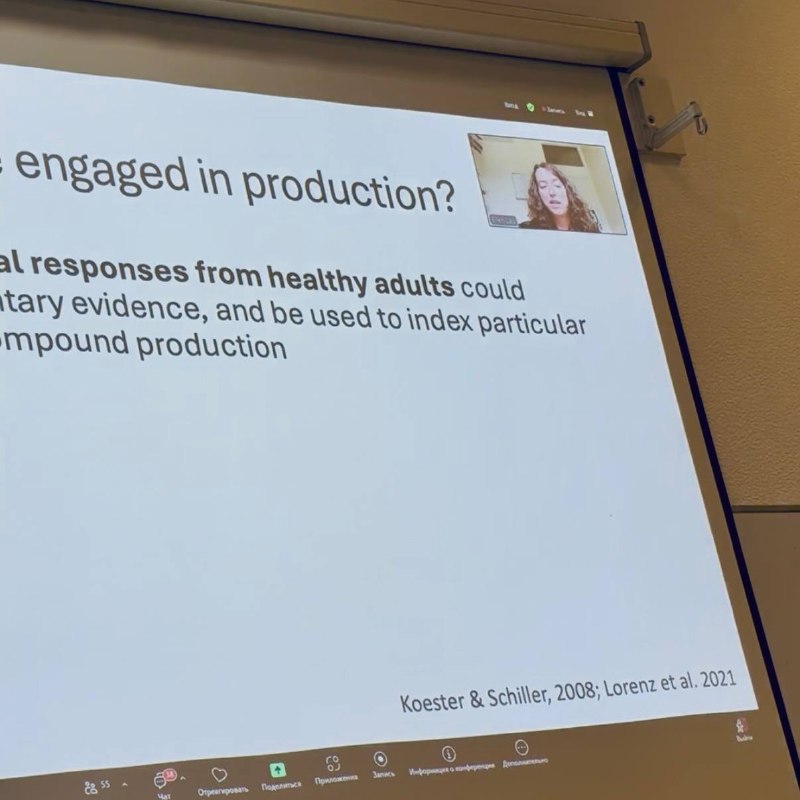
(University of Maryland, leading researcher in neurolinguistics whose work rethinks fundamental assumptions about language processing) was deeply theoretical in nature and addressed possible alternatives to lexicalism. Ellen invited the audience to reflect on what should count as units in psycholinguistic research and whether such units even exist. This type of work — critical reflection on the very foundations of research practices — represents a gold standard of fundamental science. At the same time, Ellen’s approach is far from extreme skepticism and involves comparing different computational models capable of predicting the distribution of speech correlates (such as reaction times, N400 amplitude, etc.) obtained in experiments.
- ❤ 4
- ❤🔥 2
- 🔥 1
Post #70
115
❤️ Before we sign off…
We need to say thank you.
To our keynote speakers — Dr. Jennifer Culbertson, Dr. Jana Willer-Gold, and Dr. Ellen Lau — thank you for sharing your work and setting the tone for the day with such inspiring talks.
To our showcase presenters — you brought the cutting edge to life in five minutes flat. The range and depth of your research blew us away.
To everyone who asked questions, dropped thoughts in the chat, and kept the discussion alive between sessions — you made this feel like a real community, not just a stream.
And to everyone who tuned in — spread across continents as you were — thank you for spending your day with us.
📼 Missed a talk or want to rewatch?
All recordings will be available soon — we'll share the links right here.
📂 Materials and slides will be preserved and accessible too. Nothing gets lost.
We wish you the joy of scientific discovery. The quiet thrill of understanding something you didn't understand before. The spark that sends you back to your own work with fresh eyes. That's why we do this.
See you next time!
____
#ExpDay2026
We need to say thank you.
To our keynote speakers — Dr. Jennifer Culbertson, Dr. Jana Willer-Gold, and Dr. Ellen Lau — thank you for sharing your work and setting the tone for the day with such inspiring talks.
To our showcase presenters — you brought the cutting edge to life in five minutes flat. The range and depth of your research blew us away.
To everyone who asked questions, dropped thoughts in the chat, and kept the discussion alive between sessions — you made this feel like a real community, not just a stream.
And to everyone who tuned in — spread across continents as you were — thank you for spending your day with us.
We were nervous, honestly. New format. Would it resonate? Would the day flow the way we hoped?But seeing how it came together — the curiosity, the exchange, the energy — we couldn't be happier.
📼 Missed a talk or want to rewatch?
All recordings will be available soon — we'll share the links right here.
📂 Materials and slides will be preserved and accessible too. Nothing gets lost.
We wish you the joy of scientific discovery. The quiet thrill of understanding something you didn't understand before. The spark that sends you back to your own work with fresh eyes. That's why we do this.
See you next time!
____
#ExpDay2026
- ❤ 13
Post #69
100
🎬 That’s a wrap!
…we made it. What a day. The experimental day!
📸 Share your favorite moments in the comments — let’s keep the memories about our conference alive in photos and reviews.
____
#ExpDay2026
…we made it. What a day. The experimental day!
📸 Share your favorite moments in the comments — let’s keep the memories about our conference alive in photos and reviews.
____
#ExpDay2026
- ❤ 4
Post #68
96
👏 Incredible keynote by Dr. Lau — what a way to close the plenaries!
⚡️ Last stretch! Showcase Session 3 starts in 5 minutes, at 17:20 (UTC+3):
⚪️ tACS for word retrieval in aphasia
⚪️ Plural diminutives in Brazilian Portuguese
⚪️ Identifying unreliable info in multimodal discourse
⚪️ Affective word processing across age groups
⚪️ Negative modal existential wh-predicates and negative concord
⚪️ Temporal concordance in Uruguayan Spanish
Let’s finish strong!
____
#ExpDay2026
⚡️ Last stretch! Showcase Session 3 starts in 5 minutes, at 17:20 (UTC+3):
⚪️ tACS for word retrieval in aphasia
⚪️ Plural diminutives in Brazilian Portuguese
⚪️ Identifying unreliable info in multimodal discourse
⚪️ Affective word processing across age groups
⚪️ Negative modal existential wh-predicates and negative concord
⚪️ Temporal concordance in Uruguayan Spanish
Let’s finish strong!
____
#ExpDay2026
- ❤ 4
Post #67
92
🧠 Dr. Ellen Lau is up in 3 minutes!
How to study language processing without words — an EEG study on compound production that challenges the classic "lexical item" assumption. This one's going to be special.
____
#ExpDay2026
How to study language processing without words — an EEG study on compound production that challenges the classic "lexical item" assumption. This one's going to be special.
____
#ExpDay2026
- ❤ 3
Post #66
92
☕️ Coffee break has already started — but don’t relax too much!
In 15 minutes, at 16:10 (UTC+3) our third keynote begins:
🔵 Dr. Ellen Lau (University of Maryland)
How to study language processing without words
Most psycholinguistic models still assume language processing is built around neat word-sized units — but what if that assumption is holding us back? Dr. Lau uses an EEG study on English compound production to show how we can do rigorous experimental research without relying on 1-to-1 mappings between form, syntax, and meaning.
Grab your coffee and head back in.
____
#ExpDay2026
In 15 minutes, at 16:10 (UTC+3) our third keynote begins:
🔵 Dr. Ellen Lau (University of Maryland)
How to study language processing without words
Most psycholinguistic models still assume language processing is built around neat word-sized units — but what if that assumption is holding us back? Dr. Lau uses an EEG study on English compound production to show how we can do rigorous experimental research without relying on 1-to-1 mappings between form, syntax, and meaning.
Grab your coffee and head back in.
____
#ExpDay2026
- ❤ 2
Post #65
83
⏸️ Quick pause — take a deep breath!
Then Showcase Session 2 rolls in:
⚪️ Left-branch extraction by L2 Russian learners
⚪️ Agreement attraction with coordination-adjacent phrases
⚪️ Locatives and partitive cliticization in Catalan
⚪️ Scale structure and gradable adjectives
⚪️ Working memory and sentence comprehension in kids
⚪️ Subject islands and specificity in Spanish
⚪️ Clausal argument ellipsis vs. null complement anaphora in Russian
Catch your breath and come right back.
____
#ExpDay2026
Then Showcase Session 2 rolls in:
⚪️ Left-branch extraction by L2 Russian learners
⚪️ Agreement attraction with coordination-adjacent phrases
⚪️ Locatives and partitive cliticization in Catalan
⚪️ Scale structure and gradable adjectives
⚪️ Working memory and sentence comprehension in kids
⚪️ Subject islands and specificity in Spanish
⚪️ Clausal argument ellipsis vs. null complement anaphora in Russian
Catch your breath and come right back.
____
#ExpDay2026
- ❤ 2
Post #64
83
📊 Showcase Session 1 starts in 5 mins!
⚪️ Tone reduction in Mandarin topic-comment structures
⚪️ Sentence-final particles in self-talk
⚪️ Processing ergative case in Kashmiri
⚪️ Case variation in Russian paucal constructions
⚪️ Person and number agreement processing in Russian
⚪️ Speaker social characteristics and language processing
Six talks, one room, zero time to get bored. Find your seat!
____
#ExpDay2026
⚪️ Tone reduction in Mandarin topic-comment structures
⚪️ Sentence-final particles in self-talk
⚪️ Processing ergative case in Kashmiri
⚪️ Case variation in Russian paucal constructions
⚪️ Person and number agreement processing in Russian
⚪️ Speaker social characteristics and language processing
Six talks, one room, zero time to get bored. Find your seat!
____
#ExpDay2026
- ❤ 2
Post #63
84
📸 How's your ExpDay going?
Show us your setup! Whether you're tuning in from a lab, a couch, or a café with a notebook and too much coffee — drop a photo in the comments. We'd love to see how you're spending this experimental day.
____
#ExpDay2026
Show us your setup! Whether you're tuning in from a lab, a couch, or a café with a notebook and too much coffee — drop a photo in the comments. We'd love to see how you're spending this experimental day.
____
#ExpDay2026
- 💯 2
Post #62
89
💡 What’s a Showcase Session?
Short, sharp 5-minute talks from researchers around the world — a fast-paced tour of what’s happening right now at the cutting edge. Discover new ideas, spot future collaborators, and get a taste of projects from Mandarin tones to Kashmiri ergativity.
Session 1 kicks off at 14:25 (UTC+3). Don’t be late — these go fast.
____
#ExpDay2026
Short, sharp 5-minute talks from researchers around the world — a fast-paced tour of what’s happening right now at the cutting edge. Discover new ideas, spot future collaborators, and get a taste of projects from Mandarin tones to Kashmiri ergativity.
Session 1 kicks off at 14:25 (UTC+3). Don’t be late — these go fast.
____
#ExpDay2026
Post #61
79
✨ Brilliant talk by Dr. Willer-Gold!
🍽 Lunch break coming up! We will be back in 30 minutes at 14:25 (UTC+3) with our first Showcase Session.
Enjoy your meal and keep the conversations going.
____
#ExpDay2026
🍽 Lunch break coming up! We will be back in 30 minutes at 14:25 (UTC+3) with our first Showcase Session.
Enjoy your meal and keep the conversations going.
____
#ExpDay2026
Post #60
80
⚡️ Coffee break is almost over — Dr. Jana Willer-Gold takes the stage in 3 minutes!
How prediction shapes morphological decomposition. Find your seats now.
____
#ExpDay2026
How prediction shapes morphological decomposition. Find your seats now.
____
#ExpDay2026
- ❤ 3
About this channel
- How can I read @expling without a Telegram account?
- TGViewer shows the public web preview Telegram publishes for ExpLing.INFO: recent posts, photos, videos and the subscriber count, with no app, login or account.
- How many subscribers does ExpLing.INFO have?
- ExpLing.INFO (@expling) has 111 subscribers on Telegram, refreshed roughly every 30 minutes.
- Does ExpLing.INFO know I viewed it here?
- No. Public channel previews carry no viewer identity, and TGViewer has no accounts or tracking of what you look up.