TGViewer
Channel Public Channel
Evrone

Evrone

@evrone

Our website https://evrone.com
FB: https://www.facebook.com/evrone

Web development, UI/UX design, Devops

#ruby #rails #golang #rust #javascript #react #vue #devops
Subscribers
335
Photos
622
Videos
10
Links
198
Recent Posts 16 shown
Post #769 46
A vague task leaves too much room for interpretation – and that becomes especially noticeable when AI is writing the code.

Spec-Driven Development takes a more structured approach: define the requirements, constraints, and expected behavior first, and use them as a reference during implementation.

In the article, we look at this through a practical example of integration monitoring. What exactly should the monitoring system show? What should happen when there’s no data? What counts as an error? Where does reporting a problem end and fixing it begin? Defining these details upfront gives the AI agent less room to make assumptions.

That doesn’t mean writing huge specs. The level of detail should match the complexity and risks of the task.

We also cover two more practical cases: PDF generation and a logistics status system.

How do you usually work with AI agents: define the requirements in detail upfront, or refine the result as you go?
  • ❤ 1
  • 👍 1
  • 🔥 1
Post #768 80
Sometimes, the most interesting part of an IT project isn’t what was built, but how it was put together.

For one of our DevOps clients, we built a workflow management system on top of Notion.

The starting point was a constant stream of tasks coming from chats, clients, and meetings. Some needed to be handled immediately, others could be planned for the week, while some were part of longer-term projects. At the same time, specialists could be working across multiple projects.

The system brings all of this into a single workflow: each task has a project, owner, priority, and status, while managers get a clearer view of resource allocation and work planning.

And the team didn’t have to completely change the way they worked.

As a result, daily syncs were reduced from two hours to 30 minutes, while the number of reported client complaints dropped by 87% in the first three weeks after implementation.

👉 We’ve broken down how the process works and why Notion was chosen for it in the full case study.
  • 🔥 2
  • 👍 1
Post #767 110
There are things you almost always want to add to an MVP. And almost always shouldn’t.

Another user role.
Another integration.
A proper dashboard – “let’s build it now so we don’t have to redo it later.”
An AI feature that users will definitely love.
And, of course, a mobile app – “since we’re building the product anyway.”

That’s how an MVP slowly turns into a full-scale product – only with tighter deadlines and a constantly growing budget.

There’s an opposite extreme, too: building it so quickly and simply that a couple of months later, nobody wants to touch the code.

A good MVP isn’t about writing the minimum amount of code. It’s about finding the smallest technically sensible scope that’s enough to validate the core product hypothesis.

And that means developers have to think not only about how to build something, but also whether it makes sense to build it at all – right now.

What can safely wait? Where is a temporary workaround acceptable? Which decisions will be expensive to change later? And what should be part of the architecture from day one?

We’ve put together a detailed guide to planning an MVP – from defining the first version and prioritizing features to architecture, team setup, budget, metrics, and what comes next.

If you’re currently designing a new product or debating what should make it into v1, there’s plenty here to think about: https://evrone.com/blog/how-to-plan-mvp
  • 👍 2
  • 🔥 2
Post #766 121
What if AI could help a technical interviewer prepare for an interview before the candidate even joins the call?

At Evrone, we built ArgusHire – an AI assistant that analyzes a CV against the project requirements and helps prepare an interview plan, including the topics and questions worth focusing on.

After the interview, ArgusHire analyzes the transcript, evaluates the candidate’s answers, and helps compare multiple candidates. It also analyzes the interviewer’s performance – how thoroughly the planned topics were covered and how closely the conversation followed the original plan.

Now, a bit about the engineering behind it.

The stack includes Ruby on Rails 8, Sidekiq + Redis, PostgreSQL with JSONB, and Next.js 16 / React 19 / TypeScript. Long-running AI tasks run in the background, so operations like CV and transcript analysis don’t block regular HTTP requests.

The AI layer is built with ActiveAgent and a custom model-calling pipeline. The business logic isn’t tied to a specific LLM API: out of the box, the system works with GigaChat-2-Max and deepseek-v4-pro, while the OpenAI-compatible API makes it possible to connect cloud services, corporate AI gateways, or locally deployed models via vLLM, LocalAI, and Ollama.

For each AI task, we store information about the model and the provider used to run it. This makes it possible to compare results and experiment with different models.

Another important component is custom prompts. Each workspace can have its own prompt templates for CV analysis, interview preparation, transcript analysis, and
competency assessment – with versioning, and without code changes or a new release.

And this isn’t an experiment in a vacuum: we use ArgusHire in real technical interviews at Evrone, compare its results with assessments from our technical specialists, and use the findings to refine the rules and prompts.

Learn more about the product and its architecture: https://evrone.com/blog/argushire
  • 👍 4
  • 🔥 4
Post #765 113
What happens when a logistics system has to handle very different data loads at the same time?

In this project, data from different sources was processed synchronously, creating uneven loads on the database. During peak workloads, this could slow down or even block the database and disrupt systems that depended on it.

We introduced an intermediate Python service and Kafka. NiFi sends messages to the appropriate Kafka topic, while our service retrieves them in batches, applies business rules, and loads the results into the database. This made the workload more predictable and the architecture easier to scale.

The same data bus was later reused for two more tasks: integrating a new B2B customer through data mapping and building a public shipment tracking service with its own database.

The interesting part wasn't just adding Kafka. It was finding a way to stabilize the existing data flow and then reuse that infrastructure for new integration scenarios.

Full technical case:
https://evrone.com/cases/edi-for-logistics
  • 🔥 3
  • 👍 2
Post #764 135
There are already so many AI agents that choosing one has become an engineering task in its own right.

OpenAI Agents, Claude, Copilot Studio, Agentforce, CrewAI, AutoGen, and several others – each comes with its own stack, architecture, use cases, and limitations.

Instead of another “top 10 best AI agents” list, we looked at what each tool is actually good for: where it fits, where its limitations start to show, and when a ready-made agent might not be the best option at all.

We’ve put together 10 AI agents and platforms worth knowing in 2026.

If you’re exploring AI agents for your projects, this overview will help you get a clearer picture of the options available today.

Read the full overview on the Evrone website: https://evrone.com/blog/top-10-ai-agents-business-2026 

Have you already worked with AI agents? Share your experience in the comments.
  • ❤ 4
  • 🔥 4
  • 👍 2
Post #763 145
How do you migrate dozens of services to a new infrastructure without taking down production?

In the Wayo* case study, we had one month to do it.
The task wasn't just about moving infrastructure from an old Kubernetes cluster to a new one. The services also had to be adapted to an updated internal engineering platform.

The most interesting part was the dependencies. Each service had its own set of configurations, databases, Redis and other KV stores, brokers, internal services, and external APIs. Moreover, some connections weren't obvious from the original configuration and were only discovered during analysis.

So for each service, we defined a unified preparation process and a set of readiness criteria: startup, health checks, accessibility within the cluster, connections to storage systems and APIs, logs, and key user scenarios.

In production, the old and new versions ran in parallel for some time. First we validated the new version, then switched traffic over to it, and only after a monitoring period did we decommission the old one. If something went wrong, we had the option to roll back.

By the end of the fourth week, all services scheduled for migration had been moved to the new platform and launched in the new cloud environment. The user-facing application continued running without interruption.

We covered the dependency audit, the migration process, and the traffic switchover in detail in our case study: https://evrone.com/cases/wayo 

And what stage of migration usually turns out to be the trickiest for you?

*The company name and certain identifying details have been changed because the project was completed under an NDA.
  • ❤ 5
  • 🔥 3
  • 👍 1
Post #762 140
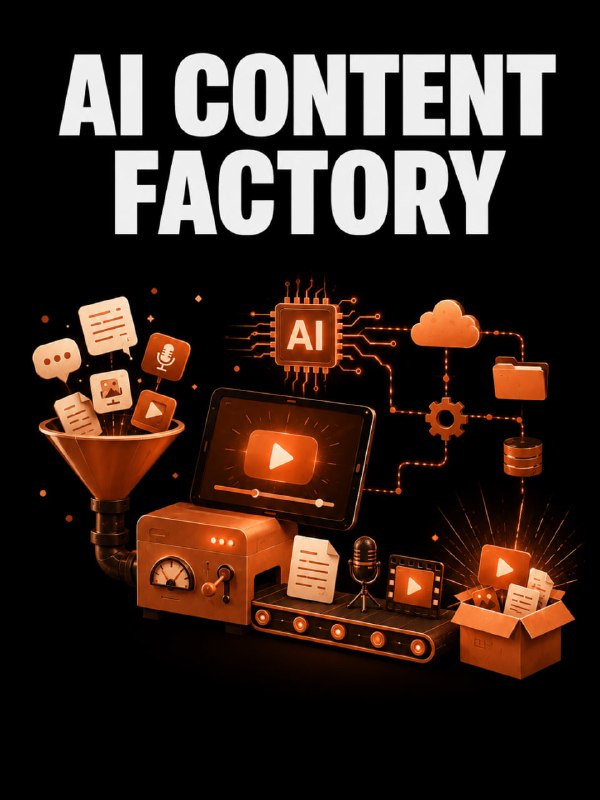
Can you publish 5–6 videos a week without a team of scriptwriters?

We decided to find out.

That's why we built Screenwriter – an AI-powered assistant that analyzes massive amounts of information, identifies the most relevant topics, and helps create scripts and interview briefs.

In its first two months, Screenwriter helped us produce around 25 video episodes. One of our new shows also surpassed 240,000 views in less than six weeks.

But AI isn't replacing creators. It takes care of the most time-consuming parts of pre-production, while every script is still reviewed, refined, and finalized by the host.

In our latest article, we explain how Screenwriter works, why we built it around multiple AI models, and how it has transformed the economics of content production.

Read the full story here: https://evrone.com/blog/screenwriter
  • 🔥 6
  • 👍 4
  • ❤ 2
Post #761 155
When a monolith becomes a bottleneck, starting from scratch is not always the answer.

One of the hardest challenges in software development is modernizing a system that is already running at scale and has become critical to the business.

In this case, we worked with a platform processing millions of orders for a large restaurant network. As data volumes grew, performance issues started to appear: searching through order history could take 25–30 seconds.

The solution wasn’t a complete rewrite. Instead, we evolved the system step by step: optimized data processing, moved search capabilities to Elasticsearch, started breaking down the monolith, and built a more flexible architecture for future scaling.

The result: search response time dropped to 250–300 milliseconds, while the platform gained the foundation needed for further growth.

A good example of why legacy systems are not always something you need to replace. Sometimes, they are systems you need to evolve in the right direction.

More technical case studies and engineering stories:
https://evrone.com/
  • 🔥 4
  • 👍 3
Post #760 163
Vibe coding: a revolution in development or a new way to accumulate technical debt?

Not long ago, putting together a working MVP required a team of developers and weeks of work.
Today, all you need is an idea, an AI tool, and a couple of evenings.

But that's where things get interesting.

AI writes great code. Sometimes even really great code. But who's responsible for architecture? Security? Scalability? Making sure that six months from now, this project doesn't need to be rewritten from scratch?

Vibe coding is reshaping the very approach to development:

▪️developers become more like architects and reviewers;

▪️prototyping speed increases manifold;

▪️the line between an "idea" and a "working product" becomes thinner.

But the big question remains open: where does acceleration end and technical debt begin?

We've broken down how development is changing in the age of AI and why vibe coding isn't just a trend – it's a new phase in the way humans and code interact.

Article: https://evrone.com/blog/vibecoding-in-2026

What do you think? Is vibe coding the future of development, or just a shiny wrapper for old problems? Share your thoughts in the comments.
  • 🔥 7
  • 👍 4
Post #759 141
A powerful GPU cluster doesn't guarantee efficient use of compute resources.

In our new case study, we share how we helped a research lab solve the challenge of sharing GPUs for ML workloads.

One of the most interesting aspects of the project was the choice between MIG and time-slicing. Both approaches allow multiple tasks to run on a single GPU, but they work differently and aren't suitable for every type of hardware.

In this case study, we cover:

• the differences between MIG and time-slicing;

• how we built an MLOps platform on Kubernetes with GitOps;

• why we chose open source and avoided vendor lock-in.

If you work with Kubernetes, ML infrastructure, or GPU clusters, this breakdown might be useful: https://evrone.com/cases/relab
  • 👍 4
  • 🔥 2
Post #758 165
An internal AI assistant doesn't have to be a separate application.

We built Mimir – an assistant that lives in Telegram and helps with everyday tasks: answering questions, searching for information, maintaining conversation context, writing Python scripts for automation, and using them to handle routine operations.

In the article, we share how Mimir grew from an internal tool into a full-fledged AI assistant powered by OpenClaw, how much its infrastructure costs, what tasks it already handles, and why a familiar messenger turned out to be more convenient than a new interface.

If you're interested in practical applications of AI agents – not just another demo – take a look: https://evrone.com/blog/mimir
  • 🔥 4
  • ❤ 2
  • 👍 2
Post #757 173
We're probably all a little tired of posts about AI writing code.

So here's a case study about a different kind of use.
In a music streaming service with a multi-million user base, we integrated AI into the development process. It helps with code review, documentation, automated testing, and other routine tasks that usually eat up the team's time.

At the same time, we optimized the platform's most resource-intensive services. As a result, infrastructure resource consumption dropped by roughly 25%, while performance increased by nearly 20%.

This is what mature AI adoption looks like: not instead of engineers, but alongside them – automating the routine and freeing up time for truly complex challenges.

Case study: https://evrone.com/cases/tune
  • 🔥 3
  • 🤩 3
  • 👍 2
Post #756 166
Rust in 2026: rewrite or not?

This question doesn't come up during a retro, and it's not a joke. It comes up when the pain becomes too obvious. When production crashes again due to a segfault. When you've spent three days hunting down yet another concurrency bug. When a new developer looks at the codebase and says: "I have no idea what's going on here."

Rust solves specific problems. Memory safety, data races, low-level performance. That's why Amazon, Google, and Microsoft choose it. Not because it's trendy, but because it works.

But migrating to it only makes sense in one case: when you have a real problem that Rust can solve and your current stack can't.

Segfaults, memory leaks, complex multithreaded code, legacy that's impossible to maintain – that's when it's worth considering.

If your project is stable, brings in money, is written in something familiar, and your team doesn't know Rust – don't invent a problem that doesn't exist.

Rust is a tool for systems programming, not a silver bullet.

Anyone already made the switch? How did it go? Worth it or not?

And if you want to dive deeper – together with Evrone's DevRel Grigory Petrov, we wrote an article breaking down exactly when migrating to Rust is truly justified, and when it's better to leave well enough alone. Link here: https://evrone.com/blog/migrating-to-rust-in-2025
  • 🔥 3
  • ❤ 1
  • 🎉 1
Post #755 143
Sometimes the best redesign is the one users barely notice.

When the Mindbox team started updating their product, it quickly became clear: they needed to change more than just the screens.

As the platform grew, it became increasingly difficult to maintain and develop. So the work began with the frontend architecture.

Evrone developers joined the Mindbox team and took part in building a new product structure. Individual parts of the system gained the ability to evolve independently, without constant intersections and limitations.

In parallel, the team reworked key user scenarios:

✅ reports;

✅ the customer data page;

✅ recommendation management tools.

This case clearly shows that the most impactful improvements for a business often start where users never look.

With architectural decisions.

Those decisions ultimately determine how fast the product can continue to grow.

👉 Full case study: https://evrone.com/cases/mindbox
  • 🔥 5
  • 👍 3
  • 👏 1
Post #745 148
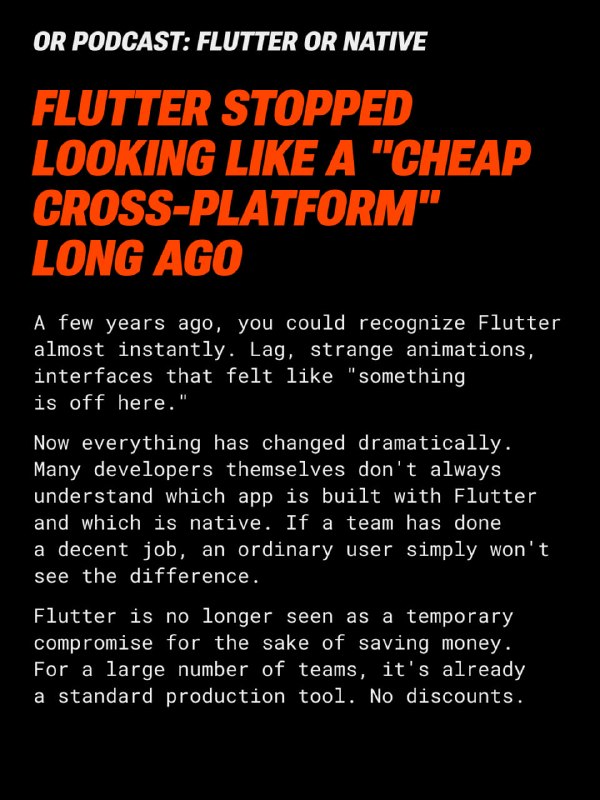
Flutter or native? Each approach has its fans who are ready to argue until they're blue in the face. But outside of internet battles, the choice usually comes down to three things: how much time to launch, how much money for maintenance, and what kind of experience users need.

In the cards – our version of the pros and cons, without trying to declare a winner.

And now a question for those who actually write code or make decisions: what do you choose for new projects and why? Not abstractly "in general," but in practice. Your actual opinion is what matters.
  • ❤ 5
  • 🔥 4
  • 👍 3
Older posts →

About this channel

How can I read @evrone without a Telegram account?
TGViewer shows the public web preview Telegram publishes for Evrone: recent posts, photos, videos and the subscriber count, with no app, login or account.
How many subscribers does Evrone have?
Evrone (@evrone) has 335 subscribers on Telegram, refreshed roughly every 30 minutes.
Does Evrone know I viewed it here?
No. Public channel previews carry no viewer identity, and TGViewer has no accounts or tracking of what you look up.
Threads Profile ViewerView any public Threads profile without an account.Open ThreadLook →Writing with AI? Make it sound human.Metric37 rewrites AI drafts so they read naturally. Free AI detector, 1,500 words free.Try Metric37 →