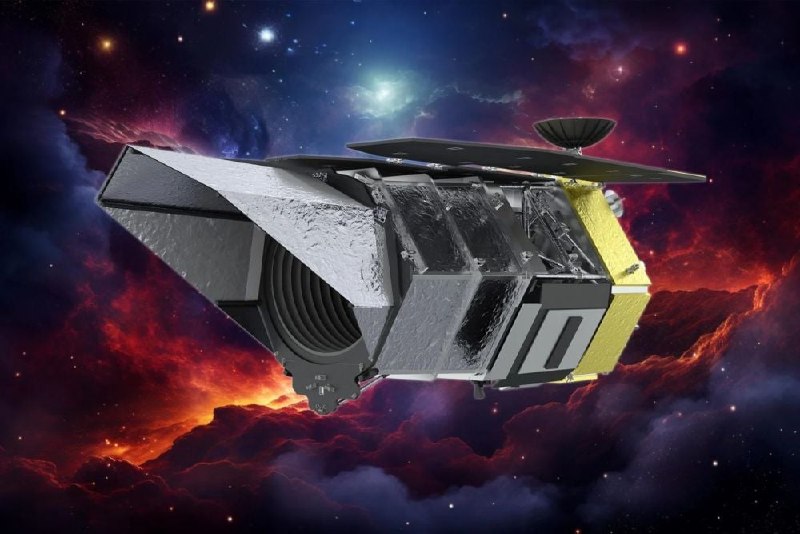
The Nancy Grace Roman Space Telescope hasn't yet reached its Sun-Earth L2 orbit and it already has some good news. NASA has announced that the mission has enough fuel to potentially double its mission length. Though initially scheduled for five years of initial observations, followed by a five year extended mission, the entire mission length could now reach 22 years.
“As a result of exquisite planning by our orbital dynamics team, brilliant execution by the operations team, and a precise launch from SpaceX, Roman has fuel for at least 22 years of potential science operations,” said Jamie Dunn, center director at NASA’s Goddard Space Flight Center in Greenbelt, Maryland.
Fuel is the Roman's only consumable resource and is the limiting factor for mission length. Several things contributed to its new, extended mission length, starting with the precise launch. The SpaceX Falcon Heavy helped set the stage with its accurate low-Earth orbit departure burn. The more accurate this is, the less fuel is required for the Roman's subsequent burns.
The next reason is the spacecraft's actual weight vs planned weight.
“A spacecraft’s mass changes throughout the design and build process, so we base the propellant budget on a set maximum value so we won’t come up short,” said Alison Rao, the Roman propulsion lead at NASA Goddard. “We track the propellant needed based on actual mass throughout integration and testing as well, to make sure we have wiggle room. Since Roman’s was lower than we budgeted for, we were able to fill the propellant tanks to their capacity rather than only filling them as much as we needed to for the 10-year requirement.”
Source: Universe Today
@EverythingScience