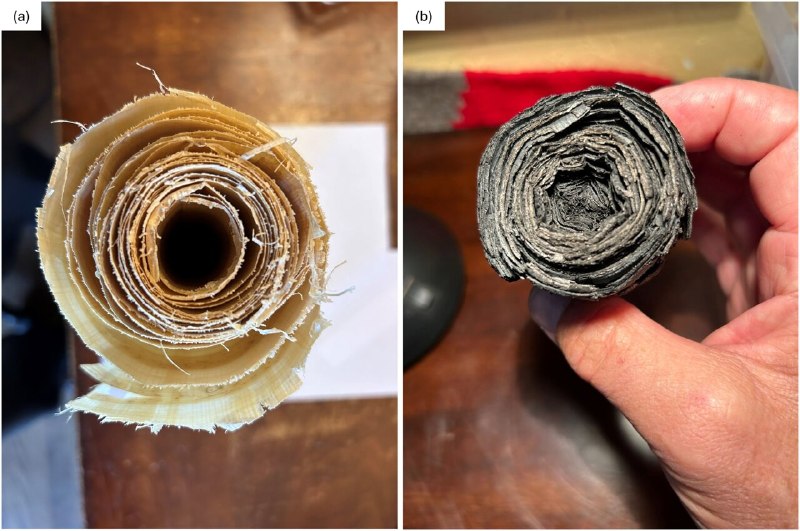
X-ray technology and artificial intelligence—along with the discovery of lead in the ink of fragments from a collection of ancient Roman scrolls—could soon help scientists read long-lost texts buried by the eruption of Mount Vesuvius in 79 CE, according to a study published Sept. 16, 2026, in the journal PLOS One by Douglas Seiler, an affiliate of the University of California, Berkeley, U.S.; Jacob Michael LaManna of the National Institute of Standards and Technology, U.S.; David Kreimer of the University of California, Berkeley, U.S.; and colleagues.
The Herculaneum papyri scrolls were discovered in the ruins of the town of Herculaneum, near Naples, Italy. During the volcanic eruption, the scrolls were covered by 65–70 feet (20–21 meters) of rock and ash, "carbonizing" them in the extreme heat and making them very brittle. While some of the scrolls have been opened and read, revealing previously unknown writings by Epicurus and other ancient thinkers, many have proven too fragile to study.
Lead offers a clearer signal
Recently, AI and X-ray tomography have allowed researchers to virtually "unroll" some of the scrolls and read some of the text. That said, X-rays can have a hard time distinguishing the text because the ink and papyrus are made of similar materials: carbon. But some of the Herculaneum scroll letters have been found to contain lead. Since X-rays can more easily distinguish between papyrus and lead, the authors of this new paper suggest scanning the scrolls for lead and then attempting to virtually unroll those that contain it.
To test this, the team recreated some carbonized scrolls by writing on new papyrus using ink with various concentrations of lead, then heating the scrolls in a high-temperature furnace and carbonizing them. X-ray fluorescence was able to detect lead in the scrolls at each lead concentration level, and X-ray tomography, combined with a custom software program, allowed the team to reread some of the words they had written on these scrolls.
Source: Phys.org
@EverythingScience