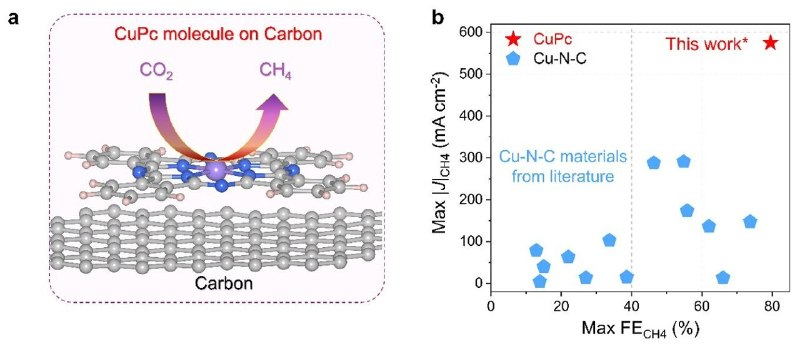
A common blue pigment could help turn carbon dioxide (CO2) from an industrial waste product into a useful fuel. A joint research team led by Tohoku University's Advanced Institute for Materials Research (WPI-AIMR), in collaboration with Hokkaido University and startup AZUL Energy, has developed a catalyst that converts CO2 directly into methane (CH4) with high efficiency using copper phthalocyanine, an inexpensive and readily available blue pigment.
Strong methane output and stability
The researchers applied the copper phthalocyanine catalyst to a gas diffusion electrode, enabling CO2 to be reduced to methane in a single electrochemical step. The system achieved a maximum current density of 575 mA cm-2 and a maximum Faradaic efficiency of 79.5% for methane production, demonstrating that the catalyst can selectively convert CO2 into methane at high rates.
The catalyst also showed stable performance during long-term operation. At a current density of 150 mA cm-2, the system maintained methane selectivity above 60% for approximately 80 hours. This durability and selectivity represent an improvement over conventional copper nanoparticle catalysts, which can produce a mixture of different products and make subsequent gas separation more difficult.
The challenge of direct conversion
Converting CO2 into useful chemicals and fuels using electricity generated from renewable energy is known as electrochemical CO2 reduction (ECR).
The approach has attracted attention as a potential means of recycling carbon while reducing reliance on fossil resources. Methane is particularly attractive as a target product because it is a widely used gaseous fuel and can potentially be integrated into existing gas infrastructure.
However, producing methane directly from CO2 is challenging. Electrochemical reduction involves a complex network of reaction pathways, and conventional catalysts can produce several different carbon-containing products alongside methane. Separating and purifying these products adds complexity and energy requirements to the overall process.
Source: Phys.org
@EverythingScience