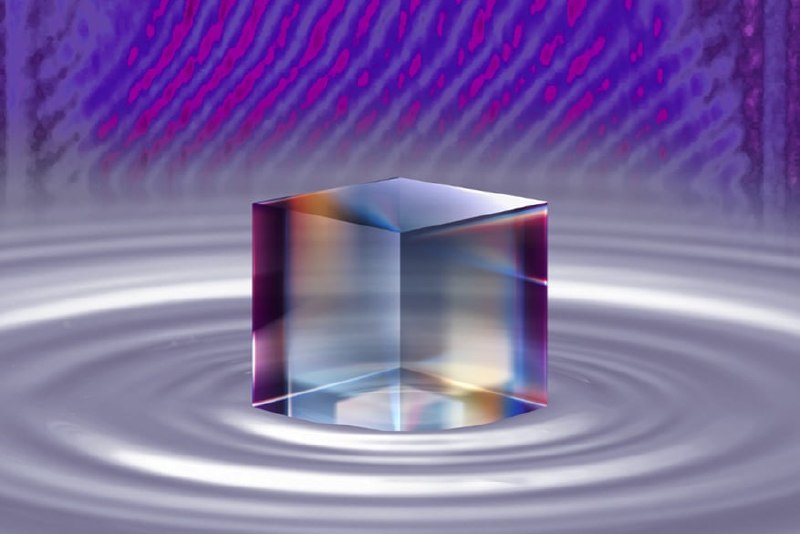
Some of the strangest weather in the solar system doesn’t happen on Earth, or even Jupiter’s Great Red Spot - it happens in the interior of the Ice Giants like Neptune and Uranus. Specifically, scientists have long believed that, at certain pressure and temperatures, it literally rains diamonds inside of these planets. And for the first time, scientists have mimicked the process they believe creates that. A new paper by physicists at the Lawrence Livermore National Laboratory (LLNL), published in Nature Physics, resolves a 20 year old scientific mystery, and shows how the same physics that makes it rain diamonds inside Neptune could also help us triple our fusion energy output.
Let’s talk about the actual experiment first. The LLNL scientists set up their experiment at the University of Rochester’s Omega Laser Facility - which does exactly what is advertised in its name. In this specific case, the laser vaporized the outer layer of a diamond sample - and the scientists were watching it with as many sensors as they could, including an ultra-fast technique called X-ray diffraction. That vaporization sent a huge shockwave through the interior of the diamond itself, compressing it to pressures more than three times that of Earth’s core, with resultant temperatures equivalent to the surface of the Sun - but only for a billionth of a second.
What they saw helped solve a 20 year old mystery. This wasn’t the first time scientists have melted diamond. However, previous physical measurements of the melting point of diamond disagreed with computer models based on quantum mechanics by up to 20%. That might not sound like a lot, but in the context of these experiments, that 20% represented a more than 1,000 degree Kelvin difference in the theoretical and observed melting point.
Despite their best efforts, scientists couldn’t get the two numbers to match up - until now. Armed with the new X-ray diffraction data, the authors were able to confirm their measured melting point of diamond aligned with modern quantum-physics based models. But that wasn’t their most interesting finding - they also discovered that, under the right conditions, diamonds would float on a sea of carbon.
As a press release from LLNL points out, we’re all familiar with one specific example where the solid version of a material is less dense than the liquid version - ice and water. But finding that solid diamond is actually less dense than liquid metallic carbon was somewhat of a surprise for the researchers. And it opened up the possibility of what, on paper, sounds like one of the coolest weather features anywhere in the solar system - diamond rain...
Source: Universe Today
@EverythingScience