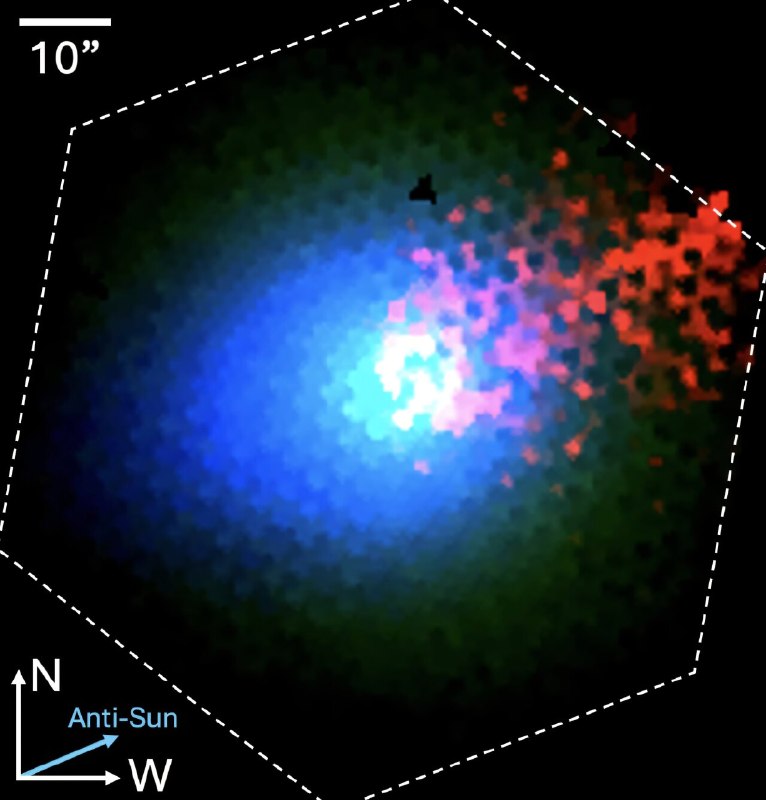
UK astronomers have uncovered new clues about the origin of 3I/ATLAS—only the third known object from beyond the solar system ever spotted. In a new paper published in Monthly Notices of the Royal Astronomical Society, researchers reveal that the comet formed in extremely cold conditions, far from any star.
Dr. Lea Ferellec, a research fellow based in Northumbria University's School of Engineering, Physics and Mathematics, led the study, which looked at the ionized gases streaming off 3I/ATLAS as it moved away from the sun.
The observations were obtained using the Large Integral Field Unit (LIFU) mode of a new instrument, the WHT Enhanced Area Velocity Explorer (WEAVE), developed with the support of the Science and Technology Facilities Council (STFC) and installed on the Isaac Newton Group's 4.2-meter William Herschel Telescope.
By combining WEAVE's LIFU imaging spectroscopy with the WHT's new non-sidereal guiding capabilities, the team identified five different ions in the comet's stream simultaneously.
This is a rare achievement for any comet and a remarkable first for an interstellar object of this nature.
By measuring how much dinitrogen gas was present compared with carbon monoxide, the researchers worked out that 3I/ATLAS formed somewhere extremely cold, likely colder than -240°C (-400°F).
This suggests it formed a long way from its home star, in the outer, icier edges of wherever its solar system took shape.
A rare sample from another system
Speaking about the findings, Ferellec said, "This object gives us a rare chance to study material that formed somewhere completely different from our own solar system...
Source: Phys.org
@EverythingScience