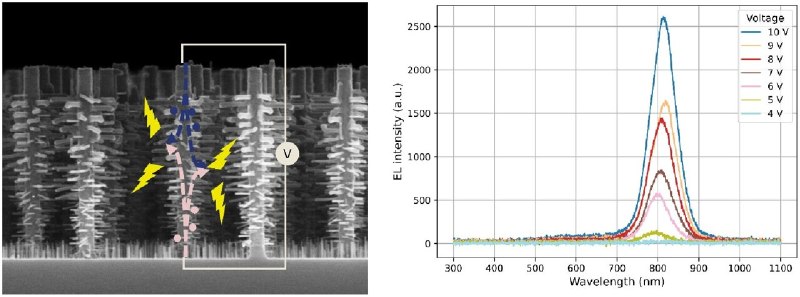
Researchers at Lund University have developed a new type of light-emitting diode based on thin, branched nanowires that could offer significantly higher efficiency and lower production costs than current technology. By controlling where in the structure the light is generated, the researchers have reduced the losses that would otherwise limit the amount of light that can be used. Their study is published in the journal Nano Research.
Escaping light trapped in LEDs
In materials used for conventional light-emitting diodes—such as the LED bulbs found in most households—a large proportion of the light is trapped inside the material because of what is known as total internal reflection. This phenomenon means that only a small proportion of the light comes out, even though it is generated inside the material.
The new design aims to overcome this problem. The method is based on the fact that light is emitted from very thin side branches that extend from a central nanowire. "If the structures are made thin enough—thinner than the wavelength of light—the light cannot be trapped inside the material in the same way.
"Theoretically, this could enable a very high light output. In principle, it would be possible to release virtually all the light," said Magnus Borgström, professor of solid-state physics at Lund University.
In materials used for today's LEDs, only around 4% of the light is emitted without additional surface treatment. To improve efficiency, various techniques and methods of processing the material are used to increase light extraction. If the new technology proves successful, it would be possible to avoid these costly processes. Although LEDs are already inexpensive, any improvement in efficiency is important for industrial production.
Source: Phys.org
@EverythingScience