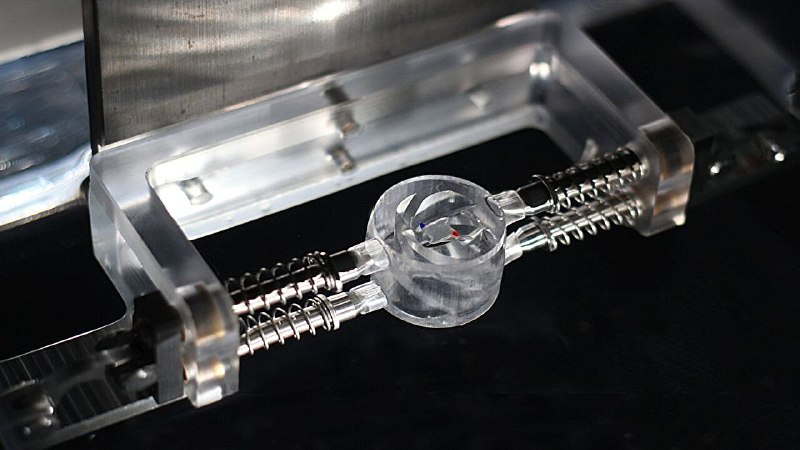
Reliably generating controlled miniature rotations has long been a challenge: Chemical propulsion systems wear out, and methods that use electric or magnetic fields require complex setups. A team from KIT's Institute of Microstructure Technology (IMT) and the Suzhou Institute of Nano-tech and Nano-bionics (SINANO) at the Chinese Academy of Sciences has now demonstrated that flow at a water surface alone is sufficient to rotate a floating object in a fixed direction. Their research is published in the journal Science Advances.
"We were able to show that motion on a small scale can be controlled entirely without chemistry, electricity, or magnetic fields, relying solely on the forces acting at a water surface. This opens up a simple and versatile way to assemble ultrafine structures in a targeted manner," said Professor Jan G. Korvink from KIT's IMT.
Why speed determines direction
At the heart of the setup is a 3D-printed component with a spiral channel. It keeps a tiny object on the water surface without touching it. When the component moves slowly up and down, the object merely oscillates back and forth, leaving no net rotation. At a higher speed, however, small vortices form, tipping the balance. The object rotates bit by bit in the same direction—just like a ratchet—gradually accumulating the rotation.
Researchers at KIT were able to visualize this process through flow simulations. "In the simulation, we could accurately trace how the flow breaks the symmetry of motion at higher speeds. It is precisely this symmetry breaking that transforms a back-and-forth movement into a directed rotation," said Professor Yongbo Deng from IMT.
Fine fiber bundles for wires, sutures and artificial muscles
The effect can be used in a targeted way. The component behaves like a tiny motor powered solely by the water surface. Its torque is about 10⁻⁸ newton-meters, which is far below that of an electric motor but significantly greater than that of biological motors. Using this approach, the scientists gradually assembled silk fibers with diameters between 10 and 20 micrometers into multilayered twisted bundles. Such structures are also typical of Litz wires and surgical suture materials.
Potential applications are low-loss transmission cables in data centers, multifunctional suture materials and artificial muscles. Conventional braiding machines fail at this scale because the fibers break under tension. The novel approach, by contrast, requires no mechanical contact and thus opens an innovative way to manufacture helical structures in a controlled manner.
Source: Phys.org
@EverythingScience