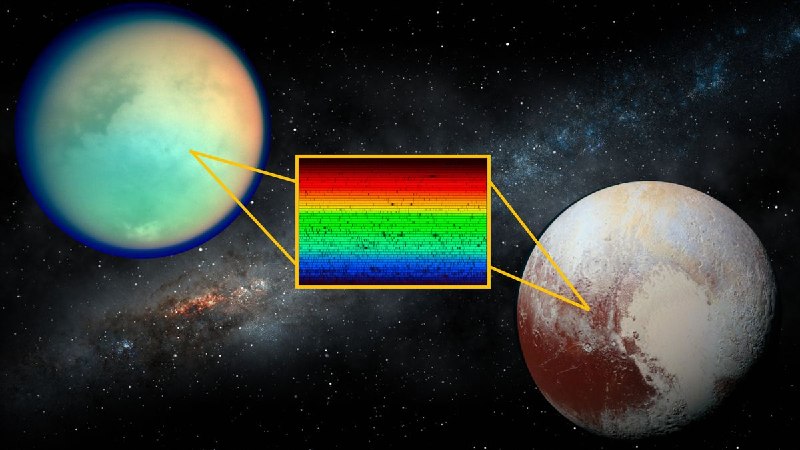
A mysterious wavelength of light is missing from the dwarf planet Pluto and Saturn's supersized moon Titan, new James Webb Space Telescope (JWST) observations show. The surprising discovery hints that these worlds harbor an unknown molecule that has not been seen in any other solar system world or exoplanet so far.
Every element or molecule in the universe absorbs unique wavelengths of electromagnetic radiation. Therefore, one of the main ways astronomers study distant worlds — both inside and outside the solar system — is by closely examining the light that reflects off them and searching for dark "absorption lines" that correspond to the wavelengths of known chemical compounds.
For example, molecular oxygen absorbs light at 230 nanometers, so if the electromagnetic spectrum of a faraway exoplanet has an absorption line at this frequency, researchers can be confident that its atmosphere contains oxygen, according to a 2021 study.
JWST has proved to be exceptionally good at capturing electromagnetic spectra and identifying specific chemicals in exoplanet atmospheres, around distant stars and within primitive galaxies. It has even identified a molecule on one alien world that could point to extraterrestrial life.
In a new study, uploaded June 11 to the preprint server arXiv, researchers analyzed JWST data from Pluto and Titan, focusing on very small wavelengths that have been relatively unexplored until now. This revealed a specific absorption line at around 5.11 micrometers in both worlds' spectra. (These findings have not been published in a peer-reviewed journal yet.)
The team pored through similar studies on other planetary spectra but "did not find any band referenced in these publications that corresponds to the location of the observed absorption in Titan and Pluto," the researchers wrote in the paper.
A molecular mystery
The discovery is even stranger because there are very few similarities between Pluto and Titan that could explain why they share a molecule not found anywhere else.
...
The researchers proposed that it could be benzene — a ring-shaped hydrocarbon — mixed with an unknown molecule, or some form of acetylene or ketene ice. However, much more work is needed to prove that any of these potential candidates are responsible for absorbing this specific wavelength, they wrote.
Source: Live Science
@EverythingScience