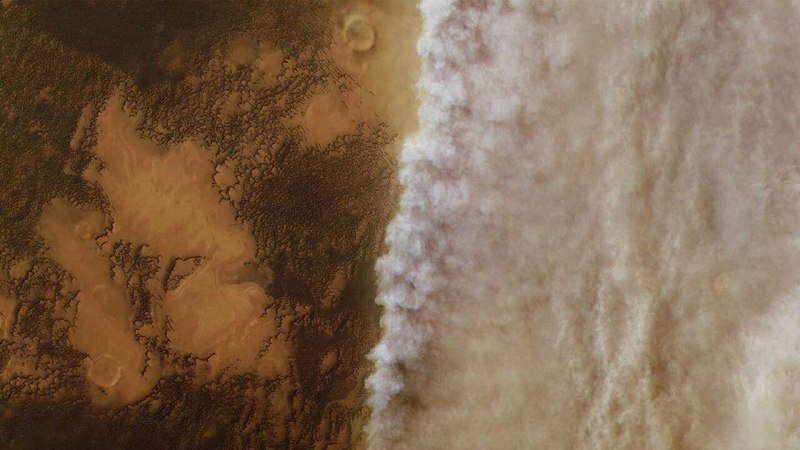
A new study by a doctoral researcher at The University of Alabama in Huntsville (UAH), part of The University of Alabama System, suggests global dust storms on Mars may organize the Martian atmosphere into regions favorable for electrical activity, increasing the potential for electrostatic discharges that could affect missions to the red planet by interfering with electronics, causing arcing between conductive surfaces, and damaging exposed scientific instruments and spacecraft systems. The research, conducted by Chali Idosa Uga, a third-year Ph.D. student in the Department of Space Science at UAH, is published in The Planetary Science Journal.Source: Phys.org
The work focuses on the Martian Year 34 global dust storm, a planet-encircling event that occurred on Mars in 2018. It is one of the best-studied Martian weather events because multiple orbiters and rovers observed it simultaneously. Uga's research focused on whether such events can create conditions in which electric fields may build up to levels favorable for electrical breakdown in localized regions of the lower atmosphere. The researcher was advised by Dr. Gary Zank, director of the UAH Center for Space Plasma and Aeronomic Research (CSPAR), and Dr. Dennis Gallagher at NASA Marshall Space Flight Center.
"Mars does not have thunderstorms in the terrestrial sense, but it does have intense dust storms in a thin carbon dioxide atmosphere," Uga explains. "During such events, dust is lifted, transported and mixed through the lower atmosphere, creating conditions in which grain collisions can separate electric charge while the weakly conducting atmosphere may allow that charge to persist."
Electrified dust as a mission hazard
The study also highlights potential implications for future Mars missions, which may need to account for electrostatic environments during dust storms.
"For future Mars exploration, our study suggests that major dust storms should be evaluated not only as atmospheric, thermal and visibility hazards, but also as structured electrostatic environments," Uga notes. "We do not quantify risk to a specific spacecraft, habitat, instrument or communication system. What we show is that during the Martian Year 34 global dust storm, the lower atmosphere developed localized and altitude-dependent regions where charge separation could persist, and modeled electric fields approached breakdown-favorable conditions."
@EverythingScience