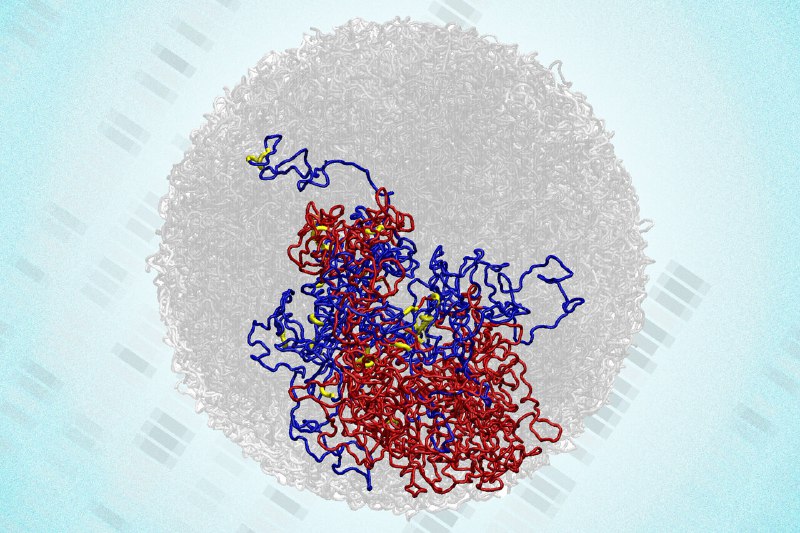
Before cells can divide, they first need to replicate all of their chromosomes, so that each of the daughter cells can receive a full set of genetic material. Until now, scientists had believed that as division occurs, the genome loses the distinctive 3D internal structure that it typically forms.
Once division is complete, it was thought, the genome gradually regains that complex, globular structure, which plays an essential role in controlling which genes are turned on in a given cell.
However, a new study from MIT shows that in fact, this picture is not fully accurate. Using a higher-resolution genome mapping technique, the research team discovered that small 3D loops connecting regulatory elements and genes persist in the genome during cell division, or mitosis.
The study has been published in Nature Structural & Molecular Biology.
"This study really helps to clarify how we should think about mitosis. In the past, mitosis was thought of as a blank slate, with no transcription and no structure related to gene activity. And we now know that that's not quite the case," says Anders Sejr Hansen, an associate professor of biological engineering at MIT. "What we see is that there's always structure. It never goes away."
The researchers also discovered that these regulatory loops appear to strengthen when chromosomes become more compact in preparation for cell division. This compaction brings genetic regulatory elements closer together and encourages them to stick together. This may help cells "remember" interactions present in one cell cycle and carry it to the next one.
"The findings help to bridge the structure of the genome to its function in managing how genes are turned on and off, which has been an outstanding challenge in the field for decades," says Viraat Goel Ph.D. '25, the lead author of the study.
Source: Phys.org
@EverythingScience