Johns Hopkins researchers may have identified a compelling clue in the ongoing hunt to prove the existence of dark matter. A mysterious diffuse glow of gamma rays near the center of the Milky Way has stumped researchers for decades, as they've tried to discern whether the light comes from colliding particles of dark matter or quickly spinning neutron stars.
It turns out that both theories are equally likely, according to research published in the journal Physical Review Letters.
If excess gamma light is not from dying stars, it could become the first proof that dark matter exists.
"Dark matter dominates the universe and holds galaxies together. It's extremely consequential and we're desperately thinking all the time of ideas as to how we could detect it," said co-author Joseph Silk, a professor of physics and astronomy at Johns Hopkins and a researcher at the Institut d'Astrophysique de Paris and Sorbonne University. "Gamma rays, and specifically the excess light we're observing at the center of our galaxy, could be our first clue."
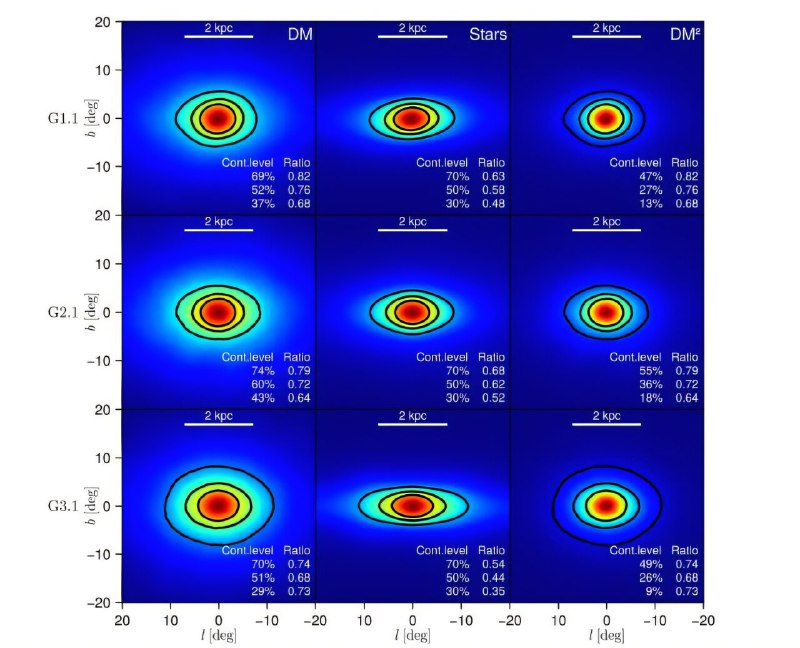
Silk and an international team of researchers used supercomputers to create maps of where dark matter should be located in the Milky Way, taking into account for the first time the history of how the galaxy formed.
Today, the Milky Way is a relatively closed system, without materials coming in or going out of it. But this hasn't always been the case. During the first billion years, many smaller galaxy-like systems made of dark matter and other materials entered and became the building blocks of the young Milky Way. As dark matter particles gravitated toward the center of the galaxy and clustered, the number of dark matter collisions increased.
When the researchers factored in more realistic collisions, their simulated maps matched actual gamma ray maps taken by the Fermi Gamma-ray Space Telescope.
These matching maps round out a triad of evidence that suggests excess gamma rays in the center of the Milky Way could originate with dark matter. Gamma rays coming from dark matter particle collisions would produce the same signal and have the same properties as those observed in the real world, the researchers said—though it's not definitive proof.
Source: Phys.org
@EverythingScience