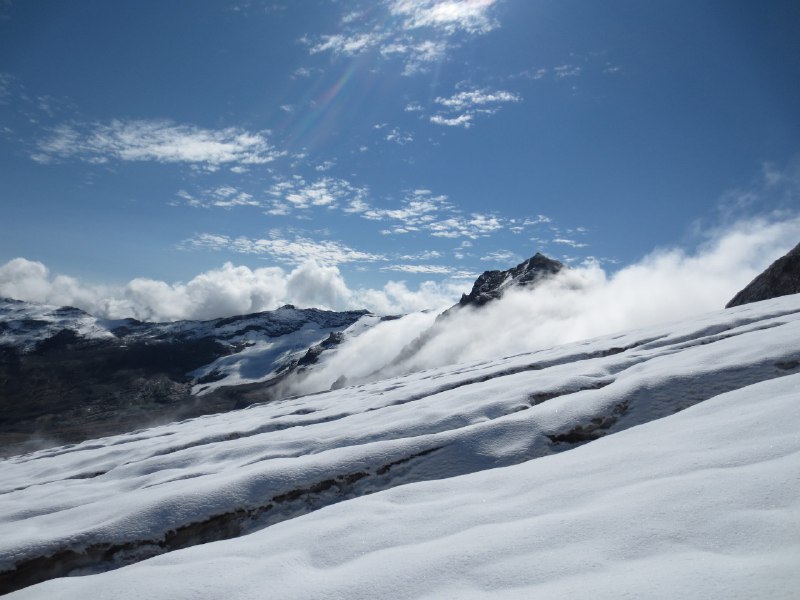
Glaciers appear to be resisting the effects of climate change by cooling the air that comes into contact with their icy surfaces. But this natural defense may not last much longer. Researchers from the Pellicciotti group at the Institute of Science and Technology Austria (ISTA) have assembled and reanalyzed an extensive global dataset of glacier observations, offering new insight into this temporary phenomenon.
According to their study, published in Nature Climate Change, glaciers are expected to reach the height of their self-cooling ability within the next decade. After that point, near-surface temperatures are projected to climb more rapidly, leading to faster melting and retreat.
Postdoctoral researcher Thomas Shaw vividly recalls a summer day in August 2022 that marked one of his key field experiences. Working under Francesca Pellicciotti at ISTA, Shaw stood atop Switzerland’s Glacier de Corbassière, 2,600 meters above sea level, gathering crucial data about the glacier’s condition. The weather was deceptively mild, with clear skies and a temperature of 17 degrees Celsius, unusual for someone standing on a glacier.
So, are glaciers “keeping their cool” a little too well? While average global temperatures continue to rise, glacier surfaces appear to warm more slowly. In the Himalayas, some of the world’s largest glaciers even send frigid air cascading down their slopes, forming cold winds that help protect their ecosystems. Yet scientists caution that this self-cooling process does not signal long-term resilience. Instead, it may be a fleeting response to a warming world.
A new study led by Shaw demonstrates that this reaction of glaciers is likely to reach its peak in the 2030s. “The more the climate warms, the more it will trigger the glaciers to cool their own microclimate and local environments down-valley,” says Shaw. “But this effect will not last long, and a trend shift will ensue before the middle of the century.” From then on, the glaciers’ melting and fragmentation due to human-caused climate change will intensify, and their near-surface temperatures will rise more rapidly, hastening their decline.
Source: SciTechDaily
@EverythingScience