TGViewer
Channel Public Channel
Englex

Englex

@englex

We're getting immersed into English through experience

@speaky - group
@lsndr - administrator
Subscribers
274
Photos
122
Videos
2
Links
46

Showing posts older than #224 · Back to latest

Older Posts 20 shown
Post #223 1.73K
- I wish he WERE here.
Post #221 1.73K
Idiom: Hit the books

If you’re a student in an English speaking environment you’re probably going to be hearing this phrase a lot. Before you imagine students running into their campus library and punching, kicking and wrestling apart the complete works of Shakespeare, we would just like to say that hit the books actually means to study. There there, you can still punch books in your spare time if you want, we won’t judge you.
Post #218 72

Forwarded from Englex

SHADE or SHADOW?

A shadow is the silhouette cast by an object that blocks a source of light. You can see your shadow on the ground or a wall or whatever you are blocking from the light source. You can make shadow puppets with your hands. A shadow can be cast by any light source such as a candle, a flashlight, an overhead light, a spotlight, or the sun.

Shade is the "darkness" created by a shadow and only really applies to shadows created outside by the sun. Underneath a tree on a sunny day would be "in the shade". Inside a building would be "out of the sun" and not "in the shade." However, under a roof with no walls (like a picnic shelter) would be "in the shade."

https://youtu.be/sUg6P1KO6xw
YouTube Common Mistakes: SHADE or SHADOW? http://www.engvid.com/ Sometimes there are words in English that have similar meanings but are used in different ways. In this vocabulary lesson, I discuss the difference between 'shade' and 'shadow' and show examples of how to use the two words. http:/…
Post #217 1.58K
This channel @one_story for anyone studying or just interested in English. And for those who like to read. To laugh, to experience and enjoy life) Join!
Post #212 1.55K
I see most of us feel a lack of speaking. So let's change it!

Send me (@lsndr) a message by the following pattern:
1. Your name, sex, age
2. Country
3. Interests
4. Level of English

Than I'll publish all blanks here so you'll be able to chat, call each other.
Post #210 1.47K
Do you have enough speaking practice?
anonymous poll

No – 102
👍👍👍👍👍👍👍 78%

Yes – 28
👍👍 22%

👥 130 people voted so far.
Post #209 1.63K
In common usage both assume and presume can mean ‘suppose’ and are often interchangeable in this meaning. However, technically there is a subtle difference between the two where presume is to ‘suppose to be the case on the basis of probability’:

Two of the journalists went missing and are presumed dead.

Assume on the other hand is to ‘suppose to be the case without proof’:

I just assumed it to be the case.

Both words also share other meanings that can be summarised as ‘to take on oneself’. In this sense assume is generally used to describe taking on a role:

I assumed the role of the aggressor in the conversation.

Whereas presume is generally used when taking on an attitude:

He had presumed too great a level of familiarity.
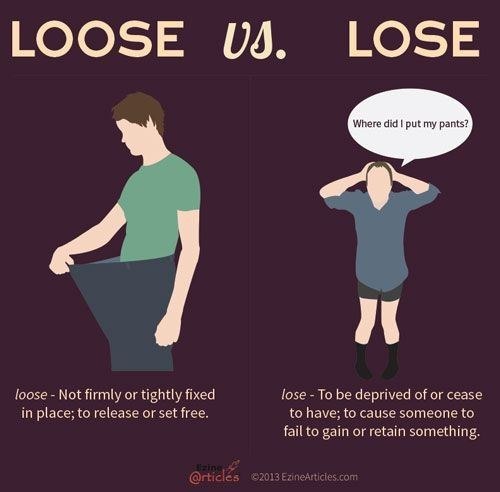
Post #205 1.83K
Lose vs. Loose

When people mix up "lose" and "loose," it's usually just because they're spelled so similarly. They know their definitions are completely different.

According to Merriam-Webster, "lose" is a verb that means "to be unable to find (something or someone), to fail to win (a game, contest, etc.), or to fail to keep or hold (something wanted or valued)." It's like losing your keys or losing a football match.

"Loose" is an adjective that means "not tightly fastened, attached, or held," like loose clothing or a loose tooth.

A trick for remembering the difference is to think of the term "loosey-goosey" -- both of those words are spelled with two o's.
Post #203 1.43K
A common #mistake is to write the word of instead of have or the contraction 've:

I could of told you that.


instead of:

I could have told you that.


or alternatively:

I could’ve told you that.


The reason for the mistake is that the pronunciation of have in unstressed contexts is the same as that of of, and the two words are confused when it comes to writing them down. The error was recorded as early as 1837 and, though common, is usually considered unacceptable in Standard English.
Post #202 1.49K
Older posts →
Threads Profile ViewerView any public Threads profile without an account.Open ThreadLook →Writing with AI? Make it sound human.Metric37 rewrites AI drafts so they read naturally. Free AI detector, 1,500 words free.Try Metric37 →