Repos & Repo Market #primers
(The repo market is such a crucially important but so-often misunderstood part of the financial system that we decided to re-post a more detailed primer with better formatting than the previous one).
At a very basic level, a repurchase agreement (repo) is a loan secured by collateral. The collateral is usually US Treasuries or other high quality liquid assets, like Agency MBS.
The repo market is the world's most important money market because it makes US Treasuries readily exchangeable with liquid bank deposits. Borrowers can easily roll-over overnight repo loans for as long as they'd want. Or, they can choose a longer-dated repo loan. It is therefore a dollar funding market, giving US Treasury holders ready access to US dollars.
For large companies, investment firms, and the very wealthy, US Treasuries are a smarter way to store wealth than as bank deposits or in assets like equities — both of which carry credit risk. This makes private repo essential for large institutions to function. As you'll see, some repo transactions use collateral that does carry credit risk, including equities.
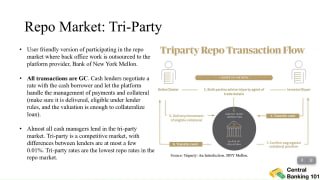
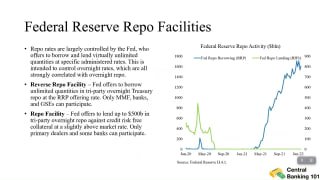
Its size is estimated to be almost $4 trillion cumulatively. There are several repo markets that exist outside of the Fed's Standing Repo Facility (SRF) and Reverse Repo Facility (RRP) — the biggest of which is the Tri-Party repo market.
> Repo Introduction
> Repo Transaction
> Repo Market: Overview
> Tri-Party repo (TPR)
> DVP FICC-cleared repo
> Uncleared bilateral repo
> GCF repo
> Non-traditional (non-trad) repo
> Fed's Repo Facilities
> Fed repo borrowing: reverse repo facility
> Fed repo lending: standing repo facility
For those who prefer text, here is the full slideshow in PDF (slides 3-25 are on repos). You can also read about repos and repo markets in Central Banking 101.
#primers
Post #116
637