
Continuing with this discussion, we can examine the achievements of the early Aryans, also known as the Proto-Indo-Iranian people, before their migrations into Iran and India. These groups were later influenced by various indigenous populations as the cultures that eventually developed into the Western Iranian and Vedic traditions emerged.
According to the available evidence, these people were associated with the Fatyanovo culture. They lived a relatively sedentary lifestyle in the forest zone for approximately 500–700 years. They then moved eastward and gradually adopted a more mobile way of life, eventually reaching the Ural Mountains, where we find what is known as the Sintashta culture.
The following are some of the notable achievements associated with these people.
1. Two-Wheeled War Chariots
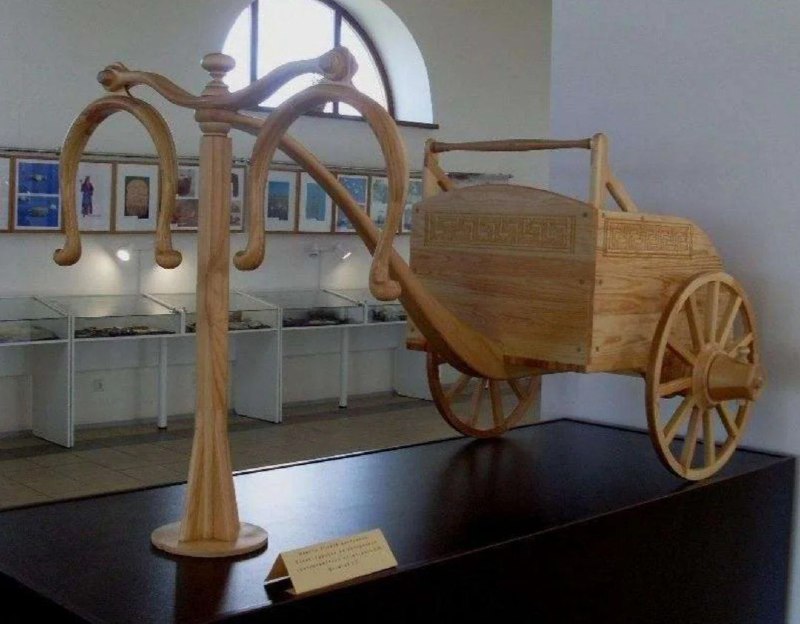
These people continued many of the technological traditions of their ancestors, including the use of horses and four-wheeled wagons. Their environment and increasingly mobile lifestyle eventually led them to modify these wagons and develop the two-wheeled war chariot.
Some of the earliest known wooden two-wheeled war chariots have been found in the Sintashta culture, and this technology later spread across large parts of Eurasia.
The chariots used in the great chariot wars involving the Hittites, Egyptians, and other peoples can ultimately be traced back to the development of this type of chariot.
They also used spoked wheels, which made the vehicles lighter, more agile, and more efficient than heavier solid-wheeled vehicles.
Their chariot technology spread across a vast area, from China to northern and western Europe, before these groups expanded into and conquered other regions.
2. Large Structures
Although the ancestors of these people were largely nomadic, and a significant proportion of their descendants remained nomadic for another 2,000 years, large and unusual structures can nevertheless be found among the early Aryans. Structures of this particular type and scale were not commonly found in other Indo-European cultures that were not associated with established agricultural civilizations.
The circular settlements of the Sintashta culture functioned in many ways like fortified settlements, with structures made from stone, wood, and earth. They appear to have been designed both for defense and to accommodate the needs of their communities.
These settlements had double-walled fortifications. The outer areas were used for livestock and herders, while the inner areas were occupied by people such as priests and blacksmiths.
Guards could stand on top of the walls to watch for approaching enemies, while charioteers could ride out from the settlements to confront attackers using chariots constructed within these communities.
Each of these fortified settlements could accommodate up to around a thousand people. In this way, they functioned as organized communities in which people from different social groups could cooperate in dealing with external threats and the challenges posed by their environment.
Structures of this particular form and scale were rarely seen again among their descendants.
@Deywoshest
Post #56
1.97K



- ❤ 4
- ⚡ 3
- 👎 2
- 👍 1