TGViewer
Channel Public Channel
Artificial Intelligence & ChatGPT Prompts

Artificial Intelligence & ChatGPT Prompts

@curiousprogrammer

🔓Unlock Your Coding Potential with ChatGPT
🚀 Your Ultimate Guide to Ace Coding Interviews!
💻 Coding tips, practice questions, and expert advice to land your dream tech job.


For Promotions: @love_data
Subscribers
42.2K
Photos
919
Videos
7
Links
844

Showing posts older than #2035 · Back to latest

Older Posts 20 shown
Post #2034 1.57K
✅ Probability and statistics basics for AI

Probability and statistics help AI deal with uncertainty and patterns in data.

Why AI Needs Probability
- Real data is noisy
- Outcomes are uncertain
- Models predict likelihood, not certainty

Example: Email spam detection (0.92 spam = 92% chance)

Basic Probability Ideas
_Probability value (0 to 1)_
0 = impossible, 1 = certain

Example: Probability of rain = 0.7 (high chance, not guaranteed)

Random Variables
Numerical representation of outcomes

Example: Coin toss (Head = 1, Tail = 0)

Distributions
Show how data is spread

_Normal distribution_ (bell-shaped, mean at center)
Example: Heights, exam scores

Key Stats Concepts
_Mean_ (average)
_Median_ (middle value, robust to outliers)
_Variance_ (spread of data)
_Standard deviation_ (typical distance from mean)

Outliers & Correlation
Outliers: Extreme values (can bias models)
_Correlation_: Relationship between features (-1 to 1)

Example: Study hours vs marks (positive correlation)

Probability in Models
_Logistic regression_ (outputs probability)
_Naive Bayes_ (probability-based)
_Loss functions_ (measure prediction error)

Your takeaway:
- AI predicts chances
- Statistics summarizes data
- Probability handles uncertainty

Double Tap ♥️ For More
  • ❤ 5
Post #2032 1.37K
Top 20 AI Concepts You Should Know

1 - Machine Learning: Core algorithms, statistics, and model training techniques.
2 - Deep Learning: Hierarchical neural networks learning complex representations automatically.
3 - Neural Networks: Layered architectures efficiently model nonlinear relationships accurately.
4 - NLP: Techniques to process and understand natural language text.
5 - Computer Vision: Algorithms interpreting and analyzing visual data effectively
6 - Reinforcement Learning: Distributed traffic across multiple servers for reliability.
7 - Generative Models: Creating new data samples using learned data.
8 - LLM: Generates human-like text using massive pre-trained data.
9 - Transformers: Self-attention-based architecture powering modern AI models.
10 - Feature Engineering: Designing informative features to improve model performance significantly.
11 - Supervised Learning: Learns useful representations without labeled data.
12 - Bayesian Learning: Incorporate uncertainty using probabilistic model approaches.
13 - Prompt Engineering: Crafting effective inputs to guide generative model outputs.
14 - AI Agents: Autonomous systems that perceive, decide, and act.
15 - Fine-Tuning Models: Customizes pre-trained models for domain-specific tasks.
16 - Multimodal Models: Processes and generates across multiple data types like images, videos, and text.
17 - Embeddings: Transforms input into machine-readable vector formats.
18 - Vector Search: Finds similar items using dense vector embeddings.
19 - Model Evaluation: Assessing predictive performance using validation techniques.
20 - AI Infrastructure: Deploying scalable systems to support AI operations.

Artificial intelligence Resources: https://whatsapp.com/channel/0029VaoePz73bbV94yTh6V2E

AI Jobs: https://whatsapp.com/channel/0029VaxtmHsLikgJ2VtGbu1R

Hope this helps you ☺️
  • ❤ 2
Post #2030 1.27K
Top 5 Case Studies for Data Analytics: You Must Know Before Attending an Interview

1. Retail: Target's Predictive Analytics for Customer Behavior
Company: Target
Challenge: Target wanted to identify customers who were expecting a baby to send them personalized promotions.
Solution:
Target used predictive analytics to analyze customers' purchase history and identify patterns that indicated pregnancy.
They tracked purchases of items like unscented lotion, vitamins, and cotton balls.
Outcome:
The algorithm successfully identified pregnant customers, enabling Target to send them relevant promotions.
This personalized marketing strategy increased sales and customer loyalty.

2. Healthcare: IBM Watson's Oncology Treatment Recommendations
Company: IBM Watson
Challenge: Oncologists needed support in identifying the best treatment options for cancer patients.
Solution:
IBM Watson analyzed vast amounts of medical data, including patient records, clinical trials, and medical literature.
It provided oncologists with evidencebased treatment recommendations tailored to individual patients.
Outcome:
Improved treatment accuracy and personalized care for cancer patients.
Reduced time for doctors to develop treatment plans, allowing them to focus more on patient care.

3. Finance: JP Morgan Chase's Fraud Detection System
Company: JP Morgan Chase
Challenge: The bank needed to detect and prevent fraudulent transactions in realtime.
Solution:
Implemented advanced machine learning algorithms to analyze transaction patterns and detect anomalies.
The system flagged suspicious transactions for further investigation.
Outcome:
Significantly reduced fraudulent activities.
Enhanced customer trust and satisfaction due to improved security measures.

4. Sports: Oakland Athletics' Use of Sabermetrics
Team: Oakland Athletics (Moneyball)
Challenge: Compete with larger teams with higher budgets by optimizing player performance and team strategy.
Solution:
Used sabermetrics, a form of advanced statistical analysis, to evaluate player performance and potential.
Focused on undervalued players with high onbase percentages and other key metrics.
Outcome:
Achieved remarkable success with a limited budget.
Revolutionized the approach to team building and player evaluation in baseball and other sports.

5. Ecommerce: Amazon's Recommendation Engine
Company: Amazon
Challenge: Enhance customer shopping experience and increase sales through personalized recommendations.
Solution:
Implemented a recommendation engine using collaborative filtering, which analyzes user behavior and purchase history.
The system suggests products based on what similar users have bought.
Outcome:
Increased average order value and customer retention.
Significantly contributed to Amazon's revenue growth through crossselling and upselling.

Like if it helps 😄
  • ❤ 2
Post #2026 1.58K
𝗙𝘂𝗹𝗹 𝗦𝘁𝗮𝗰𝗸 𝗗𝗲𝘃𝗲𝗹𝗼𝗽𝗺𝗲𝗻𝘁 𝗖𝗲𝗿𝘁𝗶𝗳𝗶𝗰𝗮𝘁𝗶𝗼𝗻 𝗣𝗿𝗼𝗴𝗿𝗮𝗺 😍

* JAVA- Full Stack Development With Gen AI
* MERN- Full Stack Development With Gen AI

Highlightes:-
* 2000+ Students Placed
* Attend FREE Hiring Drives at our Skill Centres
* Learn from India's Best Mentors

𝐑𝐞𝐠𝐢𝐬𝐭𝐞𝐫 𝐍𝐨𝐰👇 :- 

https://pdlink.in/4hO7rWY

Hurry, limited seats available!
Post #2025 1.43K
Today, let's move to the next topic of Artificial Intelligence Roadmap:

AI Basics Part-2: AI vs Machine Learning vs Deep Learning

Artificial Intelligence (AI)
- The big umbrella
- Goal: Make machines act intelligently
- Includes rules, logic, learning systems
- Example: A chess program with fixed rules (no learning, still AI)

Machine Learning (ML)
- Subset of AI
- Systems learn from data, no hard-coded rules
- How it works:
- You give input and output data
- Model finds patterns
- Uses patterns for new data
- Examples:
- Predict house prices from past sales
- Fraud detection from transaction history

Deep Learning (DL)
- Subset of machine learning
- Uses neural networks with many layers
- Handles complex data
- Why it matters:
- Works well with images, audio, text
- Learns features automatically
- Examples:
- Face recognition
- Speech recognition
- Chatbots

Simple Comparison
- AI: The goal
- Machine Learning: How systems learn
- Deep Learning: Powerful learning using neural networks

Real Product Mapping
- Spam filter: AI system, machine learning model
- Face unlock: AI system, deep learning model

When Each is Used
- Rule-based AI: Small, fixed logic
- Machine Learning: Structured data, predictions
- Deep Learning: Images, voice, large-scale text

Takeaway
- AI is the field
- Machine learning is the engine
- Deep learning is the heavy machinery

Double Tap ♥️ For Part-3
  • ❤ 6
Post #2024 1.2K
🚀 𝟰 𝗙𝗥𝗘𝗘 𝗧𝗲𝗰𝗵 𝗖𝗼𝘂𝗿𝘀𝗲𝘀 𝗧𝗼 𝗘𝗻𝗿𝗼𝗹𝗹 𝗜𝗻 𝟮𝟬𝟮𝟲 😍

📈 Upgrade your career with in-demand tech skills & FREE certifications!

1️⃣ AI & ML – https://pdlink.in/4bhetTu

2️⃣ Data Analytics – https://pdlink.in/497MMLw

3️⃣ Cloud Computing – https://pdlink.in/3LoutZd

4️⃣ Cyber Security – https://pdlink.in/3N9VOyW

More Courses – https://pdlink.in/4qgtrxU

🎓 100% FREE | Certificates Provided | Learn Anytime, Anywhere
Post #2023 1.34K
Today, let's start with the first topic of Artificial Intelligence Roadmap:

AI Basics Part-1

Artificial intelligence means
- Building systems that perform tasks that need human intelligence

Core idea
- You give data, rules, or goals
- The system learns patterns
- It makes decisions or predictions

What AI systems do
- See: Image recognition, face unlock on phones
- Hear: Voice assistants, speech to text
- Read: Spam filters, document classification
- Decide: Credit approval, recommendation engines

How AI works at a high level
- Input: Data like text, images, numbers
- Processing: Algorithms learn patterns
- Output: Prediction, classification, or action

Simple example
- Email spam filter
- Input: Email text
- Learning: Patterns from past spam emails
- Output: Spam or not spam

Where you see AI in real life
- Google search ranking results
- Netflix recommending movies
- Amazon product suggestions
- Google Maps traffic prediction
- Banks flagging fraud transactions

What AI is not
- Not magic
- Not human thinking
- Not always correct
- It depends fully on data quality

Types of tasks AI solves
- Classification: Spam vs not spam
- Regression: House price prediction
- Clustering: Customer grouping
- Recommendation: Products, videos
- Forecasting: Sales, demand

Why AI matters in products
- Handles large data fast
- Reduces manual work
- Improves decision accuracy
- Scales to millions of users

Your takeaway
- AI solves specific problems
- Data drives everything
- Models learn patterns, not meaning

Double Tap ♥️ For Part-2
  • ❤ 8
Post #2022 1.21K
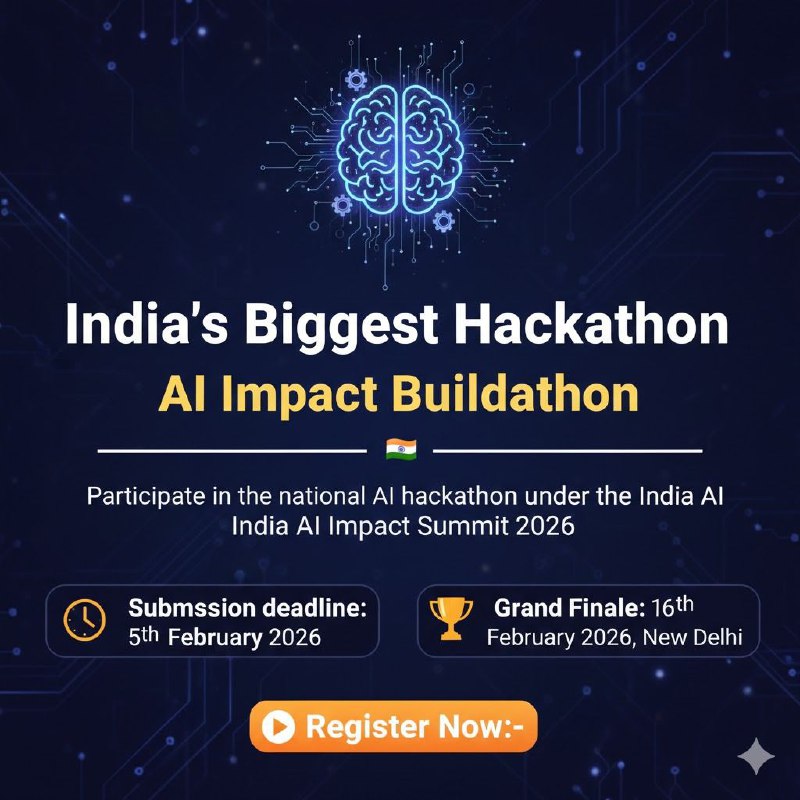
𝗜𝗻𝗱𝗶𝗮’𝘀 𝗕𝗶𝗴𝗴𝗲𝘀𝘁 𝗛𝗮𝗰𝗸𝗮𝘁𝗵𝗼𝗻 | 𝗔𝗜 𝗜𝗺𝗽𝗮𝗰𝘁 𝗕𝘂𝗶𝗹𝗱𝗮𝘁𝗵𝗼𝗻😍

Participate in the national AI hackathon under the India AI Impact Summit 2026

Submission deadline: 5th February 2026

Grand Finale: 16th February 2026, New Delhi

𝗥𝗲𝗴𝗶𝘀𝘁𝗲𝗿 𝗡𝗼𝘄👇:- 

https://pdlink.in/4qQfAOM

a flagship initiative of the Government of India 🇮🇳
Post #2021 1.25K
✅ Complete Roadmap to Master Artificial Intelligence in 3 Months

Month 1: Foundations

• Week 1: AI basics
– What artificial intelligence is
– AI vs machine learning vs deep learning
– Real business use cases
Outcome: You know where AI fits in real products.

• Week 2: Math and logic essentials
– Linear algebra basics, vectors, matrices
– Probability and statistics basics
– Cost functions and optimization idea
Outcome: You understand how models learn.

• Week 3: Python for AI
– Python syntax for analysis
– NumPy arrays and operations
– Pandas for data handling
Outcome: You work with data confidently.

• Week 4: Data preparation
– Data cleaning and preprocessing
– Handling missing values and outliers
– Feature selection basics
Outcome: Your data is model ready.

Month 2: Machine Learning Core

• Week 5: Supervised learning
– Linear and logistic regression
– Decision trees and random forest
– Model evaluation, accuracy, precision, recall
Outcome: You build prediction models.

• Week 6: Unsupervised learning
– K-means clustering
– Hierarchical clustering
– PCA with real examples
Outcome: You find patterns in data.

• Week 7: Model improvement
– Overfitting and underfitting
– Cross validation
– Hyperparameter tuning
Outcome: Your models perform better.

• Week 8: Intro to deep learning
– Neural network basics
– Activation functions
– Backpropagation concept
Outcome: You understand how deep models work.

Month 3: Applied AI and Job Prep

• Week 9: Deep learning tools
– TensorFlow or PyTorch basics
– Build a simple neural network
– Train and test models
Outcome: You build neural models.

• Week 10: Real world AI project
– Choose use case, spam detection or sales prediction
– Data prep, model training, evaluation
– Simple deployment demo
Outcome: One strong AI project.

• Week 11: Interview preparation
– Machine learning theory questions
– Model selection questions
– Project explanation flow
Outcome: You answer with clarity.

• Week 12: Resume and practice
– AI focused resume
– GitHub with notebooks and projects
– Daily problem solving
Outcome: You are AI job ready.

Practice platforms: Kaggle, Google Colab, Scikit-learn docs

Double Tap ♥️ For Detailed Explanation of Each Topic
  • ❤ 8
Post #2019 1.27K
​​​​🔎 How to generate a photo of a non-existent person! 🔎

😎 If you want to create a fake account on a social network, you can use another person's photo, but this is not the best option. It is better to use the following service to generate photos of non-existent people:

🤯. Open this website:
https://thispersondoesnotexist.com/
🤯. Visiting the website, we immediately get a photo of a non-existent person.
🤯. Updating the page, you will see a new generated image.

⚠️ That's it, you can update the resource until you are satisfied with the photo. The site works very fast which is an undoubted plus. Many sites based on the work of artificial intelligence are often very slow. ⚠️

➡️ Need 200 Reactions on this Post
  • ❤ 4
  • 👍 2
Post #2018 1.19K
𝗧𝗼𝗽 𝗖𝗲𝗿𝘁𝗶𝗳𝗶𝗰𝗮𝘁𝗶𝗼𝗻𝘀 𝗧𝗼 𝗚𝗲𝘁 𝗛𝗶𝗴𝗵 𝗣𝗮𝘆𝗶𝗻𝗴 𝗝𝗼𝗯 𝗜𝗻 𝟮𝟬𝟮𝟲😍

Opportunities With 500+ Hiring Partners 

𝗙𝘂𝗹𝗹𝘀𝘁𝗮𝗰𝗸:- https://pdlink.in/4hO7rWY

𝗗𝗮𝘁𝗮 𝗔𝗻𝗮𝗹𝘆𝘁𝗶𝗰𝘀:- https://pdlink.in/4fdWxJB

📈 Start learning today, build job-ready skills, and get placed in leading tech companies.
Post #2017 1.34K
Post #2016 1.21K
𝗙𝗥𝗘𝗘 𝗖𝗮𝗿𝗲𝗲𝗿 𝗖𝗮𝗿𝗻𝗶𝘃𝗮𝗹 𝗯𝘆 𝗛𝗖𝗟 𝗚𝗨𝗩𝗜😍

Prove your skills in an online hackathon, clear tech interviews, and get hired faster

Highlightes:- 

- 21+ Hiring Companies & 100+ Open Positions to Grab
- Get hired for roles in AI, Full Stack, & more

Experience the biggest online job fair with Career Carnival by HCL GUVI

𝗥𝗲𝗴𝗶𝘀𝘁𝗲𝗿 𝗙𝗼𝗿 𝗙𝗥𝗘𝗘👇:- 

https://pdlink.in/4bQP5Ee

Hurry Up🏃‍♂️.....Limited Slots Available
  • ❤ 1
Post #2015 1.13K
😎 Machine Learning Cheatsheet — a structured ML guide!

There are no courses here, no unnecessary theory or long lectures, but there are clear formulas, algorithms, the logic of ML pipelines, and a neatly structured knowledge base. It's perfect for quickly refreshing your understanding of algorithms or having it handy as an ML cheat sheet during work.

📌 Here's the link: ml-cheatsheet.readthedocs.io
  • 👍 2
Post #2013 1.12K
✅ Where to Apply for Web Development Jobs 💻🌐

Here’s a list of the best platforms to find web dev jobs, internships, and freelance gigs:

🔹 Job Portals (Full-time/Internships)
1. LinkedIn – Top platform for tech hiring
2. Indeed – Good for local & remote jobs
3. Glassdoor – Job search + company reviews
4. Naukri.com – Popular in India
5. Monster – Global listings
6. Internshala – Internships & fresher roles

🔹 Tech-Specific Platforms
1. Hirect App – Direct chat with startup founders/recruiters
2. AngelList / Wellfound – Startup jobs (remote/flexible)
3. Stack Overflow Jobs – Developer-focused listings
4. Turing / Toptal – Remote global jobs (for skilled devs)

🔹 Freelancing Platforms
1. Upwork – Projects from all industries
2. Fiverr – Set your own gigs (great for beginners)
3. Freelancer.com – Bidding-based freelance jobs
4. PeoplePerHour – Short-term dev projects

🔹 Social Media Platforms
There are many WhatsApp & Telegram channels which post daily job updates. Here are some of the most popular job channels:

Telegram channels:
https://t.me/getjobss
https://t.me/FAANGJob
https://t.me/internshiptojobs
https://t.me/jobs_us_uk

WhatsApp Channels:
https://whatsapp.com/channel/0029Vb1raTiDjiOias5ARu2p
https://whatsapp.com/channel/0029VaxngnVInlqV6xJhDs3m
https://whatsapp.com/channel/0029VatL9a22kNFtPtLApJ2L
https://whatsapp.com/channel/0029VaxtmHsLikgJ2VtGbu1R
https://whatsapp.com/channel/0029Vb4n3QZFy72478wwQp3n
https://whatsapp.com/channel/0029VbAOss8EKyZK7GryN63V
https://whatsapp.com/channel/0029Vb1RrFuC1Fu3E0aiac2E
https://whatsapp.com/channel/0029Vb8pF9b65yDKZxIAy83b
https://whatsapp.com/channel/0029Vb9CzaNCcW4yxgR1jX3S

🔹 Others Worth Exploring
- Remote OK / We Work Remotely – Remote jobs
- Jobspresso / Remotive – Remote tech-focused roles
- Hashnode / Dev.to – Community + job listings

💡 Tip: Always keep your LinkedIn & GitHub updated. Many recruiters search there directly!

👍 Tap ❤️ if you found this helpful!
  • ❤ 3
Post #2011 1.19K
⌨️ Benefits of learning Python Programming

1. Web Development: Python frameworks like Django and Flask are popular for building dynamic websites and web applications.

2. Data Analysis: Python has powerful libraries like Pandas and NumPy for data manipulation and analysis, making it widely used in data science and analytic.

3. Machine Learning: Python's libraries such as TensorFlow, Keras, and Scikit-learn are extensively used for implementing machine learning algorithms and building predictive models.

4. Artificial Intelligence: Python is commonly used in AI development due to its simplicity and extensive libraries for tasks like natural language processing, image recognition, and neural network implementation.

5. Cybersecurity: Python is utilized for tasks such as penetration testing, network scanning, and creating security tools due to its versatility and ease of use.

6. Game Development: Python, along with libraries like Pygame, is used for developing games, prototyping game mechanics, and creating game scripts.

7. Automation: Python's simplicity and versatility make it ideal for automating repetitive tasks, such as scripting, data scraping, and process automation.
  • ❤ 3
Post #2009 1.39K
✅ Data Analyst Resume Checklist (2025) 📊📝

1️⃣ Professional Summary
• 2-3 lines about your experience, skills, and career goals.
✔️ Example: "Data Analyst with 3+ years of experience in data mining, analysis, and visualization using Python, SQL, and Tableau."

2️⃣ Technical Skills
• Programming Languages: Python, R, SQL
• Data Visualization Tools: Tableau, Power BI, Matplotlib, Seaborn
• Statistical Analysis: Hypothesis Testing, Regression, Time Series Analysis
• Databases: SQL, NoSQL
• Cloud Technologies: AWS, Azure, GCP (if applicable)
• Other Tools: Excel, Jupyter Notebook, Git

3️⃣ Projects Section
• 2-4 data analysis projects with:
- Project name and brief description
- Tools/technologies used
- Key findings and insights
- Link to GitHub or live dashboard (if applicable)
✔️ Use bullet points and quantify achievements.

4️⃣ Work Experience (if any)
• Company name, role, and duration
• Responsibilities and achievements with metrics
✔️ Example: "Increased sales leads by 15% by identifying key customer segments using clustering techniques."

5️⃣ Education
• Degree, University/Institute, Graduation Year
✔️ Include relevant coursework or specializations (e.g., statistics, data science).
✔️ Add certifications (if any): Google Data Analytics Professional Certificate, etc.

6️⃣ Soft Skills
• Communication, problem-solving, critical thinking, teamwork, attention to detail

7️⃣ Clean & Professional Formatting
• Use a clear and easy-to-read font
• Keep it to one page if possible
• Save as a PDF

💡 Pro Tip: Tailor your resume to the specific requirements of the job. Highlight the skills and experiences that are most relevant to the position.

👍 Tap ❤️ if you found this helpful!
  • ❤ 5
  • 👍 1
Post #2007 1.35K
💡 Roadmap to learn AI Agents
  • ❤ 3
Post #2005 1.37K
Preparing for a machine learning interview as a data analyst is a great step.

Here are some common machine learning interview questions :-

1. Explain the steps involved in a machine learning project lifecycle.

2. What is the difference between supervised and unsupervised learning? Give examples of each.

3. What evaluation metrics would you use to assess the performance of a regression model?

4. What is overfitting and how can you prevent it?

5. Describe the bias-variance tradeoff.

6. What is cross-validation, and why is it important in machine learning?

7. What are some feature selection techniques you are familiar with?

8.What are the assumptions of linear regression?

9. How does regularization help in linear models?

10. Explain the difference between classification and regression.

11. What are some common algorithms used for dimensionality reduction?

12. Describe how a decision tree works.

13. What are ensemble methods, and why are they useful?

14. How do you handle missing or corrupted data in a dataset?

15. What are the different kernels used in Support Vector Machines (SVM)?


These questions cover a range of fundamental concepts and techniques in machine learning that are important for a data scientist role.
Good luck with your interview preparation!


Best Data Science & Machine Learning Resources: https://topmate.io/coding/914624

Like if you need similar content 😄👍
  • ❤ 2
Older posts →
Threads Profile ViewerView any public Threads profile without an account.Open ThreadLook →Writing with AI? Make it sound human.Metric37 rewrites AI drafts so they read naturally. Free AI detector, 1,500 words free.Try Metric37 →