TGViewer
Channel Public Channel
Artificial Intelligence & ChatGPT Prompts

Artificial Intelligence & ChatGPT Prompts

@curiousprogrammer

🔓Unlock Your Coding Potential with ChatGPT
🚀 Your Ultimate Guide to Ace Coding Interviews!
💻 Coding tips, practice questions, and expert advice to land your dream tech job.


For Promotions: @love_data
Subscribers
42.2K
Photos
919
Videos
7
Links
844

Showing posts older than #2005 · Back to latest

Older Posts 20 shown
Post #2003 1.51K
⚡️ All cheat sheets for programmers in one place.

There's a lot of useful stuff inside: short, clear tips on languages, technologies, and frameworks.

No registration required and it's free.

https://overapi.com/
  • ❤ 2
Post #2001 1.46K
Here are seven popular programming languages and their benefits:

1. Python:
- Benefits: Python is known for its simplicity and readability, making it a great choice for beginners. It has a vast ecosystem of libraries and frameworks for various applications such as web development, data science, machine learning, and automation. Python's versatility and ease of use make it a popular choice for a wide range of projects.

2. JavaScript:
- Benefits: JavaScript is the language of the web, used for building interactive and dynamic websites. It is supported by all major browsers and has a large community of developers. JavaScript can also be used for server-side development (Node.js) and mobile app development (React Native). Its flexibility and wide range of applications make it a valuable language to learn.

3. Java:
- Benefits: Java is a robust, platform-independent language commonly used for building enterprise-level applications, mobile apps (Android), and large-scale systems. It has strong support for object-oriented programming principles and a rich ecosystem of libraries and tools. Java's stability, performance, and scalability make it a popular choice for building mission-critical applications.

4. C++:
- Benefits: C++ is a powerful and efficient language often used for system programming, game development, and high-performance applications. It provides low-level control over hardware and memory management while offering high-level abstractions for complex tasks. C++'s performance, versatility, and ability to work closely with hardware make it a preferred choice for performance-critical applications.

5. C#:
- Benefits: C# is a versatile language developed by Microsoft and commonly used for building Windows applications, web applications (with ASP.NET), and games (with Unity). It offers a modern syntax, strong type safety, and seamless integration with the .NET framework. C#'s ease of use, robustness, and support for various platforms make it a popular choice for developing a wide range of applications.

6. R:
- Benefits: R is a language specifically designed for statistical computing and data analysis. It has a rich set of built-in functions and packages for data manipulation, visualization, and machine learning. R's focus on data science, statistical modeling, and visualization makes it an ideal choice for researchers, analysts, and data scientists working with large datasets.

7. Swift:
- Benefits: Swift is Apple's modern programming language for developing iOS, macOS, watchOS, and tvOS applications. It offers safety features to prevent common programming errors, high performance, and interoperability with Objective-C. Swift's clean syntax, powerful features, and seamless integration with Apple's platforms make it a preferred choice for building native applications in the Apple ecosystem.

These are just a few of the many programming languages available today, each with its unique strengths and use cases.

Credits: https://t.me/free4unow_backup

Like if you need similar content 😄👍
  • ❤ 3
Post #1999 1.43K
Complete Roadmap to become a data scientist in 5 months

Free Resources to learn Data Science: https://whatsapp.com/channel/0029Va8v3eo1NCrQfGMseL2D

Week 1-2: Fundamentals
- Day 1-3: Introduction to Data Science, its applications, and roles.
- Day 4-7: Brush up on Python programming.
- Day 8-10: Learn basic statistics and probability.

Week 3-4: Data Manipulation and Visualization
- Day 11-15: Pandas for data manipulation.
- Day 16-20: Data visualization with Matplotlib and Seaborn.

Week 5-6: Machine Learning Foundations
- Day 21-25: Introduction to scikit-learn.
- Day 26-30: Linear regression and logistic regression.

Work on Data Science Projects: https://t.me/pythonspecialist/29

Week 7-8: Advanced Machine Learning
- Day 31-35: Decision trees and random forests.
- Day 36-40: Clustering (K-Means, DBSCAN) and dimensionality reduction.

Week 9-10: Deep Learning
- Day 41-45: Basics of Neural Networks and TensorFlow/Keras.
- Day 46-50: Convolutional Neural Networks (CNNs) and Recurrent Neural Networks (RNNs).

Week 11-12: Data Engineering
- Day 51-55: Learn about SQL and databases.
- Day 56-60: Data preprocessing and cleaning.

Week 13-14: Model Evaluation and Optimization
- Day 61-65: Cross-validation, hyperparameter tuning.
- Day 66-70: Evaluation metrics (accuracy, precision, recall, F1-score).

Week 15-16: Big Data and Tools
- Day 71-75: Introduction to big data technologies (Hadoop, Spark).
- Day 76-80: Basics of cloud computing (AWS, GCP, Azure).

Week 17-18: Deployment and Production
- Day 81-85: Model deployment with Flask or FastAPI.
- Day 86-90: Containerization with Docker, cloud deployment (AWS, Heroku).

Week 19-20: Specialization
- Day 91-95: NLP or Computer Vision, based on your interests.

Week 21-22: Projects and Portfolios
- Day 96-100: Work on personal data science projects.

Week 23-24: Soft Skills and Networking
- Day 101-105: Improve communication and presentation skills.
- Day 106-110: Attend online data science meetups or forums.

Week 25-26: Interview Preparation
- Day 111-115: Practice coding interviews on platforms like LeetCode.
- Day 116-120: Review your projects and be ready to discuss them.

Week 27-28: Apply for Jobs
- Day 121-125: Start applying for entry-level data scientist positions.

Week 29-30: Interviews
- Day 126-130: Attend interviews, practice whiteboard problems.

Week 31-32: Continuous Learning
- Day 131-135: Stay updated with the latest trends in data science.

Week 33-34: Accepting Offers
- Day 136-140: Evaluate job offers and negotiate if necessary.

Week 35-36: Settling In
- Day 141-150: Start your new data science job, adapt to the team, and continue learning on the job.

ENJOY LEARNING 👍👍

  • ❤ 4
Post #1997 1.5K
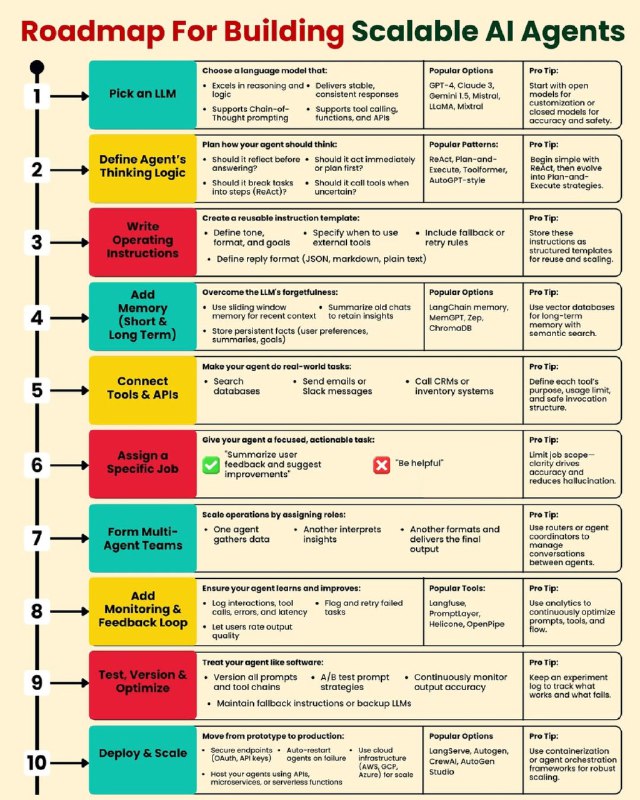
🧠 Roadmap for building scalable AI Agents!
  • ❤ 8
Post #1995 1.74K
AI is playing a critical role in advancing cybersecurity by enhancing threat detection, response, and overall security posture. Here are some key AI trends in cybersecurity:

1. Advanced Threat Detection:
- Anomaly Detection: AI systems analyze network traffic and user behavior to detect anomalies that may indicate a security breach or insider threat.
- Real-Time Monitoring: AI-powered tools provide real-time monitoring and analysis of security events, identifying and mitigating threats as they occur.

2. Behavioral Analytics:
- User Behavior Analytics (UBA): AI models profile user behavior to detect deviations that could signify compromised accounts or malicious insiders.
- Entity Behavior Analytics (EBA): Similar to UBA but focuses on the behavior of devices and applications within the network to identify potential threats.

3. Automated Incident Response:
- Security Orchestration, Automation, and Response (SOAR): AI automates routine security tasks, such as threat hunting and incident response, to reduce response times and improve efficiency.
- Playbook Automation: AI-driven playbooks guide incident response actions based on predefined protocols, ensuring consistent and rapid responses to threats.

4. Predictive Threat Intelligence:
- Threat Prediction: AI predicts potential cyber threats by analyzing historical data, threat intelligence feeds, and emerging threat patterns.
- Proactive Defense: AI enables proactive defense strategies by identifying and mitigating potential vulnerabilities before they can be exploited.

5. Enhanced Malware Detection:
- Signatureless Detection: AI identifies malware based on behavior and characteristics rather than relying solely on known signatures, improving detection of zero-day threats.
- Dynamic Analysis: AI analyzes the behavior of files and applications in a sandbox environment to detect malicious activity.

6. Fraud Detection and Prevention:
- Transaction Monitoring: AI detects fraudulent transactions in real-time by analyzing transaction patterns and flagging anomalies.
- Identity Verification: AI enhances identity verification processes by analyzing biometric data and other authentication factors.

7. Phishing Detection:
- Email Filtering: AI analyzes email content and metadata to detect phishing attempts and prevent them from reaching users.
- URL Analysis: AI examines URLs and associated content to identify and block malicious websites used in phishing attacks.

8. Vulnerability Management:
- Automated Vulnerability Scanning: AI continuously scans systems and applications for vulnerabilities, prioritizing them based on risk and impact.
- Patch Management: AI recommends and automates the deployment of security patches to mitigate vulnerabilities.

9. Natural Language Processing (NLP) in Security:
- Threat Intelligence Analysis: AI-powered NLP tools analyze and extract relevant information from threat intelligence reports and security feeds.
- Chatbot Integration: AI chatbots assist with security-related queries and provide real-time support for incident response teams.

10. Deception Technology:
- AI-Driven Honeypots: AI enhances honeypot technologies by creating realistic decoys that attract and analyze attacker behavior.
- Deceptive Environments: AI generates deceptive network environments to mislead attackers and gather intelligence on their tactics.

11. Continuous Authentication:
- Behavioral Biometrics: AI continuously monitors user behavior, such as typing patterns and mouse movements, to authenticate users and detect anomalies.
- Adaptive Authentication: AI adjusts authentication requirements based on the risk profile of user activities and contextual factors.

Cybersecurity Resources: https://t.me/EthicalHackingToday

Join for more: t.me/AI_Best_Tools
  • ❤ 3
Post #1994 1.37K
𝗛𝗶𝗴𝗵 𝗗𝗲𝗺𝗮𝗻𝗱𝗶𝗻𝗴 𝗖𝗲𝗿𝘁𝗶𝗳𝗶𝗰𝗮𝘁𝗶𝗼𝗻 𝗖𝗼𝘂𝗿𝘀𝗲𝘀 𝗪𝗶𝘁𝗵 𝗣𝗹𝗮𝗰𝗲𝗺𝗲𝗻𝘁 𝗔𝘀𝘀𝗶𝘀𝘁𝗮𝗻𝗰𝗲😍

Learn from IIT faculty and industry experts.

IIT Roorkee DS & AI Program :- https://pdlink.in/4qHVFkI

IIT Patna AI & ML :- https://pdlink.in/4pBNxkV

IIM Mumbai DM & Analytics :- https://pdlink.in/4jvuHdE

IIM Rohtak Product Management:- https://pdlink.in/4aMtk8i

IIT Roorkee Agentic Systems:- https://pdlink.in/4aTKgdc

Upskill in today’s most in-demand tech domains and boost your career 🚀
  • ❤ 1
Post #1993 1.47K
✅ GitHub Profile Tips for AI/ML Developers 🤖📂

Want to impress recruiters with your AI skills? Build a GitHub that shows, not tells.

1️⃣ Create a Strong Profile README
• Short intro: “AI developer interested in NLP, LLMs, and MLOps”
• Highlight top skills: Python, PyTorch, Hugging Face, etc.
• Add links: LinkedIn, portfolio, blog, or resume

2️⃣ Pin AI Projects with Impact
• Showcase 3–6 well-documented projects
✅ Examples:
– Chatbot with RAG pipeline
– Image classifier with CNN (Keras/TensorFlow)
– Sentiment analysis using BERT
– Fraud detection with real-world data

3️⃣ Well-Written READMEs Are a Must
• Problem solved
• Dataset used
• Tech stack
• Screenshots (if applicable)
• How to run the code (with requirements.txt or Colab)

4️⃣ Use Jupyter Notebooks & Python Scripts
• Share .ipynb for EDA + model experiments
• Keep .py files clean & modular for deployment

5️⃣ Add Model Deployment Projects
✅ Example:
– FastAPI + Hugging Face model deployed on Render/Streamlit
– Flask app with image detection model

6️⃣ Use Git Intentionally
• Frequent, meaningful commits
• Branches for experiments
• Push only clean code (no huge datasets/models)

📌 Practice Task:
Pick 1 AI project → Add README → Push to GitHub → Share link on resume

💬 Tap ❤️ for more!
  • ❤ 3
Post #1992 1.61K
✅ AI Projects You Should Build as a Beginner 🤖💡

1️⃣ Chatbot using NLP
➤ Use Python + NLTK or spaCy
➤ Basic intent recognition
➤ Reply with scripted or smart responses

2️⃣ Image Classifier
➤ Use TensorFlow or PyTorch
➤ Train on datasets like MNIST or CIFAR-10
➤ Predict handwritten digits or objects

3️⃣ Movie Recommendation System
➤ Use Pandas + Scikit-Learn
➤ Collaborative or content-based filtering
➤ Suggest similar movies

4️⃣ Sentiment Analysis Tool
➤ Analyze tweets or reviews
➤ Use pre-trained models or train one
➤ Classify as positive, negative, or neutral

5️⃣ Voice Assistant (Mini)
➤ Use SpeechRecognition + pyttsx3
➤ Take voice commands
➤ Respond with actions or answers

6️⃣ AI Resume Screener
➤ Extract data from PDFs
➤ Use NLP to match skills with job roles
➤ Score resumes

7️⃣ Object Detection App
➤ Use OpenCV + YOLO or TensorFlow
➤ Detect and label objects in images or video

8️⃣ AI Art Generator (with Stable Diffusion or DALL·E API)
➤ Generate images from text prompts
➤ Add UI for prompt input and output display

💡 Choose one project. Go deep. Document everything.

💬 Tap ❤️ for more!
  • ❤ 7
Post #1991 1.47K
𝗙𝗥𝗘𝗘 𝗢𝗻𝗹𝗶𝗻𝗲 𝗠𝗮𝘀𝘁𝗲𝗿𝗰𝗹𝗮𝘀𝘀 𝗢𝗻 𝗟𝗮𝘁𝗲𝘀𝘁 𝗧𝗲𝗰𝗵𝗻𝗼𝗹𝗼𝗴𝗶𝗲𝘀😍

- Data Science 
- AI/ML
- Data Analytics
- UI/UX
- Full-stack Development 

Get Job-Ready Guidance in Your Tech Journey

𝗥𝗲𝗴𝗶𝘀𝘁𝗲𝗿 𝗙𝗼𝗿 𝗙𝗥𝗘𝗘👇:- 

https://pdlink.in/4sw5Ev8

Date :- 11th January 2026
Post #1990 1.87K
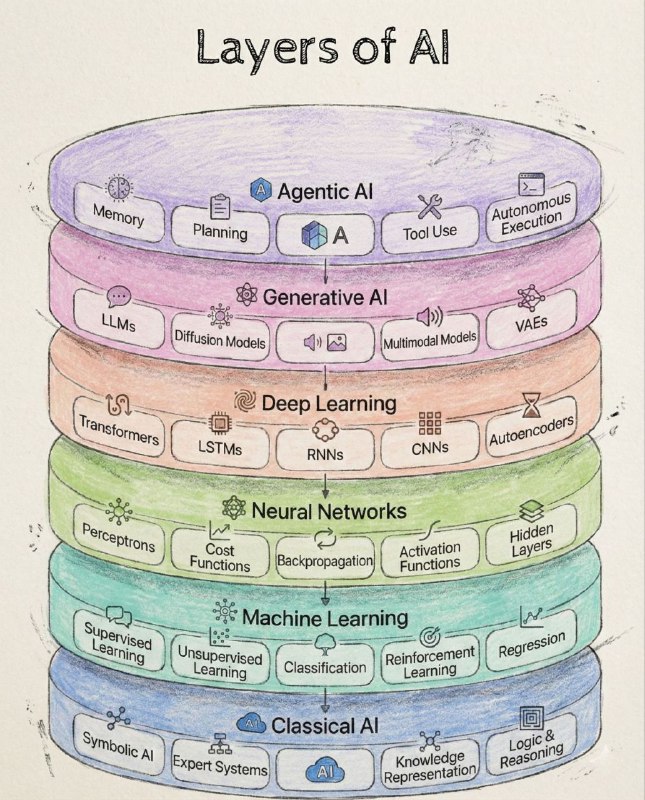
𝗟𝗮𝘆𝗲𝗿𝘀 𝗼𝗳 𝗔𝗜 — 𝗨𝗻𝗱𝗲𝗿𝘀𝘁𝗮𝗻𝗱𝗶𝗻𝗴 𝘁𝗵𝗲 𝗙𝘂𝗹𝗹 𝗔𝗜 𝗦𝘁𝗮𝗰𝗸 🧠🤖

🔹 𝗖𝗹𝗮𝘀𝘀𝗶𝗰𝗮𝗹 𝗔𝗜
The roots of AI — rule-based systems, symbolic logic, expert systems, and knowledge representation.
Still relevant today in domains requiring strict rules and explainability.

🔹 𝗠𝗮𝗰𝗵𝗶𝗻𝗲 𝗟𝗲𝗮𝗿𝗻𝗶𝗻𝗴
Where data replaces hard-coded rules.
Includes supervised, unsupervised, and reinforcement learning powering predictions, classification, and optimization.

🔹 𝗡𝗲𝘂𝗿𝗮𝗹 𝗡𝗲𝘁𝘄𝗼𝗿𝗸𝘀
Inspired by the human brain.
Concepts like perceptrons, activation functions, backpropagation, and hidden layers form the backbone of modern AI.

🔹 𝗗𝗲𝗲𝗽 𝗟𝗲𝗮𝗿𝗻𝗶𝗻𝗴
Neural networks at scale.
Architectures like CNNs, RNNs, LSTMs, Transformers, and Autoencoders enable vision, speech, and language understanding.

🔹 𝗚𝗲𝗻𝗲𝗿𝗮𝘁𝗶𝘃𝗲 𝗔𝗜
Models that create — not just predict.
LLMs, diffusion models, VAEs, and multimodal systems generate text, images, audio, and video.

🔹 𝗔𝗴𝗲𝗻𝘁𝗶𝗰 𝗔𝗜 (𝗧𝗵𝗲 𝗘𝗺𝗲𝗿𝗴𝗶𝗻𝗴 𝗟𝗮𝘆𝗲𝗿 🚀)
AI that can plan, remember, use tools, and execute tasks autonomously.
  • ❤ 4
Post #1988 1.78K
Python Roadmap 🐍

📂 Syntax Basics
∟📂 Data Structures
 ∟📂 Algorithms
  ∟📂 OOP Concepts
   ∟📂 Module & Packages
    ∟📂 Error Handling
     ∟📂 File Handling
      ∟📂 Networking
       ∟📂 Security
        ∟📂 Do Lab
         ∟✅ Job

React ❤️ For More

#techinfo
  • ❤ 6
Post #1984 1.65K
💡 AI Agent vs. MCP

An AI agent is a software program that can interact with its environment, gather data, and use that data to achieve predetermined goals. AI agents can choose the best actions to perform to meet those goals.

Key characteristics of AI agents are as follows:

1 - An agent can perform autonomous actions without constant human intervention. Also, they can have a human in the loop to maintain control.

2 - Agents have a memory to store individual preferences and allow for personalization. It can also store knowledge. An LLM can undertake information processing and decision-making functions.

3 - Agents must be able to perceive and process the information available from their environment.

Model Context Protocol (MCP) is a new system introduced by Anthropic to make AI models more powerful.

It is an open standard that allows AI models (like Claude) to connect to databases, APIs, file systems, and other tools without needing custom code for each new integration.

MCP follows a client-server model with 3 key components:
1 - Host: AI applications like Claude

2 - MCP Client: Component inside an AI model (like Claude) that allows it to communicate with MCP servers

3 - MCP Server: Middleman that connects an AI model to an external system
  • ❤ 6
Post #1983 1.91K
✅ Today’s AI News – Jan 5, 2026 🤖📊

1️⃣ Microsoft Expands Copilot AI Tools
Microsoft announces new AI features for Copilot in Office 365 — including AI‑powered meeting summaries, action item suggestions, and real‑time document insights across Word, Excel, and Teams.

2️⃣ Google Gemini Learns New Multimodal Skills
Google updates Gemini with deeper multimodal understanding — meaning it can now interpret text + audio + video together for more context‑aware responses.

3️⃣ AI Beats Humans in Real‑Time Strategy Game
A research team reveals an AI agent that outperforms professional players in a popular real‑time strategy game, using advanced planning and adaptation strategies.

4️⃣ EU Introduces AI Accountability Framework
The European Commission finalizes new accountability guidelines for AI systems, requiring transparency, audit logs, and ethical reporting for high‑impact applications.

5️⃣ AI Speeds Up Drug Discovery Process
AI models are helping researchers identify promising drug candidates in record time — cutting months off traditional screening methods for new medicines.

💬 Tap ❤️ for more daily AI updates!
  • ❤ 4
Post #1980 2.95K
✅ Roadmap to Learn Prompt Engineering in 30 Days 🧠💬

📅 Week 1: Foundations
🔹 Day 1–2: What is Prompt Engineering? Basics of LLMs
🔹 Day 3–4: Learn how GPT-style models work (inputs → tokens → outputs)
🔹 Day 5–7: Prompt formats: zero-shot, one-shot, few-shot

📅 Week 2: Techniques Best Practices
🔹 Day 8–10: Role-based prompting (e.g., "Act as a…")
🔹 Day 11–12: Chain-of-thought prompting
🔹 Day 13–14: Tips to get more accurate, creative, or structured responses

📅 Week 3: Use Cases Tools
🔹 Day 15–17: Prompts for coding, summarization, QA, writing, translation
🔹 Day 18–19: Explore OpenAI Playground, ChatGPT, Claude, Gemini
🔹 Day 20–21: Tools like LangChain, Flowise, and Prompt chaining

📅 Week 4: Advanced Prompts + Projects
🔹 Day 22–24: Function calling, JSON outputs, prompt constraints
🔹 Day 25–27: Build mini-projects (e.g., chatbot, quiz generator, data extractor)
🔹 Day 28: Test and optimize prompt performance
🔹 Day 29–30: Create a prompt portfolio + start freelancing/applying skills

💬 Tap ❤️ for more!
  • ❤ 12
Post #1979 2.49K
✅ How Large Language Models (LLMs) Work 🤖📚

Ever wondered how tools like ChatGPT actually work? Here's a beginner-friendly breakdown:

1️⃣ What is an LLM?
A Large Language Model is an AI trained to understand and generate human-like text using massive amounts of data.

2️⃣ What powers an LLM?
– Neural networks (especially Transformers)
– Billions of parameters
– Training on internet-scale data (books, code, websites)

3️⃣ What is a Transformer?
A deep learning model introduced by Google in 2017.
It uses attention to understand word relationships, making it great for language.

4️⃣ What are Tokens?
Text is broken into chunks called tokens (e.g., words, sub-words).
Models learn patterns between tokens.

5️⃣ How Does It Learn?
LLMs are trained using next word prediction.
Example: Given "The cat sat on the", the model learns to predict "mat".

6️⃣ What is Fine-Tuning?
Once trained, LLMs are adjusted (fine-tuned) on specific data to improve performance for particular tasks like coding, chatting, etc.

7️⃣ What is Prompt Engineering?
It’s the art of crafting your input to get better, more useful responses from an LLM.

8️⃣ Why Are LLMs Powerful?
They can:
– Write text
– Translate languages
– Write code
– Summarize info
– Answer questions
– Simulate conversations

9️⃣ Do They Understand Like Humans?
No. LLMs predict text based on patterns—not true understanding or awareness.

🔟 Can You Build One?
Training a full LLM needs high-end hardware data, but you can fine-tune small ones using tools like Hugging Face.

💬 Tap ❤️ for more!
  • ❤ 8
Post #1978 2.06K
🤗 HuggingFace is offering 9 AI courses for FREE!

📩
These 9 courses covers LLMs, Agents, Deep RL, Audio and more

1️⃣ LLM Course:
https://huggingface.co/learn/llm-course/chapter1/1

2️⃣ Agents Course:
https://huggingface.co/learn/agents-course/unit0/introduction

3️⃣ Deep Reinforcement Learning Course:
https://huggingface.co/learn/deep-rl-course/unit0/introduction

4️⃣ Open-Source AI Cookbook:
https://huggingface.co/learn/cookbook/index

5️⃣ Machine Learning for Games Course
https://huggingface.co/learn/ml-games-course/unit0/introduction

6️⃣ Hugging Face Audio course:
https://huggingface.co/learn/audio-course/chapter0/introduction

7️⃣ Vision Course:
https://huggingface.co/learn/computer-vision-course/unit0/welcome/welcome

8️⃣ Machine Learning for 3D Course:
https://huggingface.co/learn/ml-for-3d-course/unit0/introduction

9️⃣ Hugging Face Diffusion Models Course:
https://huggingface.co/learn/diffusion-course/unit0/1
  • ❤ 2
Post #1977 2.26K
– TensorFlow/PyTorch (for deep learning)

5. Online Courses and Resources:
– Coursera, edX, Udacity for structured courses.
– Kaggle for hands-on practice with datasets and competitions.
– Books like "Hands-On Machine Learning with Scikit-Learn, Keras, and TensorFlow" by Aurélien Géron.

▎Conclusion

Data Science and Machine Learning are powerful tools that can transform industries by enabling data-driven decision-making and automation. With the right skills and knowledge, practitioners in these fields can uncover valuable insights and create innovative solutions to complex problems. Whether you’re just starting or looking to deepen your expertise, there are abundant resources available to help you succeed in this dynamic domain.
  • ❤ 2
Older posts →
Threads Profile ViewerView any public Threads profile without an account.Open ThreadLook →Writing with AI? Make it sound human.Metric37 rewrites AI drafts so they read naturally. Free AI detector, 1,500 words free.Try Metric37 →