TGViewer
Channel Public Channel
Coding & Data Science Resources

Coding & Data Science Resources

@codingfreebooks

Official Telegram Channel for Free Coding & Data Science Resources

Admin: @love_data
Subscribers
32.6K
Photos
352
Videos
1
Links
361

Showing posts older than #1945 · Back to latest

Older Posts 13 shown
Post #1925 2.34K
📊 Complete Roadmap to Become a Power BI Expert

📂 1. Understand Basics of Data & BI
– What is Business Intelligence?
– Importance of data visualization

📂 2. Learn Power BI Interface
– Power BI Desktop overview
– Power Query Editor basics

📂 3. Connect to Data Sources
– Excel, SQL Server, SharePoint, APIs, CSV, etc.

📂 4. Data Transformation & Cleaning
– Use Power Query to shape, clean, and prepare data

📂 5. Learn Data Modeling
– Create relationships between tables
– Understand star schema & normalization basics

📂 6. Master DAX (Data Analysis Expressions)
– Calculated columns, measures, time intelligence functions

📂 7. Create Interactive Visualizations
– Charts, slicers, maps, tables, and custom visuals

📂 8. Build Dashboards & Reports
– Combine visuals for insightful dashboards
– Use bookmarks, drill-throughs, tooltips

📂 9. Publish & Share Reports
– Power BI Service basics
– Sharing, workspaces, and app creation

📂 10. Learn Power BI Administration
– Row-level security (RLS)
– Gateway setup & scheduled refresh

📂 11. Practice Real-World Projects
– Sales dashboards, financial reports, customer insights

👍 Like for more!
  • ❤ 3
  • 👍 1
Post #1905 2.74K
🌐 Data Analytics Tools & Their Use Cases 📊📈

🔹 Excel ➜ Spreadsheet analysis, pivot tables, and basic data visualization
🔹 SQL ➜ Querying databases for data extraction and relational analysis
🔹 Tableau ➜ Interactive dashboards and storytelling with visual analytics
🔹 Power BI ➜ Business intelligence reporting and real-time data insights
🔹 Google Analytics ➜ Web traffic analysis and user behavior tracking
🔹 Python (with Pandas) ➜ Data manipulation, cleaning, and exploratory analysis
🔹 R ➜ Statistical computing and advanced graphical visualizations
🔹 Apache Spark ➜ Big data processing for distributed analytics workloads
🔹 Looker ➜ Semantic modeling and embedded analytics for teams
🔹 Alteryx ➜ Data blending, predictive modeling, and workflow automation
🔹 Knime ➜ Visual data pipelines for no-code analytics and ML
🔹 Splunk ➜ Log analysis and real-time operational intelligence

💬 Tap ❤️ if this helped!
  • ❤ 10
Post #1881 3.02K
Starting with coding is a fantastic foundation for a tech career. As you grow your skills, you might explore various areas depending on your interests and goals:

• Web Development: If you enjoy building websites and web applications, diving into web development could be your next step. You can specialize in front-end (HTML, CSS, JavaScript) or back-end (Python, Java, Node.js) development, or become a full-stack developer.

• Mobile App Development: If you're excited about creating apps for smartphones and tablets, you might explore mobile development. Learn Swift for iOS or Kotlin for Android, or use cross-platform tools like Flutter or React Native.

• Data Science and Analysis: If analyzing and interpreting data intrigues you, focusing on data science or data analysis could be your path. You'll use languages like Python or R and tools like Pandas, NumPy, and SQL.

• Game Development: If you’re passionate about creating games, you might explore game development. Languages like C# with Unity or C++ with Unreal Engine are popular choices in this field.

• Cybersecurity: If you're interested in protecting systems from threats, diving into cybersecurity could be a great fit. Learn about ethical hacking, penetration testing, and security protocols.

• Software Engineering: If you enjoy designing and building complex software systems, focusing on software engineering might be your calling. This involves writing code, but also planning, testing, and maintaining software.

• Automation and Scripting: If you're interested in making repetitive tasks easier, scripting and automation could be a good path. Python, Bash, and PowerShell are popular for writing scripts to automate tasks.

• Artificial Intelligence and Machine Learning: If you're fascinated by creating systems that learn and adapt, exploring AI and machine learning could be your next step. You’ll work with algorithms, data, and models to create intelligent systems.

Regardless of the path you choose, the key is to keep coding, learning, and challenging yourself with new projects. Each step forward will deepen your understanding and open new opportunities in the tech world.
  • ❤ 9
Post #1874 2.41K
1. What is the Impact of Outliers on Logistic Regression?

The estimates of the Logistic Regression are sensitive to unusual observations such as outliers, high leverage, and influential observations. Therefore, to solve the problem of outliers, a sigmoid function is used in Logistic Regression.


2. What is the difference between vanilla RNNs and LSTMs?


The main difference between vanilla RNNs and LSTMs is that LSTMs are able to better remember long-term dependencies, while vanilla RNNs tend to forget them. This is due to the fact that LSTMs have a special type of memory cell that can retain information for longer periods of time, while vanilla RNNs only have a single layer of memory cells.

3. What is Masked Language Model in NLP?


Masked language models help learners to understand deep representations in downstream tasks by taking an output from the corrupt input. This model is often used to predict the words to be used in a sentence.


4. Why is the KNN Algorithm known as Lazy Learner?

When the KNN algorithm gets the training data, it does not learn and make a model, it just stores the data. Instead of finding any discriminative function with the help of the training data, it follows instance-based learning and also uses the training data when it actually needs to do some prediction on the unseen datasets. As a result, KNN does not immediately learn a model rather delays the learning thereby being referred to as Lazy Learner.
  • ❤ 6
Post #1867 2.46K
💼 10 Chat Prompts for Career Growth & Job Success 🚀

1️⃣ Master “Tell Me About Yourself”
🗣️ Prompt:
"Craft a 60-second answer to ‘Tell me about yourself’ for a [job title] role. Highlight my background in [field], key achievements, and why I’m a strong fit. Make it confident and engaging."

2️⃣ STAR Method for Behavioral Questions
🧠 Prompt:
"Help me answer this behavioral question using the STAR method: ‘Describe a time you solved a difficult problem at work.’ Include Situation, Task, Action, Result with measurable outcomes."

3️⃣ Strengths & Weaknesses
💬 Prompt:
"Suggest a professional, honest answer to ‘What are your strengths and weaknesses?’ for a [job title]. Make it relatable and show self-awareness."

4️⃣ Career Switch Explanation
🔄 Prompt:
"Draft a concise explanation for switching careers from [old field] to [new field] in an interview. Highlight transferable skills and enthusiasm for the new role."

5️⃣ Technical Interview Prep
💻 Prompt:
"List the top 10 technical questions I might face for a [job title] in [industry]. Provide detailed sample answers I can practice."

6️⃣ Salary Negotiation Email
💰 Prompt:
"Write a polite and confident email to negotiate a higher salary for [job title]. Include justification based on market rates and my experience."

7️⃣ Thank-You / Follow-Up Emails
🙏 Prompt:
"Draft a professional thank-you email after an interview for [job title]. Keep it short, grateful, and reinforce my interest in the role."

8️⃣ Networking Message Template
🤝 Prompt:
"Write a professional LinkedIn message to connect with a [role] at [company]. Mention shared interests in [industry/topic] and ask for a brief call or advice."

9️⃣ Career Growth Plan
📈 Prompt:
"Create a 6-month career growth roadmap for a [job title] in [industry]. Include skills to learn, certifications, networking, and portfolio projects."

🔟 Confidence & Mindset Prep
🧘 Prompt:
"Give me 5 practical psychological tips to stay confident and calm before an interview. Include small exercises or affirmations I can do in 5 minutes."

Double Tap ♥️ For More
  • ❤ 7
Post #1823 4.65K
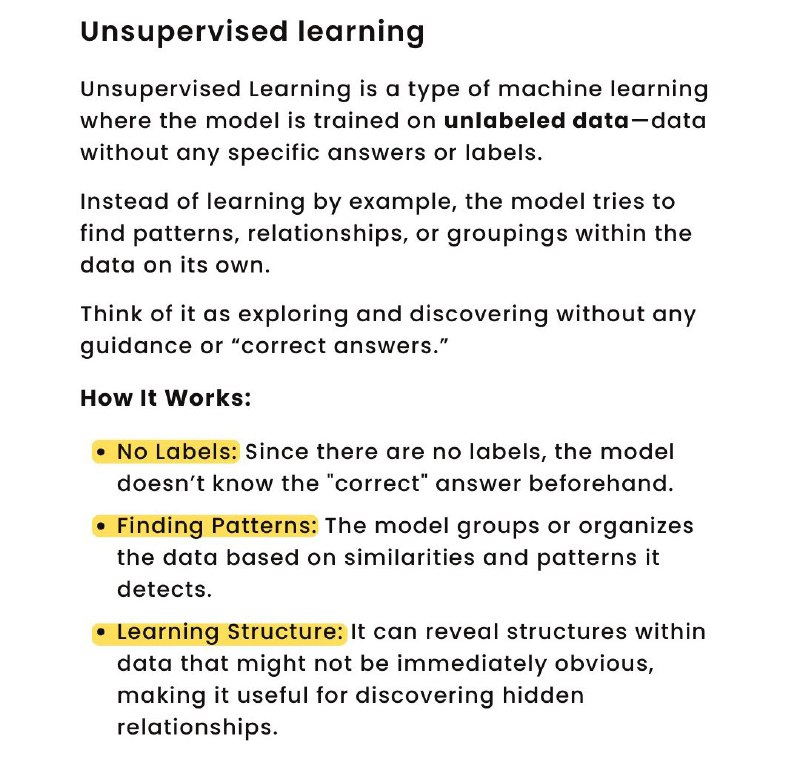
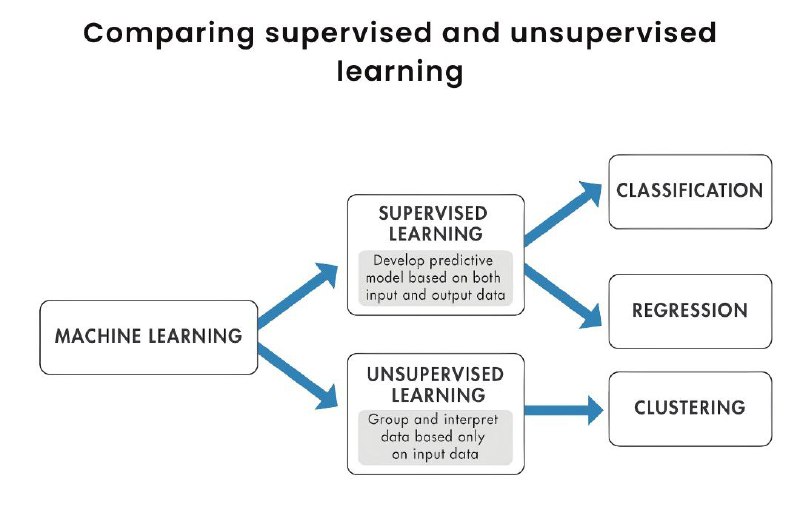
Types of Machine Learning
  • ❤ 2
Post #1802 3.5K
✔️ 10 Books to Understand How Large Language Models Function (2026)

1. Deep Learning
https://deeplearningbook.org
The definitive reference for neural networks, covering backpropagation, architectures, and foundational concepts.

2. Artificial Intelligence: A Modern Approach
https://aima.cs.berkeley.edu
A fundamental perspective on artificial intelligence as a comprehensive system.

3. Speech and Language Processing
https://web.stanford.edu/~jurafsky/slp3/
An in-depth examination of natural language processing, transformers, and linguistics.

4. Machine Learning: A Probabilistic Perspective
https://probml.github.io/pml-book/
An exploration of probabilities, statistics, and the theoretical foundations of machine learning.

5. Understanding Deep Learning
https://udlbook.github.io/udlbook/
A contemporary explanation of deep learning principles with strong intuitive insights.

6. Designing Machine Learning Systems
https://oreilly.com/library/view/designing-machine-learning/9781098107956/
Strategies for deploying models into production environments.

7. Generative Deep Learning
https://github.com/3p5ilon/ML-books/blob/main/generative-deep-learning-teaching-machines-to-paint-write-compose-and-play.pdf
Practical applications of generative models and transformer architectures.

8. Natural Language Processing with Transformers
https://dokumen.pub/natural-language-processing-with-transformers-revised-edition-1098136799-9781098136796-9781098103248.html
Methodologies for constructing natural language processing systems based on transformers.

9. Machine Learning Engineering
https://mlebook.com
Principles of machine learning engineering and operational deployment.

10. The Hundred-Page Machine Learning Book
https://themlbook.com
A highly concentrated foundational overview without extraneous detail. 📚🤖
  • ❤ 6
Post #1764 3.86K
Web Development Roadmap with FREE resources 👇

1. HTML and CSS https://youtu.be/mU6anWqZJcc

2. CSS
https://css-tricks.com

3. Git & GitHub
https://udemy.com/course/git-started-with-github/

4. Tailwind CSS
https://scrimba.com/learn/tailwind

5. JavaScript
https://javascript30.com

6. ReactJS
https://scrimba.com/learn/learnreact

7. NodeJS
https://nodejsera.com/30-days-of-node.html

8. Database:
✨MySQL https://mysql.com
✨MongoDB https://mongodb.com

Other FREE RESOURCES
https://t.me/free4unow_backup/554

Don't forget to build projects at each stage

ENJOY LEARNING 👍👍
  • ❤ 5
  • 🕊 1
Post #1718 4.46K
✅ Data Science Interview Prep Guide

1️⃣ Core Data Science Concepts
• What is Data Science vs Data Analytics vs ML
• Descriptive, diagnostic, predictive, prescriptive analytics
• Structured vs unstructured data
• Data-driven decision making
• Business problem framing

2️⃣ Statistics Probability (Non-Negotiable)
• Mean, median, variance, standard deviation
• Probability distributions (normal, binomial, Poisson)
• Hypothesis testing p-values
• Confidence intervals
• Correlation vs causation
• Sampling bias

3️⃣ Data Cleaning EDA
• Handling missing values outliers
• Data normalization scaling
• Feature engineering
• Exploratory data analysis (EDA)
• Data leakage detection
• Data quality validation

4️⃣ Python SQL for Data Science
• Python (NumPy, Pandas)
• Data manipulation transformations
• Vectorization performance optimization
• SQL joins, CTEs, window functions
• Writing business-ready queries

5️⃣ Machine Learning Essentials
• Supervised vs unsupervised learning
• Regression vs classification
• Model selection baseline models
• Overfitting, underfitting
• Bias–variance tradeoff
• Hyperparameter tuning

6️⃣ Model Evaluation Metrics
• Accuracy, precision, recall, F1
• ROC AUC
• Confusion matrix
• RMSE, MAE, log loss
• Metrics for imbalanced data
• Linking ML metrics to business KPIs

7️⃣ Real-World Deployment Knowledge
• Feature stores
• Model deployment (batch vs real-time)
• Model monitoring drift
• Experiment tracking
• Data model versioning
• Model explainability (business-friendly)

8️⃣ Must-Have Projects
• Customer churn prediction
• Fraud detection
• Sales or demand forecasting
• Recommendation system
• End-to-end ML pipeline
• Business-focused case study

9️⃣ Common Interview Questions
• Walk me through an end-to-end DS project
• How do you choose evaluation metrics?
• How do you handle imbalanced data?
• How do you explain a model to leadership?
• How do you improve a failing model?

🔟 Pro Tips
✔️ Always connect answers to business impact
✔️ Explain why, not just how
✔️ Be clear about trade-offs
✔️ Discuss failures learnings
✔️ Show structured thinking

Double Tap ♥️ For More
  • ❤ 14
Post #1714 3.04K
💡 10 Smart Programming Habits Every Developer Should Build 👨‍💻🧠

1️⃣ Write clean, readable code
→ Code is read more often than it’s written. Clarity > cleverness.

2️⃣ Break big problems into small parts
→ Divide and conquer. Small functions are easier to debug and reuse.

3️⃣ Use meaningful commit messages
→ “Fixed stuff” doesn’t help. Be specific: “Fix null check on login form.”

4️⃣ Keep learning new tools & languages
→ Tech evolves fast. Stay curious and adaptable.

5️⃣ Write tests, even basic ones
→ Prevent future bugs. Start with simple unit tests.

6️⃣ Use a linter and formatter
→ Tools like ESLint, Black, or Prettier keep your code clean automatically.

7️⃣ Document your code
→ Write docstrings or inline comments to explain logic clearly.

8️⃣ Review your code before pushing
→ Catch silly mistakes early. Think of it as proofreading your code.

9️⃣ Optimize only when needed
→ First make it work, then make it fast.

🔟 Contribute to open source or side projects
→ Practice, network, and learn from real-world codebases.

💬 Tap ❤️ if you found this helpful!
  • ❤ 10
Post #1713 2.34K
How to use chatgpt 5.2 for data analysis 🔥
Post #1697 2.57K
Excel Scenario-Based Questions Interview Questions and Answers :


Scenario 1) Imagine you have a dataset with missing values. How would you approach this problem in Excel?

Answer:

To handle missing values in Excel:

1. Identify Missing Data:

Use filters to quickly find blank cells.

Apply conditional formatting:
Home → Conditional Formatting → New Rule → Format only cells that are blank.


2. Handle Missing Data:

Delete rows with missing critical data (if appropriate).

Fill missing values:

Use =IF(A2="", "N/A", A2) to replace blanks with “N/A”.

Use Fill Down (Ctrl + D) if the previous value applies.

Use functions like =AVERAGEIF(range, "<>", range) to fill with average.


3. Use Power Query (for large datasets):

Load data into Power Query and use “Replace Values” or “Remove Empty” options.

Scenario 2) You are given a dataset with multiple sheets. How would you consolidate the data for analysis?

Answer:

Approach 1: Manual Consolidation

1. Use Copy-Paste from each sheet into a master sheet.
2. Add a new column to identify the source sheet (optional but useful).
3. Convert the master data into a table for analysis.


Approach 2: Use Power Query (Recommended for large datasets)

1. Go to Data → Get & Transform → Get Data → From Workbook.
2. Load each sheet into Power Query.
3. Use the Append Queries option to merge all sheets.


4. Clean and transform as needed, then load it back to Excel.

Approach 3: Use VBA (Advanced Users)

Write a macro to loop through all sheets and append data to a master sheet.

Hope it helps :)
  • ❤ 8
Older posts →
Threads Profile ViewerView any public Threads profile without an account.Open ThreadLook →Writing with AI? Make it sound human.Metric37 rewrites AI drafts so they read naturally. Free AI detector, 1,500 words free.Try Metric37 →