TGViewer
Channel Public Channel
Coding & Data Science Resources

Coding & Data Science Resources

@codingfreebooks

Official Telegram Channel for Free Coding & Data Science Resources

Admin: @love_data
Subscribers
32.6K
Photos
352
Videos
1
Links
361
Recent Posts 20 shown
Post #2041 1.03K
๐Ÿ”Ÿ AI Project Ideas for Beginners

1. Chatbot Development: Build a simple chatbot using Natural Language Processing (NLP) with libraries like NLTK or SpaCy. Train it to respond to common queries.

2. Image Classification: Use a pre-trained model (like MobileNet) to classify images from a dataset (e.g., CIFAR-10) using TensorFlow or PyTorch.

3. Sentiment Analysis: Create a sentiment analysis tool to classify text (e.g., movie reviews) as positive, negative, or neutral using NLP techniques.

4. Recommendation System: Build a recommendation engine using collaborative filtering or content-based filtering techniques to suggest products or movies.

5. Stock Price Prediction: Use time series forecasting models (like ARIMA or LSTM) to predict stock prices based on historical data.

6. Face Recognition: Implement a face recognition system using OpenCV and deep learning techniques to detect and identify faces in images.

7. Voice Assistant: Develop a basic voice assistant that can perform simple tasks (like setting reminders or searching the web) using speech recognition libraries.

8. Handwritten Digit Recognition: Use the MNIST dataset to build a neural network that recognizes handwritten digits with TensorFlow or PyTorch.

9. Game AI: Create an AI that can play a simple game (like Tic-Tac-Toe) using Minimax algorithm or reinforcement learning.

10. Automated News Summarizer: Build a tool that summarizes news articles using NLP techniques like extractive or abstractive summarization.

Best Data Science & Machine Learning Resources: https://topmate.io/coding/914624

Credits: https://t.me/datasciencefun

Like if you need similar content ๐Ÿ˜„๐Ÿ‘

ENJOY LEARNING ๐Ÿ‘๐Ÿ‘
  • โค 4
  • ๐Ÿ‘ 2
  • ๐Ÿ‘ 2
Post #2040 1.24K
โœ… Data Analytics Roadmap for Freshers ๐Ÿš€๐Ÿ“Š

1๏ธโƒฃ Understand What a Data Analyst Does
๐Ÿ” Analyze data, find insights, create dashboards, support business decisions.

2๏ธโƒฃ Start with Excel
๐Ÿ“ˆ Learn:
โ€“ Basic formulas
โ€“ Charts & Pivot Tables
โ€“ Data cleaning
๐Ÿ’ก Excel is still the #1 tool in many companies.

3๏ธโƒฃ Learn SQL
๐Ÿงฉ SQL helps you pull and analyze data from databases.
Start with:
โ€“ SELECT, WHERE, JOIN, GROUP BY
๐Ÿ› ๏ธ Practice on platforms like W3Schools or Mode Analytics.

4๏ธโƒฃ Pick a Programming Language
๐Ÿ Start with Python (easier) or R
โ€“ Learn pandas, matplotlib, numpy
โ€“ Do small projects (e.g. analyze sales data)

5๏ธโƒฃ Data Visualization Tools
๐Ÿ“Š Learn:
โ€“ Power BI or Tableau
โ€“ Build simple dashboards
๐Ÿ’ก Start with free versions or YouTube tutorials.

6๏ธโƒฃ Practice with Real Data
๐Ÿ” Use sites like Kaggle or Data.gov
โ€“ Clean, analyze, visualize
โ€“ Try small case studies (sales report, customer trends)

7๏ธโƒฃ Create a Portfolio
๐Ÿ’ป Share projects on:
โ€“ GitHub
โ€“ Notion or a simple website
๐Ÿ“Œ Add visuals + brief explanations of your insights.

8๏ธโƒฃ Improve Soft Skills
๐Ÿ—ฃ๏ธ Focus on:
โ€“ Presenting data in simple words
โ€“ Asking good questions
โ€“ Thinking critically about patterns

9๏ธโƒฃ Certifications to Stand Out
๐ŸŽ“ Try:
โ€“ Google Data Analytics (Coursera)
โ€“ IBM Data Analyst
โ€“ LinkedIn Learning basics

๐Ÿ”Ÿ Apply for Internships & Entry Jobs
๐ŸŽฏ Titles to look for:
โ€“ Data Analyst (Intern)
โ€“ Junior Analyst
โ€“ Business Analyst

๐Ÿ’ฌ React โค๏ธ for more!
  • โค 3
  • ๐Ÿ‘ 1
Post #2039 1.01K
๐ŸŽ“ ๐—ง๐—ผ๐—ฝ ๐—œ๐—ป-๐——๐—ฒ๐—บ๐—ฎ๐—ป๐—ฑ ๐—™๐—ฅ๐—˜๐—˜ ๐—–๐—ฒ๐—ฟ๐˜๐—ถ๐—ณ๐—ถ๐—ฐ๐—ฎ๐˜๐—ถ๐—ผ๐—ป๐˜€ ๐˜๐—ผ ๐— ๐—ฎ๐˜€๐˜๐—ฒ๐—ฟ ๐—ถ๐—ป ๐Ÿฎ๐Ÿฌ๐Ÿฎ๐Ÿฒ ๐Ÿ”ฅ

Explore these FREE certification courses in todayโ€™s most in-demand technology fields:

๐Ÿ“Š ๐——๐—ฎ๐˜๐—ฎ ๐—”๐—ป๐—ฎ๐—น๐˜†๐˜๐—ถ๐—ฐ๐˜€ :- https://pdlink.in/4eRA6eF

๐Ÿ’ป ๐—ช๐—ฒ๐—ฏ ๐——๐—ฒ๐˜ƒ๐—ฒ๐—น๐—ผ๐—ฝ๐—บ๐—ฒ๐—ป๐˜ :- https://pdlink.in/4gP18Eo

๐Ÿ’ซ ๐—”๐—ฟ๐˜๐—ถ๐—ณ๐—ถ๐—ฐ๐—ถ๐—ฎ๐—น ๐—œ๐—ป๐˜๐—ฒ๐—น๐—น๐—ถ๐—ด๐—ฒ๐—ป๐—ฐ๐—ฒ :- https://pdlink.in/45HWa5Q

โ˜๏ธ ๐—–๐—น๐—ผ๐˜‚๐—ฑ ๐—–๐—ผ๐—บ๐—ฝ๐˜‚๐˜๐—ถ๐—ป๐—ด :- https://pdlink.in/4zrksPn

๐ŸŸง ๐—”๐—ช๐—ฆ :- https://pdlink.in/4j4Jxtv

๐Ÿ›ก๏ธ ๐—–๐˜†๐—ฏ๐—ฒ๐—ฟ๐˜€๐—ฒ๐—ฐ๐˜‚๐—ฟ๐—ถ๐˜๐˜† & ๐—”๐˜‡๐˜‚๐—ฟ๐—ฒ :- https://pdlink.in/4f0GNuH

โšก Start learning today and prepare yourself for better career opportunities in 2026!
Post #2038 2.46K
๐Ÿ’ป How to Learn Programming in 1 Year โ€“ Step by Step ๐Ÿ“โœจ

โœ… Tip 1: Start with a Single Language
Choose one language (Python, JavaScript, or Java) and stick to it. Mastering one deeply beats superficial knowledge of manyโ€”Python's great for beginners due to its readability.

โœ… Tip 2: Learn the Basics First
Focus on fundamentals:
โฆ Variables & Data Types
โฆ Loops & Conditionals
โฆ Functions / Methods
โฆ Lists, Arrays, Dictionaries / Objects

โœ… Tip 3: Practice Small Projects
Build weekly:
โฆ Calculator
โฆ To-do list app
โฆ Simple web scraper
โฆ Guess-the-number game
โฆ Weather API fetcher

โœ… Tip 4: Understand Problem-Solving & Logic
Programming is problem-solving:
โฆ Break problems into steps
โฆ Write pseudocode
โฆ Debug carefullyโ€”use print statements or debuggers

โœ… Tip 5: Learn Version Control
Use Git to track changes, collaborate, and avoid losing work. Commands like git commit, push, and branch are essentials.

โœ… Tip 6: Read Others' Code
Explore open-source on GitHub to see pro structure and patternsโ€”start with simple repos like a basic web app.

โœ… Tip 7: Practice Coding Challenges
Hit LeetCode, HackerRank, or Codewars daily for logic, algorithms, and speedโ€”aim for 5-10 problems/week.

โœ… Tip 8: Understand Key Concepts Deeply
โฆ Object-Oriented Programming (OOP)
โฆ Recursion
โฆ Data Structures โ€“ Arrays, Lists, Stacks, Queues, Trees
โฆ Algorithms โ€“ Sorting, Searching

โœ… Tip 9: Build Real Projects
โฆ Portfolio website
โฆ Chatbot
โฆ Data analysis with Python
โฆ Simple game
โฆ Full-stack app like a blog

โœ… Tip 10: Be Consistent & Review
Code daily (30-60 mins), review old code to refine style. Track progress with a journal or GitHub streak.

๐Ÿ’ฌ Tap โค๏ธ for more!
  • โค 11
  • ๐Ÿ‘ 2
Post #2037 2.29K
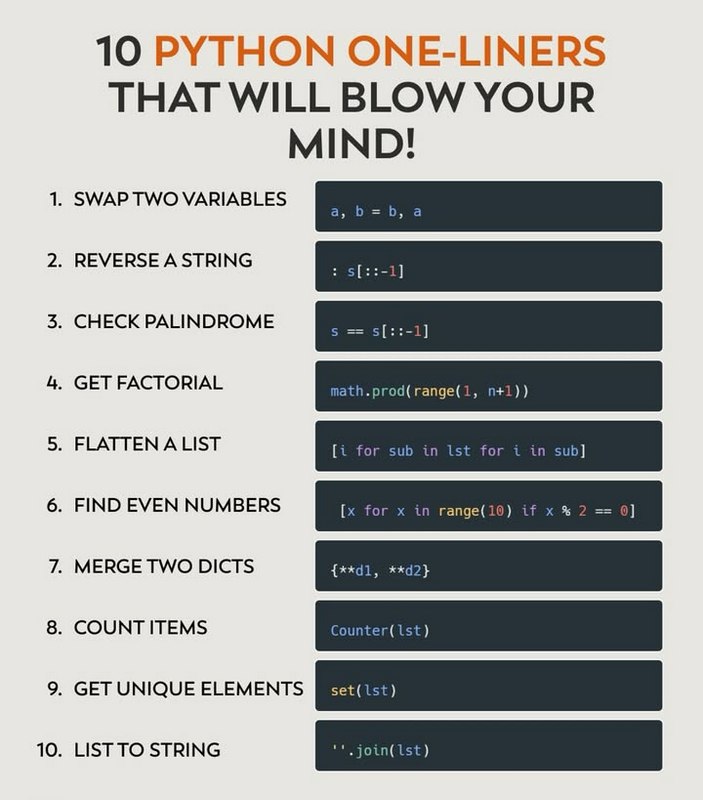
๐Ÿ”ฐ 10 python one liners
  • โค 4
Post #2036 2.13K
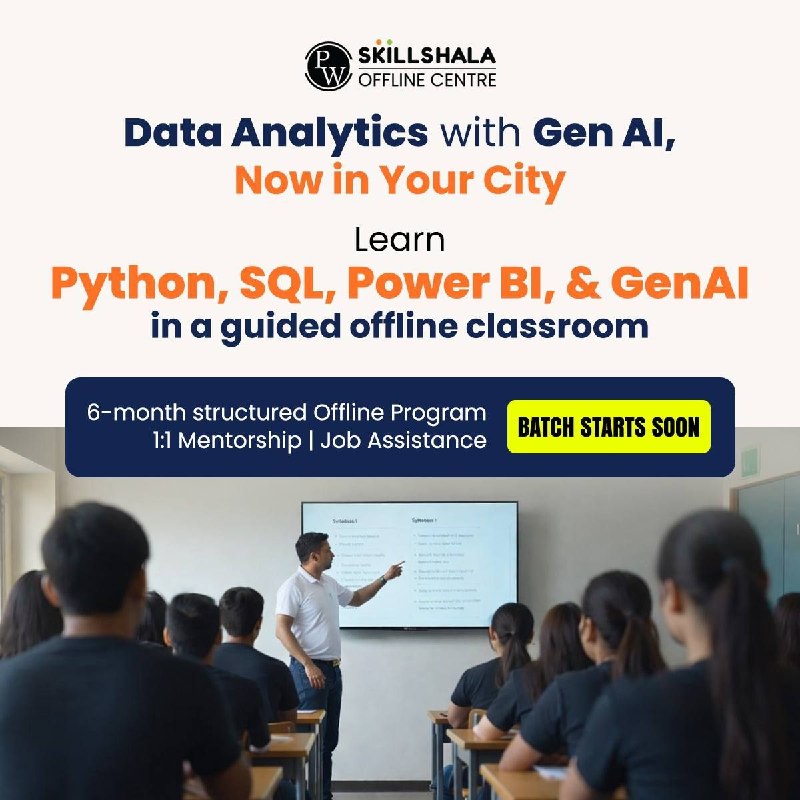
If youโ€™re a student, graduate, or someone looking for a career switch, read this.

Most people spend months watching random YouTube videos and still donโ€™t become job-ready.

Instead, learn in a structured offline classroom.

๐Ÿ“Œ Data Analytics with GenAI
๐Ÿ“Œ Python + SQL + Power BI
๐Ÿ“Œ 6-Month Program
๐Ÿ“Œ 1:1 Mentorship
๐Ÿ“Œ Job Assistance

๐Ÿ“Now available in your city.

Seats are limited.

๐Ÿ‘‰ Register Here: https://lp.pwskills.com/data-analytics-course-offline-batch0?utm_source=telegram&utm_medium=influencer&utm_campaign=daoffline
  • โค 3
Post #2035 1.65K
Data Analyst Interview Questions & Preparation Tips

Be prepared with a mix of technical, analytical, and business-oriented interview questions.

1. Technical Questions (Data Analysis & Reporting)

SQL Questions:

How do you write a query to fetch the top 5 highest revenue-generating customers?

Explain the difference between INNER JOIN, LEFT JOIN, and FULL OUTER JOIN.

How would you optimize a slow-running query?

What are CTEs and when would you use them?

Data Visualization (Power BI / Tableau / Excel)

How would you create a dashboard to track key performance metrics?

Explain the difference between measures and calculated columns in Power BI.

How do you handle missing data in Tableau?

What are DAX functions, and can you give an example?

ETL & Data Processing (Alteryx, Power BI, Excel)

What is ETL, and how does it relate to BI?

Have you used Alteryx for data transformation? Explain a complex workflow you built.

How do you automate reporting using Power Query in Excel?


2. Business and Analytical Questions

How do you define KPIs for a business process?

Give an example of how you used data to drive a business decision.

How would you identify cost-saving opportunities in a reporting process?

Explain a time when your report uncovered a hidden business insight.


3. Scenario-Based & Behavioral Questions

Stakeholder Management:

How do you handle a situation where different business units have conflicting reporting requirements?

How do you explain complex data insights to non-technical stakeholders?

Problem-Solving & Debugging:

What would you do if your report is showing incorrect numbers?

How do you ensure the accuracy of a new KPI you introduced?

Project Management & Process Improvement:

Have you led a project to automate or improve a reporting process?

What steps do you take to ensure the timely delivery of reports?


4. Industry-Specific Questions (Credit Reporting & Financial Services)

What are some key credit risk metrics used in financial services?

How would you analyze trends in customer credit behavior?

How do you ensure compliance and data security in reporting?


5. General HR Questions

Why do you want to work at this company?

Tell me about a challenging project and how you handled it.

What are your strengths and weaknesses?

Where do you see yourself in five years?

How to Prepare?

Brush up on SQL, Power BI, and ETL tools (especially Alteryx).

Learn about key financial and credit reporting metrics.(varies company to company)

Practice explaining data-driven insights in a business-friendly manner.

Be ready to showcase problem-solving skills with real-world examples.

React with โค๏ธ if you want me to also post sample answer for the above questions

Share with credits: https://t.me/sqlspecialist

Hope it helps :)
  • โค 3
  • ๐Ÿ”ฅ 1
Post #2034 1.46K
Aaj hi ek certified Hackar bano!๐Ÿ’ป

Shuru se saari cheeze seekho bilkul basic se!!

PW skills leke aaya h certified Ethical Hacking ka course!!

Isme milega :
โœ… Hands on Practice
โœ… LIVE Hacking Labs
โœ… Certificate after Completion

Sirf Rs 4999 mai
Abhi enroll karo HACK30 Coupon code use karke 30% OFF milega!

Enroll NOW : https://pwskills.com/web-development/certified-ethical-hacking-course-035473/?source=pwskills.com&position=course_dropdown&from=home_page&utm_source=pwskills&utm_medium=telegram&utm_campaign=ethical_hacking
  • โค 6
Post #2033 1.55K
Python has a built-in topological dependency sorter!๐Ÿš€

If you're working with tasks that have dependencies โ€” for example, in build systems, CI/CD pipelines, or workflow orchestration โ€” the order of execution often has to be determined manually.

Usually through graphs, DFS,, or custom execution order logic.

But Python's standard library already has graphlib.TopologicalSorter.

ts = TopologicalSorter()
ts.add("deploy", "test")
ts.add("test", "build")

After preparation, the sorter returns the correct execution order.

tuple(ts.static_order())

Result:

("build", "test", "deploy")

Especially useful for workflow management systems, dependency resolution, orchestration systems, and any tasks with a dependency graph.

๐Ÿ”ฅ TopologicalSorter allows you to solve dependency problems using Python's built-in tools without having to implement graph algorithms manually.
  • โค 3
  • ๐Ÿ”ฅ 1
Post #2031 1.47K
๐Ÿš€ Want to build your own AI Agent but donโ€™t know where to start?

Hereโ€™s your step-by-step blueprintโ€”from defining the goal to deploying with MLOps.

Master AI, one block at a time. ๐Ÿง ๐Ÿ’ป
  • โค 2
  • ๐Ÿ”ฅ 1
Post #2022 1.63K
Top Free AI Courses from Google: โฌ‡๏ธ


1. Intro to the Cloud

Understand the cloud and why it's critical in AI.

Link: https://lnkd.in/eU6icWR3


2. Prompt Design in Vertex AI

Master better prompts & use Gemini effectively.

Link: https://lnkd.in/eAaG_iHb


3. Google AI Essentials (via Coursera)

Use AI to brainstorm, write faster, and be more productive.

Link: https://lnkd.in/eJYGt2Xa


4. What is Generative AI?

Googleโ€™s free certified course explains it in simple terms.

Perfect for beginners โ€” no coding needed.

Link: https://lnkd.in/eqqa37dV


5. Introduction to Machine Learning

Make predictions from data and explore ethical AI.

Link: https://lnkd.in/eHpGkmrx


6. Intro to Large Language Models (LLMs)

Learn how LLMs (like ChatGPT) work and why they matter.

Googleโ€™s FREE certified course is live now:

Link: https://lnkd.in/enNnyxwU


7. Applying AI Principles with Google Cloud

Learn how Google applies responsible AI in practice.

Link: https://lnkd.in/eRU7xB_t


8. Basics of Code

A beginner-friendly intro to programming and logic.

๐Ÿ‘‰ https://lnkd.in/eUd_XEcf


9. Cloud Computing Foundations

Dive into cloud, big data, and ML โ€” in one course.

Link: https://lnkd.in/ebVfPdrD


10. Intro to Responsible AI

Learn how to build safer and more inclusive AI systems.

Link: https://lnkd.in/e4EC8xNJ

Double Tap โค๏ธ For More
  • โค 2
Post #2018 1.22K
Quick Power BI Functions Cheat Sheet for Beginners ๐Ÿ“Šโœ๏ธ

Aggregation Functions (DAX)
โ€ข SUM(column): Returns the total of a column.
โ€ข AVERAGE(column): Calculates the average value.
โ€ข COUNT(column): Counts non-blank rows in a column.
โ€ข DISTINCTCOUNT(column): Counts unique values.
โ€ข MAX(column): Returns the highest value.
โ€ข MIN(column): Returns the lowest value.

Filter Functions
โ€ข FILTER(table, condition): Returns a filtered table based on a condition.
โ€ข ALL(table/column): Removes filters from a table or column.
โ€ข ALLEXCEPT(table, column): Removes all filters except specified columns.
โ€ข VALUES(column): Returns unique values from a column.

Logical Functions
โ€ข IF(condition, true_result, false_result): Performs conditional logic.
โ€ข SWITCH(expression, value1, result1, โ€ฆ): Evaluates multiple conditions.
โ€ข AND(condition1, condition2): Returns TRUE if both conditions are true.
โ€ข OR(condition1, condition2): Returns TRUE if any condition is true.

Date Time Functions
โ€ข TODAY(): Returns the current date.
โ€ข NOW(): Returns the current date and time.
โ€ข YEAR(date): Extracts the year from a date.
โ€ข MONTH(date): Extracts the month from a date.
โ€ข DATEDIFF(date1, date2, interval): Returns the difference between two dates.

Text Functions
โ€ข CONCATENATE(text1, text2): Joins two text values.
โ€ข LEFT(text, num_chars): Extracts characters from the left.
โ€ข RIGHT(text, num_chars): Extracts characters from the right.
โ€ข LEN(text): Returns the length of text.
โ€ข FORMAT(value, text, format_string): Converts value to formatted text.

Relationship Functions
โ€ข RELATED(column): Fetches data from a related table.
โ€ข RELATEDTABLE(table): Returns related rows from another table.
โ€ข USERELATIONSHIP(column1, column2): Activates an inactive relationship.

Power BI Resources: https://whatsapp.com/channel/0029Vai1xKf1dAvuk6s1v22c

Double Tap โ™ฅ๏ธ For More
  • โค 1
Post #2014 1.32K
Websites I wish I knew about before graduating ๐Ÿฅฒ

1. DORA : This website lets you create animated apps and sites in seconds
https://www.dora.run/

2. Chatgpt study : Turns your ChatGPT into an actual tutor that can test you in real time
https://openai.com/index/chatgpt-study-mode/

3. docsity : Gives you free access to past papers, exams just by entering your university
https://www.docsity.com/en/

4. chatpdf : Lets you upload your documents so you can chat and question the different sections
https://www.chatpdf.com/

5. paper panda : This website can legit gives you access to any paper or article you canโ€™t access
https://paperpanda.app/

6. Paperpal: You can paste your entire essay in here and it edits it like a top students
https://paperpal.com

7. flow: This website lets you create an entire animated movie using AI
https://labs.google/flow/about
  • โค 2
Post #1999 2.09K
Understanding Popular ML Algorithms:

1๏ธโƒฃ Linear Regression: Think of it as drawing a straight line through data points to predict future outcomes.

2๏ธโƒฃ Logistic Regression: Like a yes/no machine - it predicts the likelihood of something happening or not.

3๏ธโƒฃ Decision Trees: Imagine making decisions by answering yes/no questions, leading to a conclusion.

4๏ธโƒฃ Random Forest: It's like a group of decision trees working together, making more accurate predictions.

5๏ธโƒฃ Support Vector Machines (SVM): Visualize drawing lines to separate different types of things, like cats and dogs.

6๏ธโƒฃ K-Nearest Neighbors (KNN): Friends sticking together - if most of your friends like something, chances are you'll like it too!

7๏ธโƒฃ Neural Networks: Inspired by the brain, they learn patterns from examples - perfect for recognizing faces or understanding speech.

8๏ธโƒฃ K-Means Clustering: Imagine sorting your socks by color without knowing how many colors there are - it groups similar things.

9๏ธโƒฃ Principal Component Analysis (PCA): Simplifies complex data by focusing on what's important, like summarizing a long story with just a few key points.

Best Data Science & Machine Learning Resources: https://topmate.io/coding/914624

ENJOY LEARNING ๐Ÿ‘๐Ÿ‘
  • โค 5
Post #1988 1.88K
๐Ÿ”– Cheat sheets on Transformers and LLMs from Stanford

We found an excellent set of materials from the Stanford CME-295 course on large language models.

They cover tokenization, the self-attention mechanism, prompting, fine-tuning, LLM-as-a-judge, RAG, AI agents, and reasoning models.

โ›“๏ธ Download here
https://github.com/afshinea/stanford-cme-295-transformers-large-language-models
  • โค 2
Post #1968 2.21K
10 commonly asked data science interview questions along with their answers

1๏ธโƒฃ What is the difference between supervised and unsupervised learning?
Supervised learning involves learning from labeled data to predict outcomes while unsupervised learning involves finding patterns in unlabeled data.

2๏ธโƒฃ Explain the bias-variance tradeoff in machine learning.
The bias-variance tradeoff is a key concept in machine learning. Models with high bias have low complexity and over-simplify, while models with high variance are more complex and over-fit to the training data. The goal is to find the right balance between bias and variance.

3๏ธโƒฃ What is the Central Limit Theorem and why is it important in statistics?
The Central Limit Theorem (CLT) states that the sampling distribution of the sample means will be approximately normally distributed regardless of the underlying population distribution, as long as the sample size is sufficiently large. It is important because it justifies the use of statistics, such as hypothesis testing and confidence intervals, on small sample sizes.

4๏ธโƒฃ Describe the process of feature selection and why it is important in machine learning.
Feature selection is the process of selecting the most relevant features (variables) from a dataset. This is important because unnecessary features can lead to over-fitting, slower training times, and reduced accuracy.

5๏ธโƒฃ What is the difference between overfitting and underfitting in machine learning? How do you address them?
Overfitting occurs when a model is too complex and fits the training data too well, resulting in poor performance on unseen data. Underfitting occurs when a model is too simple and cannot fit the training data well enough, resulting in poor performance on both training and unseen data. Techniques to address overfitting include regularization and early stopping, while techniques to address underfitting include using more complex models or increasing the amount of input data.

6๏ธโƒฃ What is regularization and why is it used in machine learning?
Regularization is a technique used to prevent overfitting in machine learning. It involves adding a penalty term to the loss function to limit the complexity of the model, effectively reducing the impact of certain features.

7๏ธโƒฃ How do you handle missing data in a dataset?
Handling missing data can be done by either deleting the missing samples, imputing the missing values, or using models that can handle missing data directly.

8๏ธโƒฃ What is the difference between classification and regression in machine learning?
Classification is a type of supervised learning where the goal is to predict a categorical or discrete outcome, while regression is a type of supervised learning where the goal is to predict a continuous or numerical outcome.

9๏ธโƒฃ Explain the concept of cross-validation and why it is used.
Cross-validation is a technique used to evaluate the performance of a machine learning model. It involves spliting the data into training and validation sets, and then training and evaluating the model on multiple such splits. Cross-validation gives a better idea of the model's generalization ability and helps prevent over-fitting.

๐Ÿ”Ÿ What evaluation metrics would you use to evaluate a binary classification model?
Some commonly used evaluation metrics for binary classification models are accuracy, precision, recall, F1 score, and ROC-AUC. The choice of metric depends on the specific requirements of the problem.

Best Data Science & Machine Learning Resources: https://topmate.io/coding/914624

Credits: https://t.me/datasciencefun

Like if you need similar content ๐Ÿ˜„๐Ÿ‘

Hope this helps you ๐Ÿ˜Š
  • โค 5
Post #1963 1.81K
Difference between linear regression and logistic regression ๐Ÿ‘‡๐Ÿ‘‡

Linear regression and logistic regression are both types of statistical models used for prediction and modeling, but they have different purposes and applications.

Linear regression is used to model the relationship between a dependent variable and one or more independent variables. It is used when the dependent variable is continuous and can take any value within a range. The goal of linear regression is to find the best-fitting line that describes the relationship between the independent and dependent variables.

Logistic regression, on the other hand, is used when the dependent variable is binary or categorical. It is used to model the probability of a certain event occurring based on one or more independent variables. The output of logistic regression is a probability value between 0 and 1, which can be interpreted as the likelihood of the event happening.

Data Science Interview Resources
๐Ÿ‘‡๐Ÿ‘‡
https://topmate.io/coding/914624

Like for more ๐Ÿ˜„
  • โค 2
Post #1951 1.96K
Like for more useful shortcuts
  • โค 7
  • ๐Ÿ‘ 1
  • ๐Ÿ”ฅ 1
Post #1945 2.18K
โœ… Top Deep Learning Interview Questions & Answers ๐Ÿค–๐Ÿง 

๐Ÿ“ 1. What is Deep Learning?
Answer: A subset of Machine Learning that uses multi-layered neural networks to learn patterns from large datasets. It excels in image recognition, speech processing, and NLP.

๐Ÿ“ 2. What is a Neural Network?
Answer: A system of interconnected nodes (neurons) organized in layers โ€” input, hidden, and output โ€” that process data using weights and activation functions.

๐Ÿ“ 3. What are Activation Functions?
Answer: They introduce non-linearity into the network. Common types:
โฆ ReLU: max(0, x) โ€” fast and widely used
โฆ Sigmoid: outputs between 0 and 1
โฆ Tanh: outputs between -1 and 1

๐Ÿ“ 4. What is Backpropagation?
Answer: The process of updating weights in a neural network by calculating the gradient of the loss function and propagating it backward using chain rule.

๐Ÿ“ 5. What is Dropout?
Answer: A regularization technique that randomly disables neurons during training to prevent overfitting.

๐Ÿ“ 6. What is Transfer Learning?
Answer: Using a pre-trained model on a new, related task. Example: fine-tuning ResNet for medical image classification.

๐Ÿ“ 7. What are CNNs used for?
Answer: Convolutional Neural Networks are ideal for image and video data. They use filters to detect spatial hierarchies like edges, shapes, and textures.

๐Ÿ“ 8. What are RNNs and LSTMs?
Answer:
โฆ RNNs handle sequential data but suffer from vanishing gradients.
โฆ LSTMs solve this using memory cells and gates to retain long-term dependencies.

๐Ÿ“ 9. What are Autoencoders?
Answer: Unsupervised neural networks that compress data into a lower-dimensional form and then reconstruct it. Used in anomaly detection and denoising.

๐Ÿ“ 10. What are GANs?
Answer: Generative Adversarial Networks consist of a Generator (creates fake data) and a Discriminator (detects fakes). Used in image synthesis, deepfakes, and art generation.

๐Ÿ“ 11. What is Regularization in Deep Learning?
Answer: Techniques like L1/L2 penalties, Dropout, and Early Stopping help reduce overfitting by constraining model complexity.

๐Ÿ“ 12. What is the Vanishing Gradient Problem?
Answer: In deep networks, gradients can become too small during backpropagation, making it hard to update weights. Solutions include using ReLU and batch normalization.

๐Ÿ“ 13. What is Batch Normalization?
Answer: It normalizes inputs to each layer, stabilizing learning and speeding up training.

๐Ÿ“ 14. What is the role of Epochs, Batches, and Iterations?
Answer:
โฆ Epoch: One full pass through the dataset
โฆ Batch: Subset of data used in one forward/backward pass
โฆ Iteration: One update of weights per batch

๐Ÿ“ 15. What is the difference between Training and Inference?
Answer:
โฆ Training: Model learns from data
โฆ Inference: Model makes predictions using learned weights

๐Ÿ’ก Pro Tip: Always explain concepts with examples or analogies in interviews. For instance, compare CNN filters to human vision detecting edges and shapes.

โค๏ธ Tap for more AI/ML interview prep!
  • โค 5
Older posts โ†’

About this channel

How can I read @codingfreebooks without a Telegram account?
TGViewer shows the public web preview Telegram publishes for Coding & Data Science Resources: recent posts, photos, videos and the subscriber count, with no app, login or account.
How many subscribers does Coding & Data Science Resources have?
Coding & Data Science Resources (@codingfreebooks) has 32.6K subscribers on Telegram, refreshed roughly every 30 minutes.
Does Coding & Data Science Resources know I viewed it here?
No. Public channel previews carry no viewer identity, and TGViewer has no accounts or tracking of what you look up.
Threads Profile ViewerView any public Threads profile without an account.Open ThreadLook โ†’Writing with AI? Make it sound human.Metric37 rewrites AI drafts so they read naturally. Free AI detector, 1,500 words free.Try Metric37 โ†’