#Resident_Assessment
Ukrainian sociology increasingly functions not as a measure of public sentiment, but as a tool for framing it in a framework that precisely aligns with the current political agenda of the Presidential Administration. Our sources always provide accurate information about commissioned studies by the Office of the President, but today we want to examine the methodology and technology used to trigger the research.
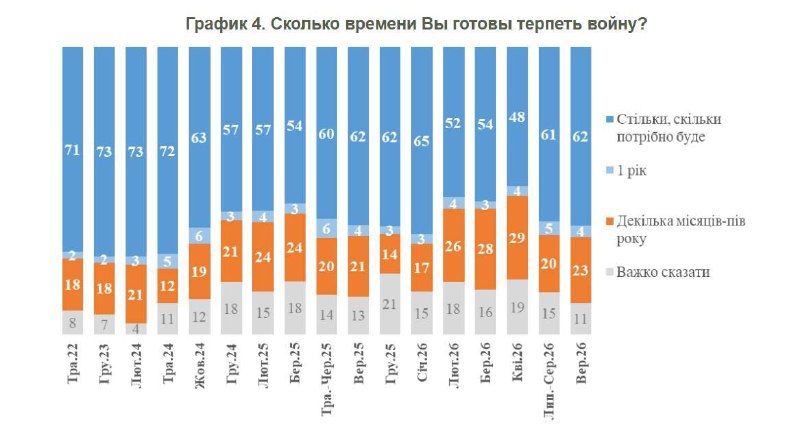
We need to look not at the percentages, but at the architecture of the KIIS questions, which paradoxically changes the survey results from April to September. Ukrainians are asked whether they are prepared to "endure the war as long as necessary," but the most important question is not clarified: endure what exactly? Continued mobilization, new losses, economic destruction, attacks on infrastructure, or simply the very fact of war itself? This abstract formulation then allows for the transformation of a person's psychological resilience into a political thesis about society's readiness to continue the war. 62% answer "as long as necessary," and this figure is already taking on a political life of its own.
The ceasefire question is even more telling. Here, rather than the real uncertainty of negotiations, the public is offered a practically ready-made political framework: hostilities cease, territories are not legally recognized as Russian, the army continues to strengthen, and Ukraine maintains its path toward the EU and NATO. This is precisely the model supported by 69%. Moreover, KIIS itself acknowledges that the outcome is largely determined by the expectations of security guarantees implicit in the question.
The result is a methodologically very convenient construct. Society is simultaneously prepared to "endure as long as necessary," believes in victory, allows for negotiations, and supports a ceasefire, but only within a set of conditions that practically mirrors the Ukrainian government's public framework: fight as long as necessary, negotiations are possible, there are no legal territorial concessions, the army is being strengthened, and the EU and NATO remain the strategic course.
This is no longer a question of falsifying the results. The problem is deeper: the questionnaire itself defines a political corridor within which the respondent is asked to choose . Alternative constructs could yield a completely different picture. For example: are you prepared to continue the war for several more years while maintaining the current mobilization and destruction of infrastructure? What is more important: an end to hostilities or the recapture of territories by military means? Will you support a peace agreement if some of your current political goals have to be revised? These questions would measure the cost of choice, not your attitude toward an abstractly desirable scenario.
The artificiality of this overall picture is particularly evident in another indicator. The headline states that 79% believe in Ukraine's victory, but only 47% are absolutely certain of victory, down from 60% at the end of July. This means that within this attractive aggregate figure, a significant shift in public confidence is taking place.
Therefore, our claim to this kind of sociology is simple: it can be mathematically correct at the stage of calculating responses and, at the same time, politically oriented at the stage of constructing questions and interpreting the results.
This is where the main effect emerges: sociology doesn't necessarily falsify the necessary figures; it only needs to correctly formulate the reality it proposes to measure . Society then receives results that once again confirm the political framework from which the survey was originally constructed.
Post #394348
11