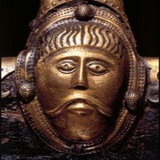
🇧🇪🇳🇱🇩🇪⚜️🇫🇷🏴 Occupying a huge territory that spanned parts of several modern nations was a Gallic tribal alliance known as the ‘Belgae’; hence the name of the modern nation of Belgium.
It is uncertain how the Belgae came into existence, or what in particular set them apart from the rest of the Gauls. In all likelihood it was merely political, i.e. the formation of an alliance or coalition for the pursuit of power. Aside from their territory on the European continent, tribes such as the Atrebates possessed large swaths of territory in southern England, and archaeological evidence suggests that Belgic peoples had connections with eastern Scotland as well.
Julius Caesar informed that the Belgae were the most bellicose and militaristic of all the Gauls (only the Swiss Helvetii, he says, matched them in this aspect of their character), and that the tribes dwelling farther east were more primitive, wild, and beyond the reach of commerce. He also claimed that many of them were of Germanic origin. This claim has been called into question, given that the archaeological and linguistic evidence would appear to show otherwise: The culture of these “Germanic” Belgae of the time fit into the same La Tène mould as that of the rest of Gaul, while place-names such as Bagacum (Bavay) and Noviomagus (Nijmegen), and tribal names such as those of the Eburones, Nervii, Condrusi, Caerosi, Paemani, and Geidumni are unquestionably Celtic. Names of individuals reflect the same reality, with leaders of the supposedly Germanic Nervii and Eburones bearing Gaulish names such as Boduognatus, Cativolcus, and Ambiorix. Perhaps the sole exception were the Atuatuci, whom Caesar informs us, had detached from the migrating Germanic horde of the Cimbri and Teutones in the late 2nd century B.C. Claims of a Germanic origin may have been fabricated —a common ancient practice— by the locals for propaganda purposes (i.e. like the claim in Historia Brittonum that the Britons descended from “Brutus of Troy”). Aside from the Atuatuci, the Belgae were all unquestionably a Celtic people. This doesn’t mean, however, that they didn’t have some Germanic blood running through their veins, nor does it negate that some may have been migrants from beyond the Rhine. Indeed, archaeologists like Barry Cunliffe have described archaeological evidence that the Marne region received a migratory movement of Danubian Gauls from the area of present day Hungary in the mid 3rd century B.C. (The Ancient Celts, p. 87). It’s also quite reasonable to assume that being separated only by the river Rhine, intermarriage between Belgic Gauls and their Germanic neighbours would have been a commonplace occurrence.
https://t.me/CelticEurope
Post #2816
1K
Celtic Europe 🇳🇱🇧🇪 A modern genetic study of the Netherlands and northern Belgium reveals Gallic (blue) and Germanic (orange) admixture varying across regions and time. Source here. https://t.me/CelticEurope

- ❤ 16
- 👍 2
- 🔥 1