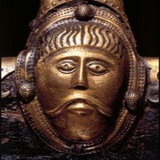
Gyptis offers the bowl of wine to Protis; art by Sandrine Duval. 🇬🇷⚜️🇫🇷
Around the year 600 B.C; a marriage between a Gallic chieftain’s daughter and a Greek merchant led to the foundation of the city of Massalia —now Marseille— in southern France. Protis, son of Euxenus came to Gaul from the Greek city of Phocaea (modern Foça in Turkey) and established contact with a local Celtic tribe, the Segobriges. The local chief, Nannus, is said to have held a feast in which his daughter, Gyptis, was allowed to choose a mate by presenting the man with a bowl of wine. She chose the Greek adventurer, and an alliance was sealed between the two people whereby the Greeks were allowed to build a settlement within the territory of the Celts, that settlement of course, being Massalia. The relationship brought prosperity to both peoples, but within about twenty years it broke down. The new chief of the Segobriges, Nannus’ son Comanus, began to fear the growing power and wealth of the Greek settlers, whose numbers increased day by day. He is said to have initiated a war, during which an attempt was made to infiltrate the city in carts full of victuals that were being brought in for a religious festival. The plot was betrayed by one of Comanus’ own nobles, enabling the Greeks to foil it and launch a counterattack in which Comanus was defeated and killed. From then on, the relationship was inverted, with Massalia becoming a fully independent and powerful state and the Segobriges reduced to being its vassals. Soon, the Greek colony had built a small empire in southern Gaul and the western Mediterranean. The foundation of satellite colonies throughout southern France, such as Nice (Greek: Níkaia; “victory”), attest to territorial expansion and successful battles against the natives.
But Massalia’s power did not last long. The city was defeated by an alliance of Carthage and the Etruscan League at the naval Battle of Alalia (~535 B.C.), thus losing its dominance in the Mediterranean. Massalia then went into decline, and soon found itself beleaguered by the resurgent natives of Gaul. By the year 387 B.C; the Segobriges were on the rebound and led by a king named Catumandus, besieged the Greek city. Fortunately for the Massaliotes, the conflict ended with a peace treaty. Still, Massalia never recovered its initial power, and constantly found itself confronted by aggressive natives. At some point, the Segobriges were displaced in the area by the Celto-Ligurian Salluvii, who proved to be much dreaded bullies to the Greek settlers. Unable to defeat them or free themselves from their yoke, the Massaliotes were eventually forced to beg Rome for intervention, which came in the late 120s B.C; and resulted in the conquest of southern Gaul. Ironically, this would eventually lead Massalia’s final undoing, as the consequent period of tranquility and security didn’t even last a century. In 49 B.C; the Massaliotes made the mistake of taking the side of Gnaeus Pompey in the civil war against Julius Caesar. The result was the Siege of Massalia by Caesar, which ended in a humiliating surrender and the confiscation of all Massalia’s surrounding territories.
https://t.me/CelticEurope
Post #2827
986

- ❤ 20
- 👍 4
- 🥰 1