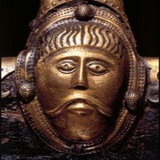
Portrait of the Norman baron Hugh de Lacy by Gerald of Wales, from his work Expugnatio Hibernica. 🏴🇮🇪
After the first English invasion of Ireland, Hugh de Lacy was appointed Lord of Meath by king Henry II of England in the year 1172, and acted as the de facto English viceroy on the island. Lacy was involved in the killing of the Irish king of Bréifne, Tighernán Ó’Ruairc during a parley at the Hill of Ward in Meath, where the Normans instigated a scuffle and sprung an attack by a squad of knights who’d been practicing jousts nearby while the parley dragged on. Ó’Ruairc was killed by the oncoming knights, while De Lacy panicked and fled from the violence (after being knocked to the ground twice by Ó’Ruairc). De Lacy briefly fell out of royal favor after he married Róis Ní Chonchobhair, daughter of former Irish High King Ruaidrí Ó’Conchobhair without king Henry’s permission. The marriage was eventually approved and Lacy restored to his position. During his tenure, he was also noted for building large numbers of motte-and-bailey castles in Meath to defend against and better control the native population. This apparently wasn’t enough, however: In the year 1186 Lacy was killed by an Irish assassin nicknamed “Gilla-gan-mathair” (“Motherless lad”) Ó’Maidhaigh, who approached him as he inspected a newly completed castle at Durrow, then struck off his head with an axe he’d been concealing under his cloak. The assassin escaped on foot in spite of being pursued by multiple soldiers. The Annals of the Four Masters state that the killing was carried out in revenge of St. Columba, i.e. for having profaned churches and monasteries founded by and associated with the saint.
https://t.me/CelticEurope
Post #2811
1.19K

- ❤ 17
- ⚡ 1