
Bara’a R. Alnemrawi and Rajai Al-Rousan (Jordan)
Influence of Fast Freeze-Thaw Cycles on the Behavior of Segmental Bridge Shear Key Joints Using Nonlinear Finite Element Analysis
// Исследование влияния количества циклов попеременного замораживания-оттаивания на поведение сборных железобетонных мостов со шпоночными соединениями, используя нелинейный конечно-элементный анализ //
Для ускорения процесса строительства мостов часто применяют сборные железобетонные сегменты, объединяемые на стройплощадке путем натяжения напрягаемой арматуры. В процессе эксплуатации мостов эти стыки подвергаются попеременному замораживанию и оттаиванию, что негативно сказывается на механических свойствах бетона и снижает прочность и надежность стыка.
Авторами статьи исследуется поведение "сухих" стыков сборных железобетонных сегментов при воздействии сдвигающих нагрузок с учетом различных уровней бокового обжатия и различного количества циклов попеременного замораживания-оттаивания.
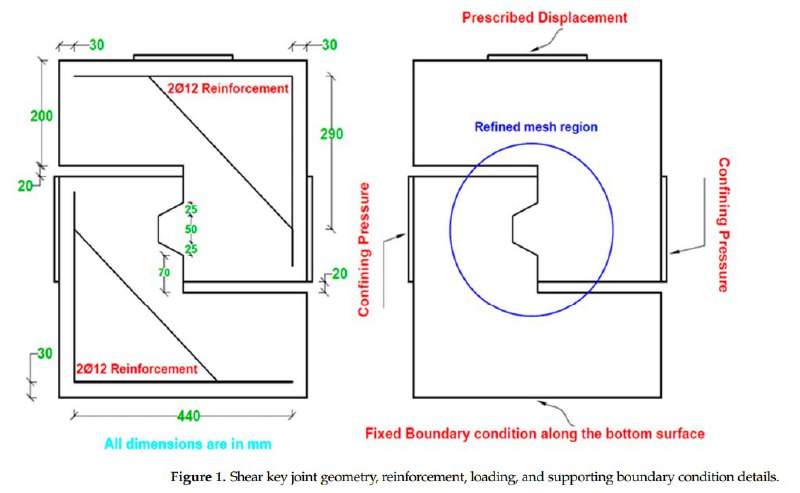
Abstract. The structural behavior of precast concrete segmental bridges is very important to investigate, and the necessity is increased under the effect of being exposed to severe environmental conditions, such as freezing and thawing cycles. In this study, nonlinear finite element analysis (NLFEA) was adopted to address the behavior of reinforced shear keys where they were very small and distributed within the overall depth of the connection region. The effect of the amount of lateral confinement was investigated using six values (1, 2, 3, 4, 5, and 6 MPa), along with the effect of different freezing-thawing cycles (0 (undamaged), 100, 200, 300, and 400). Simulation was accomplished using the direct static shear method, where vertical loading was applied. The simulated models were first validated using experimental data from the literature, where the overall structural behavior was captured well. Thirty NLFEA models were simulated, and results were reported in terms of the load-deflection characteristics and the detailed cracking propagation process. It was found that increasing the lateral confinement will increase the shear strength capacity of the confined joint, in addition to increasing the ultimate deflection and initial stiffness values. Furthermore, a new formula was introduced for calculating the shear capacity compared with experimental data, NLFEA results, literature models, and AASHTO predictions, where good matching was observed, with a minor margin error.
Alnemrawi, B. R. Influence of Fast Freeze-Thaw Cycles on the Behavior of Segmental Bridge Shear Key Joints Using Nonlinear Finite Element Analysis / B. R. Alnemrawi, R. Al-Rousan // Buildings – 2025. – Vol. 15, № 11. – Article 1892. – 21 p. – DOI: https://doi.org/10.3390/buildings15111892.
https://www.mdpi.com/2075-5309/15/11/1892
Заглавное изображение - авторов статьи