
// Исследование температурного воздействия и влияния прямых солнечных лучей на открытую стальную коробчатую балку (без устройства ж/б плиты и дорожной одежды) с большим соотношением высоты к ширине и вертикальными стенками //
Zengwu Liu et al (China)
В статье рассматривается проблема солнечного нагрева главных балок сталежелезобетонных мостов в процессе строительства методом продольной надвижки. При надвижки пролетного строения стальные балки находятся под прямыми солнечными лучами без защиты в виде железобетонной плиты и дорожной одежды, что приводит к возникновению значительных температурных градиентов и соответствующих напряжений в конструкции.
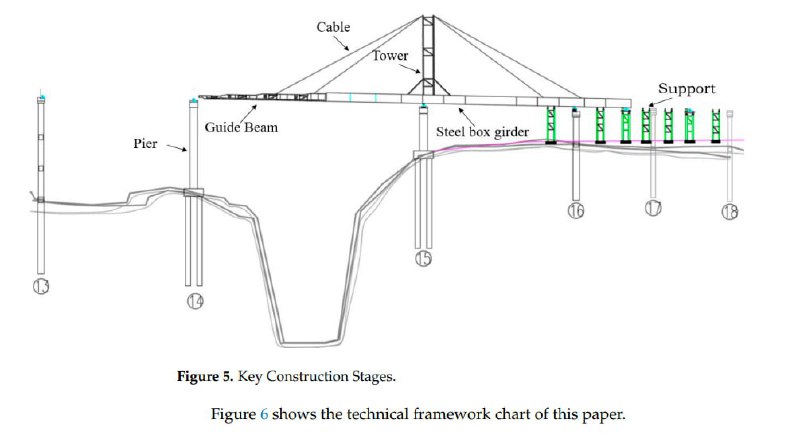
Экспериментальное исследование проводилось на сталежелезобетонном мосту через реку Фэншуй, расположенном в юго-западном регионе Китая. Максимальный пролет моста составляет 90 м. По причине расположения моста в гористой местности установка временных опор невозможна, поэтому для надвижки была выбрана конструкция временного пилона с тросовыми оттяжками.
Abstract. While building the steel–concrete composite girder bridge by means of the incremental launching method, the steel box is directly in the sunlight, and the temperature impact should not be neglected. However, the existing specifications fail to offer the temperature gradient pattern applicable to the steel box featuring a significant height–width ratio and straight web. This paper, relying on the Fenshui River Bridge situated in the southwest region of China, carried out a temperature test. By analyzing the experimental data, the rules of temperature changes at the measuring points in various positions of the steel box were studied, and the temperature disparities of the steel box across different seasons were contrasted. Through the analysis of the test data, the rule governing temperature distribution across the height dimension of the cross-section and its change with time were studied, and a model designed to represent the temperature gradient within the steel box was put forward. By utilizing the numerical model, the effect of the temperature gradient on the force acting on the structure in the process of incremental launching was analyzed. The findings indicate that the temperature of the top plate of the steel box is the highest from 14:00 to 16:00. There is a lag phenomenon in the temperature rise in the bottom plate. The greatest temperature disparity between the upper and lower plates of the steel box is not always present in the season when the temperature is comparatively high. The curve of temperature gradient change exhibits nonlinear features, and the variation in temperature is considerable within the scope of 1 m. In this article, a double-broken line temperature gradient model is put forward, with the corresponding temperature gradient of 17.8 °C. The temperature gradient obviously affects the structural stress, changing the stress distribution, and it notably impacts the deformation. The deformation generated on the guide beam due to the temperature gradient makes up 39% of the total deformation. The temperature gradient is not a fixed value. When the steel box girder is under the jacking process, especially while the structure remains in its maximum cantilever condition and is about to cross the pier, the time should be avoided when the temperature gradient is at its highest.
Study on the Temperature Model and Influence Effect of Uncovered Steel Box Girder with Large Height–Width Ratio and Straight Web Plate. // Z. Liu, S. Luo, M. Jiang / Buildings. – 2025. – Vol. 15, № 1818.
https://www.mdpi.com/2075-5309/15/11/1818
Заглавное изображение - авторов статьи