

When Go didn't have a
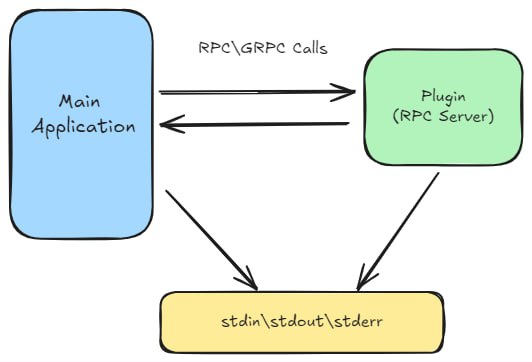
plugin package, Hashicorp implemented their own plugin architecture. The main difference from other plugin systems is that it works over RPC. At first, that might sound a bit unusual, but the approach shows really good results and it is actively used in many popular products like Hashicorp Valut, Terraform, Nomad, Velero.Key concepts:
✏️ Plugin is a binary that runs an RPC (or gRPC) server.
✏️ A main application loads plugins from a specified directory and runs them as OS child processes.
✏️ A single connection is made between each plugin and the host process.
✏️ The connection is bidirectional, so plugin can also call application APIs.
✏️ Plugin and the application itself must be on the same host and use local network only, no remote calls are allowed.
✏️ Each plugin provides a protocol version that can be used as its API version.
✏️ A special handshake is used to establish a connection. The plugin writes its protocol version, network type, address and protocol to stdout, and the main app uses this information to connect.
Benefits of the approach:
✏️ Plugins can't crash the main process
✏️ Plugins can be written in different languages
✏️ Easy installation - just put a binary into the folder
✏️ Stdout/Stderr Syncing. While plugins are subprocesses, they can continue to use stdout/stderr as usual and their output will get mirrored to the host app.
✏️ Host upgrade while a plugin is running. Plugins can be "reattached" so that the host process can be upgraded while the plugin is still running.
✏️ Plugins are secure: Plugins have access only to the interfaces and args given to it, not to the entire memory space of the process.
In cloud ecosystem, plugins can be delivered as init containers. During startup, the plugin binary from the init container is copied into the main app container.
If you're designing some pluggable architecture, Hashicorp RPC Plugins is definitely the approach to look at.
#systemdesign #engineering